A 95% tariff just sent motor oil blending back to Britain
In brief:
- The UK Trade Remedies Authority delivered its Final Determination under Investigation AD0059 in December 2025.
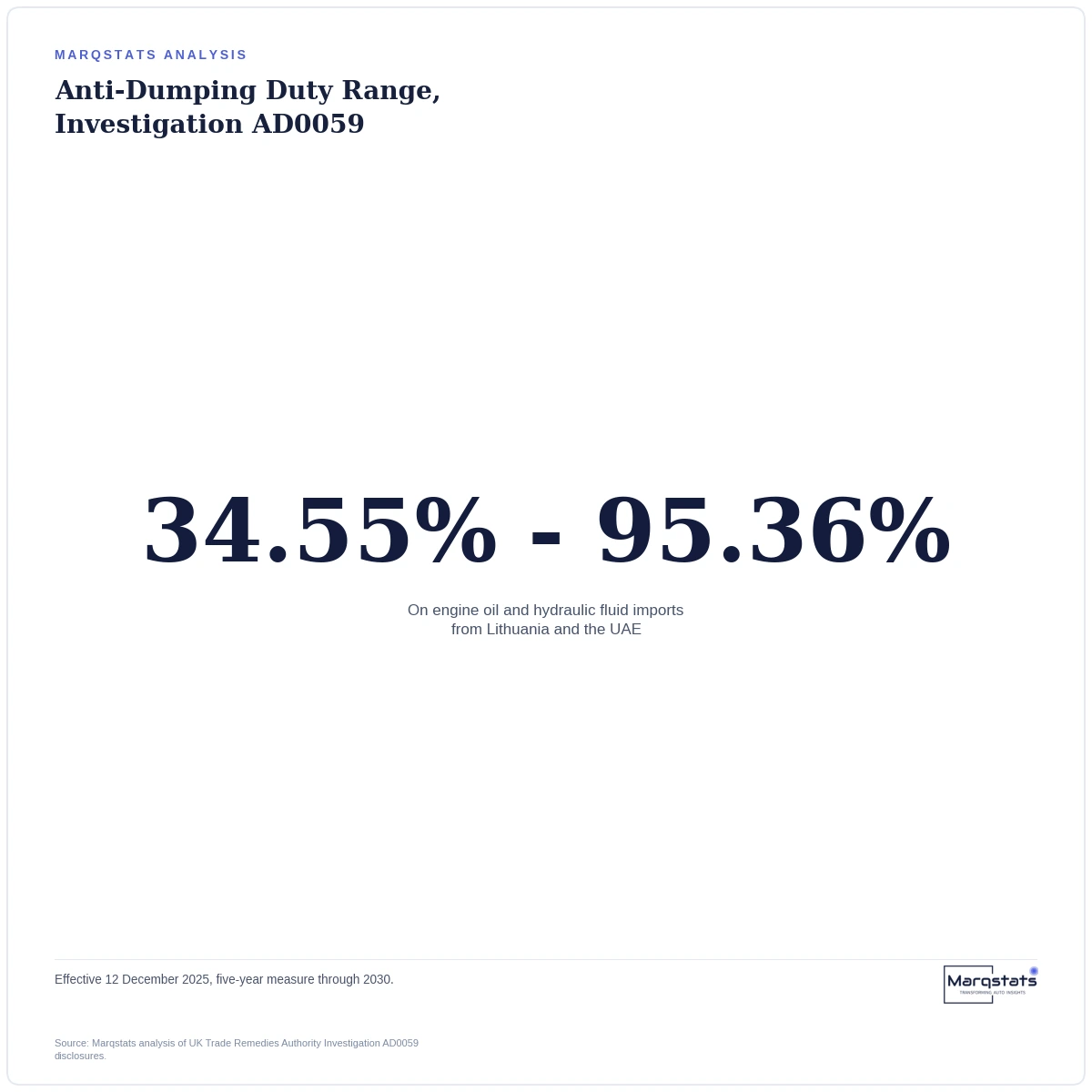
- Definitive five-year anti-dumping duties now range from 34.55% on UAE imports to 95.36% on most Lithuanian exporters.
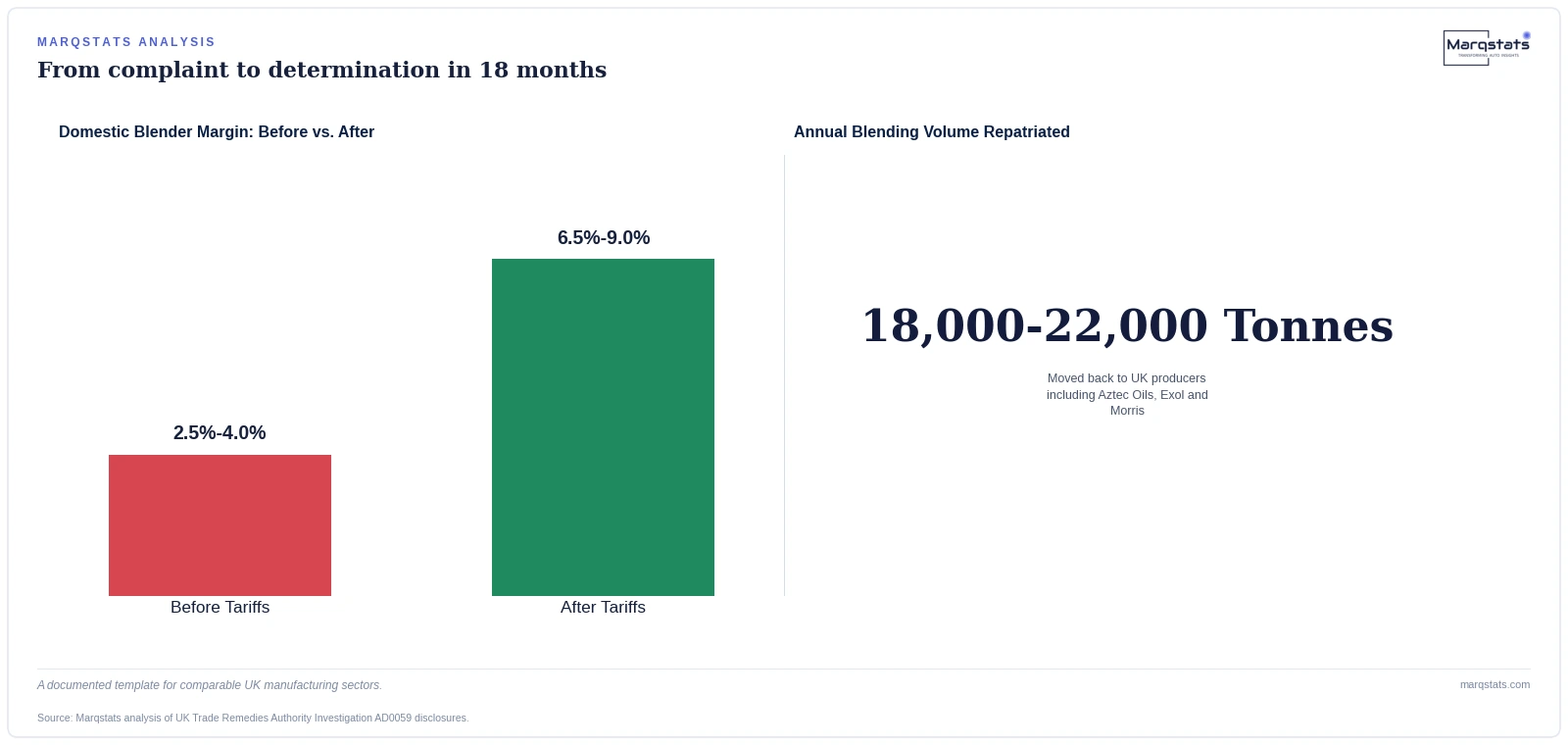
- An estimated 18,000 to 22,000 tonnes of annual blending volume has been repatriated to UK domestic producers.
Trade policy doesn't usually reshape an entire domestic industry's supply chain within a single calendar year. This one did. A government investigation into underpriced engine oil imports ended with tariffs large enough to functionally remove a fifth of the market's supply base overnight. Most sector-wide realignments take years. This one took roughly eighteen months, start to finish.
What the investigation actually found
The UK Trade Remedies Authority initiated Investigation AD0059 in June 2024, following a formal application from domestic manufacturer Aztec Oils Ltd. The investigation examined allegations of dumped engine oil and hydraulic fluid imports from Lithuania and the United Arab Emirates. In December 2025, the TRA delivered its Final Determination, finding that the domestic UK lubricant blending industry had suffered substantial material injury caused by dumped imports that significantly undercut domestic wholesale prices. The Secretary of State for Business and Trade accepted the TRA's recommendation, and the definitive duties took effect 12 December 2025.
A single government determination did what years of competitive pressure hadn't: it made cheap imported oil genuinely uncompetitive.
— Marqstats Analyst Team
What the actual numbers were before the tariffs
Prior to the determination, dumped imports were sold at an estimated 23% to 35% discount beneath UK cost-of-production benchmarks. That's a genuinely severe undercut, large enough to squeeze domestic independent blenders' operating margins down to just 2.5% to 4.0%, a level that makes sustained investment in facilities, formulation research or workforce genuinely difficult. Low-cost imported synthetic oils from Eastern Europe and the Middle East had captured an estimated 15% to 20% share of entry-level workshop and fast-fit supply chains under those conditions.
What changed once the tariffs took effect
The imposition of duties ranging from 34.55% to 95.36% eliminated that price discount entirely. Motor factors, the wholesale distributors supplying independent garages and fast-fit chains, re-engaged domestic independent blenders and toll manufacturers almost immediately. The estimated result: 18,000 to 22,000 tonnes of annual blending volume moved back to UK producers including Aztec Oils, Exol Lubricants and Morris Lubricants, and domestic processing margins recovered to historic norms of 6.5% to 9.0%, roughly double their pre-tariff level. That's a genuinely fast reversal for a market this fragmented.
Why this matters beyond the specific companies involved
The significance here extends past the direct commercial outcome for the named blenders. This case demonstrates that a formal trade remedies complaint, properly evidenced and pursued through the full statutory investigation process, can produce a genuinely decisive market realignment within roughly eighteen months from initiation to final determination. That's a meaningfully faster and more consequential timeline than most regulatory interventions in this sector typically achieve, and it establishes a documented precedent that other UK manufacturing sectors facing comparable import undercutting could plausibly follow.
The counter-argument: is this repatriation durable, or could it unwind if the tariffs face successful legal challenge?
A fair concern is whether this volume and margin recovery is genuinely durable, given that UAB SCT Lubricants submitted a formal application for reconsideration in January 2026, specifically challenging the TRA's cost calculation methodologies underlying the determination. This introduces real uncertainty. If that challenge succeeds in meaningfully revising the duty calculations, some of the current tariff protection could erode. What weighs against expecting a full unwinding, though, is that the duties remain fully enforced by HM Revenue & Customs throughout the reconsideration process, and the underlying finding of material injury from dumped pricing, the core legal basis for the tariffs, isn't itself what's being challenged, only the specific cost methodology used to calculate one exporter's rate. The broader tariff framework appears structurally more durable than a single exporter's specific rate dispute would suggest.
What this means for UK blenders and motor factors
- Domestic independent blenders should treat the current margin recovery as a genuine window to reinvest in capacity and formulation capability, given the five-year duration of the tariff measure through 2030.
- Motor factors and workshop networks should reassess supplier relationships now favoring UK-based blending capacity, given the structural price shift the tariffs have created.
- Businesses in adjacent UK manufacturing sectors facing comparable import undercutting should study the AD0059 case as a documented, successful template for pursuing formal trade remedies action.
Which specific products the duties actually cover
It's worth being precise about the exact scope of what these tariffs apply to, since the investigation covered a genuinely broad product range. The duties apply to passenger car motor oils, heavy-duty commercial vehicle oils and hydraulic oils, spanning specific grades including 5W-30, 5W-40, 0W-16, 0W-20, 0W-30, 10W-40, 10W-30, 20W-50, SAE 40, SAE 50, 15W-40, and several ISO and hydraulic viscosity grades. That's essentially the full commercial range of finished automotive and hydraulic lubricants, not a narrow technical subcategory, which is part of why the market impact has been broad rather than confined to a single niche product line.
The Lithuanian tariff specifically targets products marketed under the MANNOL and Fanfaro brands through UAB SCT Lubricants, at an 84.72% rate for that specific exporter and a considerably higher 95.36% residual rate for all other Lithuanian exporters. The UAE rate of 34.55% applies countrywide across all covered exporters from that territory, a somewhat lower but still commercially decisive duty level.
How the timeline actually unfolded, step by step
The path from initial complaint to final enforcement is worth laying out concretely, since it illustrates how the UK's post-Brexit trade remedies system actually operates in practice. Aztec Oils lodged its formal application in mid-2024. The Trade Remedies Authority initiated the formal investigation in June 2024. A provisional measure took effect in April 2025, requiring importers to provide guarantees, bank guarantees, bonds or cash, against the estimated duty rather than paying the full tariff immediately. The TRA then completed its full injury and dumping analysis, issuing Statement of Essential Facts responses to interested parties in October 2025, before reaching its Final Determination and definitive duty in December 2025.
Notably, the TRA did not recommend backdating the definitive measure to the earlier provisional determination date, and importers who paid guarantees during the provisional period between April and October 2025 are eligible for reimbursement where applicable. This procedural detail matters for understanding the actual cash-flow timeline domestic blenders experienced: real competitive relief effectively began building from the April 2025 provisional measure onward, roughly eight months before the definitive duty made headlines in December.
The full market picture
Marqstats' complete UK automotive lubricants aftermarket analysis, including the full regulatory and competitive landscape, is available in the linked report below.
Related reportUnited Kingdom Automotive Lubricants Aftermarket Size, Share & Forecast 2026 – 2030