
A Cost Gap That Insurers Already Price Into Every Policy
It's worth understanding exactly what's driving this premium gap before assuming it's simply new-technology caution.
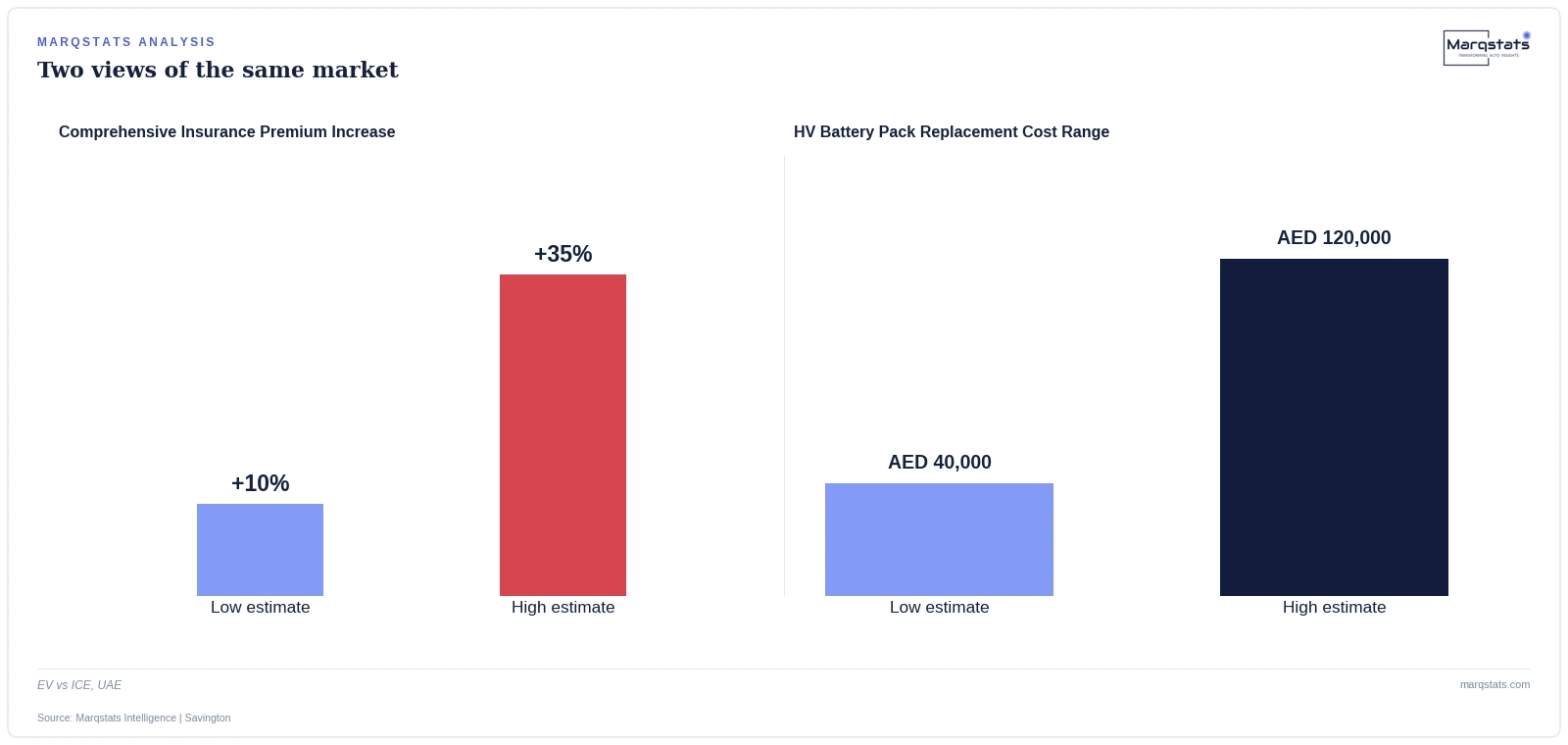
In brief: comprehensive motor insurance premiums for electric vehicles in the UAE already run 10% to 35% higher than for equivalent internal combustion vehicles -- and the severe storm and localized flooding of April 2024 widened that gap further.
Why Water and High-Voltage Batteries Don't Mix
This isn't a general electronics-and-water concern -- it's a specific, documented failure mode with a specific price tag.
A submerged battery pack isn't a repair. It's a replacement.
— Marqstats Analyst Team
High-voltage battery packs submerged in floodwater face water intrusion risks that compromise electrical isolation resistance -- a genuine safety hazard, not a cosmetic problem, that requires full pack replacement rather than a partial repair. That replacement runs AED 40,000 to AED 120,000, frequently exceeding 50% of the vehicle's residual market value on its own.
A Named Comparison: Why Minor Impacts Can Total a Car Too
Flooding isn't the only path to this outcome, and the second one is worth naming explicitly.
Modern EVs often feature large structural aluminum underbody castings integrated with the battery enclosure. Minor impacts from road debris that deform the lower battery shield frequently result in total constructive losses as well, driven by the risk of internal cell puncture rather than by the visible damage itself -- a genuinely different damage-assessment logic than insurers apply to a comparable ICE vehicle's underbody scrape.
Why This Total-Loss Pattern Should Persist
Nothing about this cost structure is likely to soften quickly, since it traces to the physical chemistry of the battery pack itself rather than to a fixable process inefficiency.
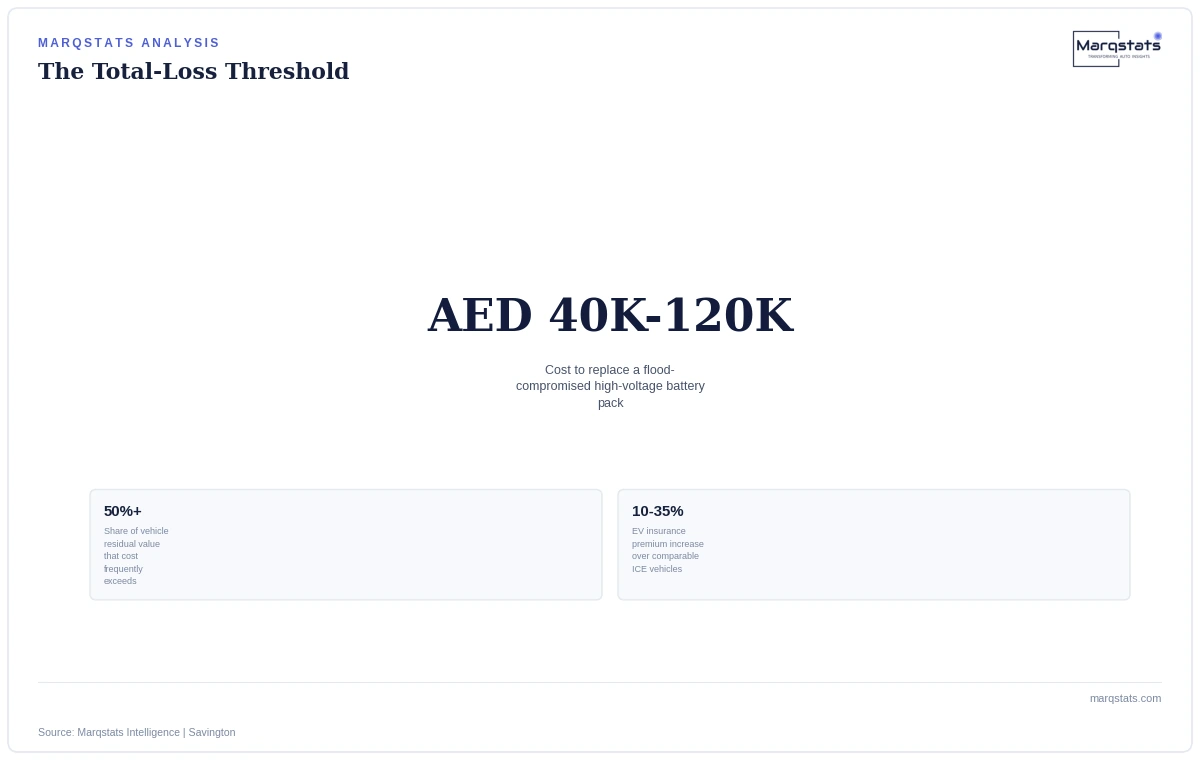
Battery pack replacement costs are tied to cell chemistry and manufacturing scale, not to workshop labor efficiency, meaning this total-loss dynamic should be treated as a structural feature of EV ownership economics in flood- and impact-prone conditions rather than a gap likely to close as the market matures.
Manufacturers could, in principle, redesign battery enclosures with more localized sacrificial crumple zones specifically to reduce the frequency of full-pack write-offs from minor impacts, but that engineering trade-off competes directly against the structural rigidity and crash-safety benefits the current integrated-casting approach provides, meaning it is unlikely to be prioritized purely to improve UAE-specific insurance economics.
What This Means for Fleet Operators and Insurers
The practical takeaway: fleet operators and insurers should factor flood-zone exposure and underbody impact risk into vehicle acquisition and coverage decisions specifically, given how directly AED 40,000-to-120,000 replacement costs can turn what would be a moderate ICE repair claim into a full EV total loss.