
A Registration Share That Overstates the Real Market
The gap between the headline registration figure and the underlying operational reality is worth understanding before drawing conclusions about where to invest.
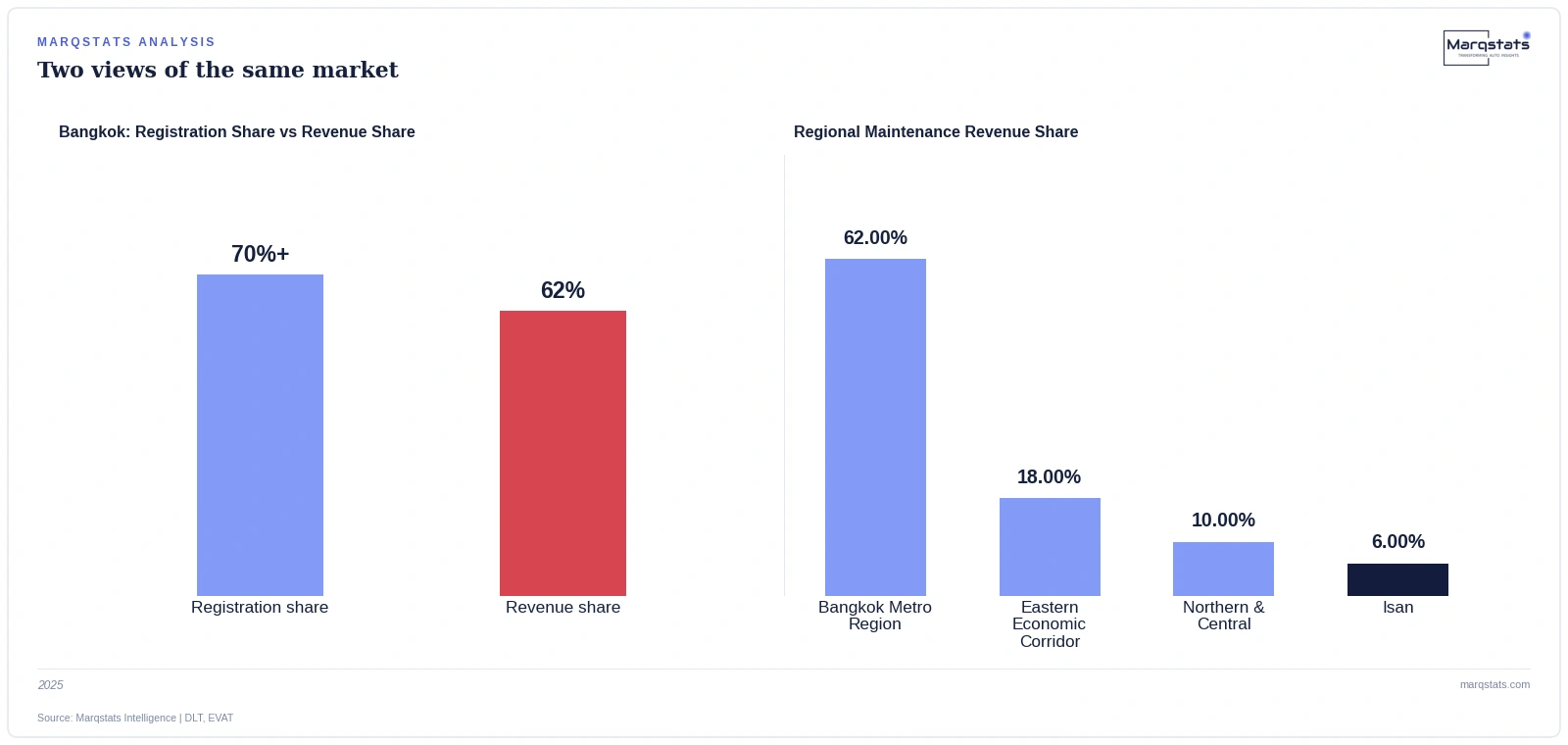
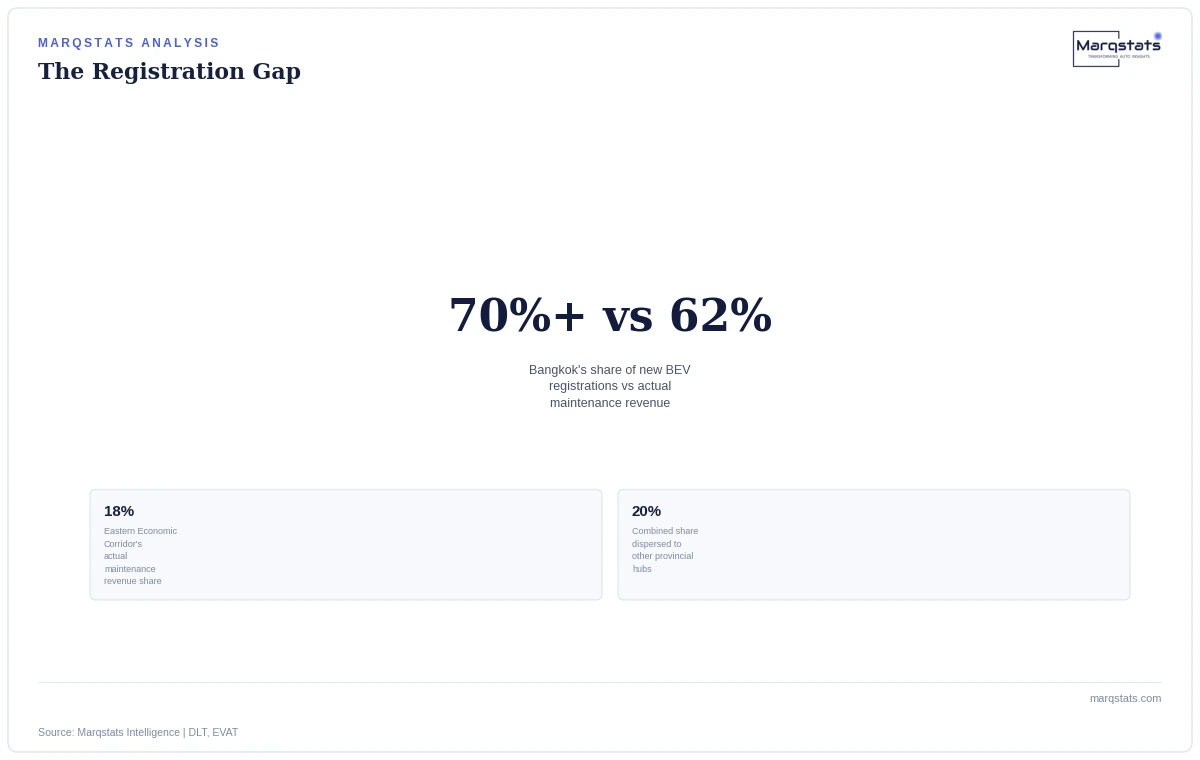
Official Department of Land Transport records show over 70% of new battery electric vehicles registered within the Bangkok Metropolitan Area. Read that as proof that 70% of Thailand's EV servicing activity happens in the capital, and the actual maintenance data tells a noticeably different story.
Why Corporate Fleets Register Where They Don't Operate
This is a routine business decision at the individual company level, with a genuine cumulative effect on national statistics.
Commercial leasing companies, corporate fleets, and rental operators register vehicles at Bangkok corporate headquarters while operating them in provincial tourism, manufacturing, and transit sectors. That's a routine administrative decision, not a reflection of where the vehicles spend their operating lives or generate their servicing demand.
What Charging and Service Data Actually Shows
Looking past registration counts to actual infrastructure usage tells the more accurate story.
Analyzing public charging infrastructure utilization compiled by the Electric Vehicle Association of Thailand and regional service branch transaction volumes yields a more moderate figure: the Bangkok Metropolitan Region captures 62.00% of national maintenance revenue -- still dominant, but genuinely lower than the registration statistic alone would suggest, with the difference dispersed into provincial hubs including the Eastern Economic Corridor, Chiang Mai, and Hat Yai.
A Named Comparison: Why This Gap Matters for Workshop Investment
Treating the registration figure as the real market size would lead to a genuinely different investment conclusion than the operational data supports.
An investor sizing regional workshop opportunity purely from DLT registration data would overestimate Bangkok's true addressable market and underestimate the Eastern Economic Corridor's, Chiang Mai's, and Hat Yai's genuine servicing demand -- a meaningful planning error for anyone deciding where to locate the next EV service bay.
Why This Pattern Should Persist
Corporate headquarters registration and actual operational deployment are driven by entirely separate business logics -- administrative convenience on one side, project and route location on the other -- meaning there is little structural reason to expect Thailand's registration-versus-circulation gap to narrow as the corporate fleet continues expanding.
If anything, the gap should widen rather than close as the EV3.5 offset schedule pulls more manufacturing investment into the Eastern Economic Corridor specifically -- employees, contractors, and logistics operators tied to that industrial base will keep generating genuine provincial maintenance demand even as their employers' corporate fleet vehicles remain registered under Bangkok headquarters addresses for administrative simplicity.
What This Means for Regional Workshop Investment
The practical takeaway: workshop investors evaluating provincial expansion should weight EVAT charging-infrastructure and service-transaction data over raw DLT registration counts specifically, since the latter systematically overstates Bangkok's true servicing demand relative to the provinces.