Two Philosophies, One Market
In brief: Tesla and BYD, two of the highest-volume EV brands in Australia, have built genuinely opposite approaches to when and how often a car should actually see a mechanic. Neither is objectively wrong. They're optimizing for different things.
BYD's Bet: Predictability
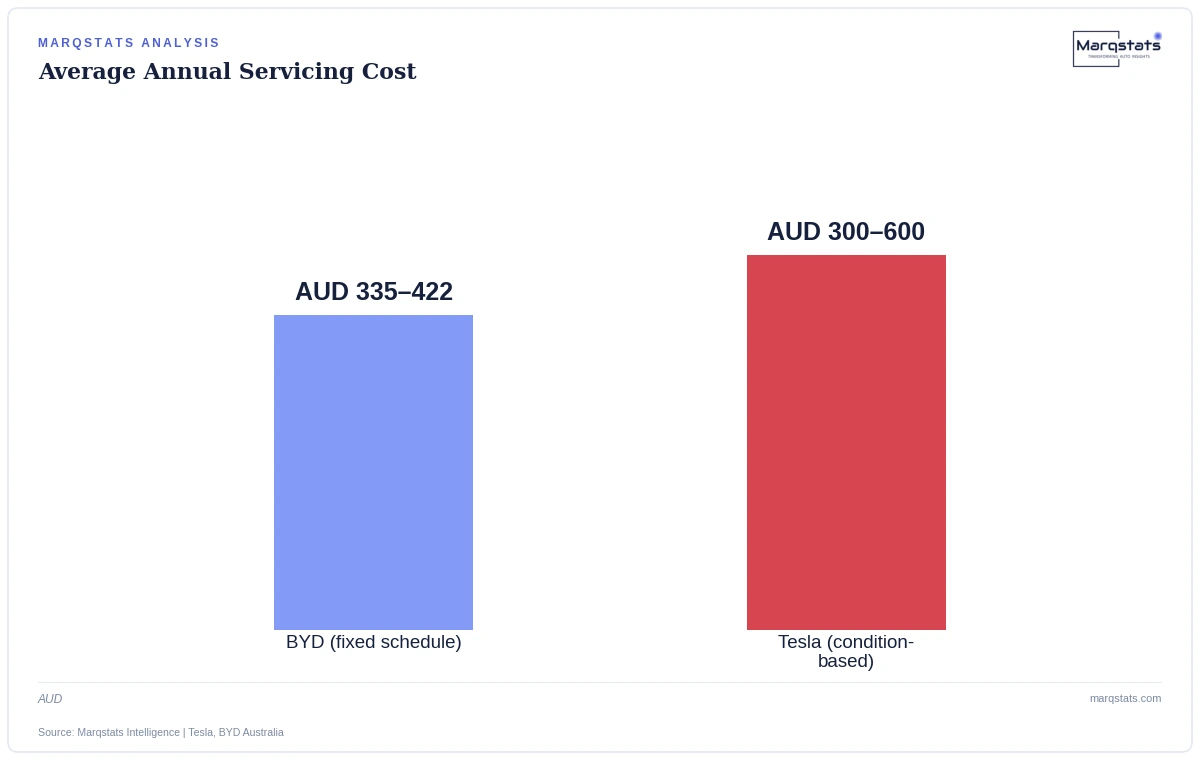
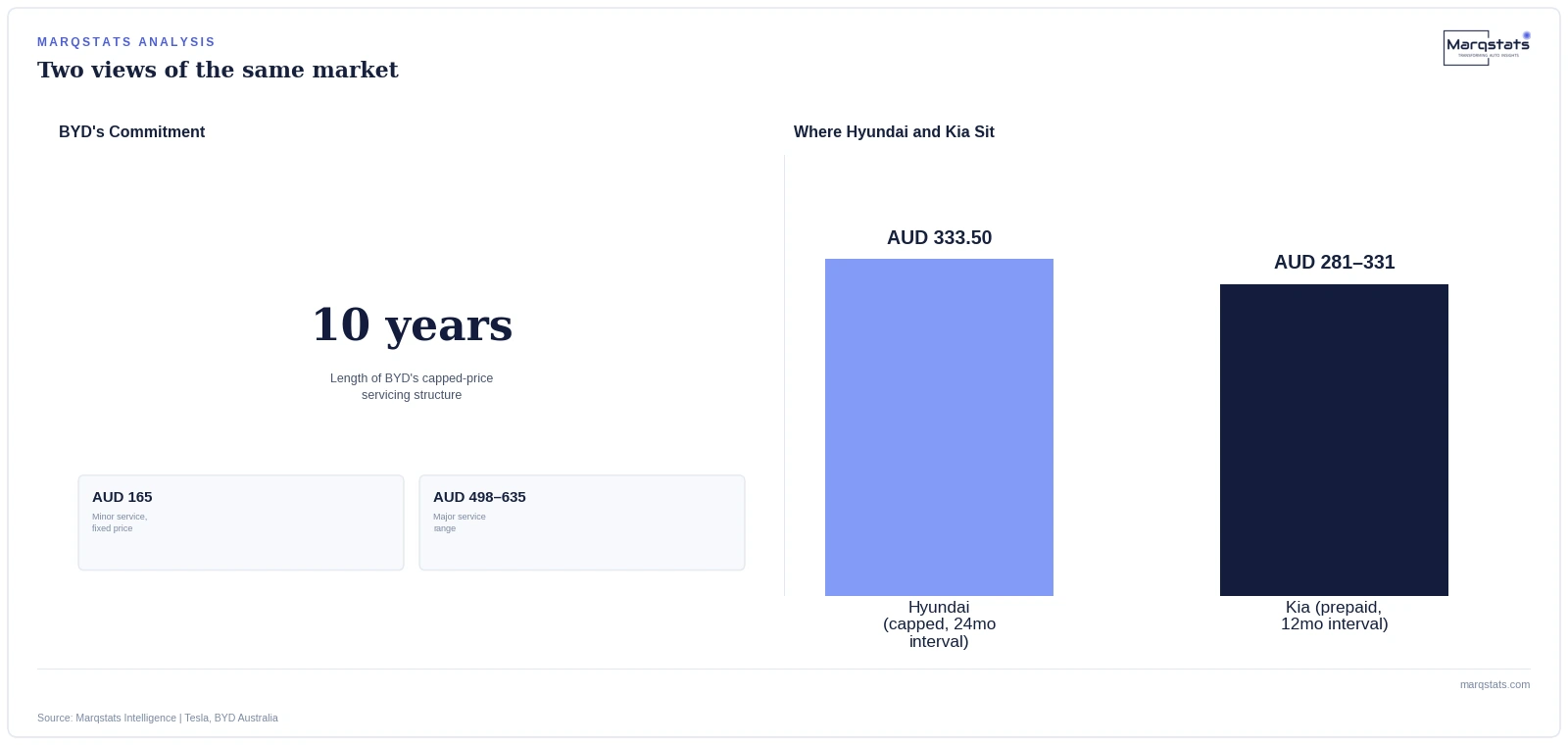
BYD's model is straightforward: fixed 12-month or 20,000 km intervals, a 10-year capped-price commitment, minor services locked at AUD 165 and major services between AUD 498 and AUD 635. Distributed through EVDirect and serviced through a formal partnership with mycar Tyre & Auto's national network, the entire structure is built around one core promise: you will know exactly what your servicing costs for the next decade, regardless of how the vehicle actually performs.
Tesla's Bet: Responsiveness
Tesla does the opposite. No enforced annual logbook visit. Instead, specific component intervals — cabin air filters every 2 years, brake fluid checks every 2 years, tyre rotations every 10,000 km — combined with condition-based alerts that trigger service only when the vehicle's own telemetry indicates it's actually needed. The resulting average annual cost, AUD 300 to AUD 600, reflects real-world usage variation rather than a fixed calendar commitment.
Why This Isn't Just a Pricing Difference
One brand is selling certainty. The other is selling precision. Both are legitimate answers to the same underlying question.
— Marqstats Analyst Team
The deeper difference is philosophical, not just financial. BYD's fixed structure suits buyers who value budget predictability above all else — fleet managers, novated lease customers, anyone planning total cost of ownership years in advance. Tesla's condition-based approach suits buyers comfortable with variability in exchange for potentially paying only for service genuinely needed, not service scheduled by calendar regardless of actual vehicle condition.
What Each Model Reveals About the Brand Behind It
There's a broader signal here too: BYD's capped-price model reflects a company entering a new market and prioritizing trust-building through predictability. Tesla's condition-based model reflects a company confident enough in its own vehicle telemetry and diagnostic systems to let real usage data, not a fixed calendar, decide when service is genuinely warranted.
A Named Comparison: Where Hyundai and Kia Sit Between the Two
Hyundai and Kia occupy a middle ground worth naming: Hyundai's Lifetime Service Plan caps pricing at AUD 667 per visit on a 24-month/30,000 km interval, while Kia's prepaid packages (AUD 842 for 3 years, AUD 1,570 for 5 years, AUD 2,319 for 7 years) offer BYD-style predictability but at longer, Tesla-adjacent service intervals — a genuinely hybrid approach neither pure model fully captures.
What This Means for Buyers and Workshops Alike
For a prospective EV buyer, the practical lesson is to match the servicing philosophy to your own priorities — budget certainty versus usage-based efficiency — rather than assuming one brand's approach is simply better. For an independent workshop, it means genuinely different service-scheduling and inventory-planning demands depending on which brands dominate a given local market.