
A Registration Number That Tells a Misleading Story
It's the kind of detail easy to miss if you're reading a cantonal fleet table at face value, but it materially changes what the numbers actually mean for anyone using them to plan around.
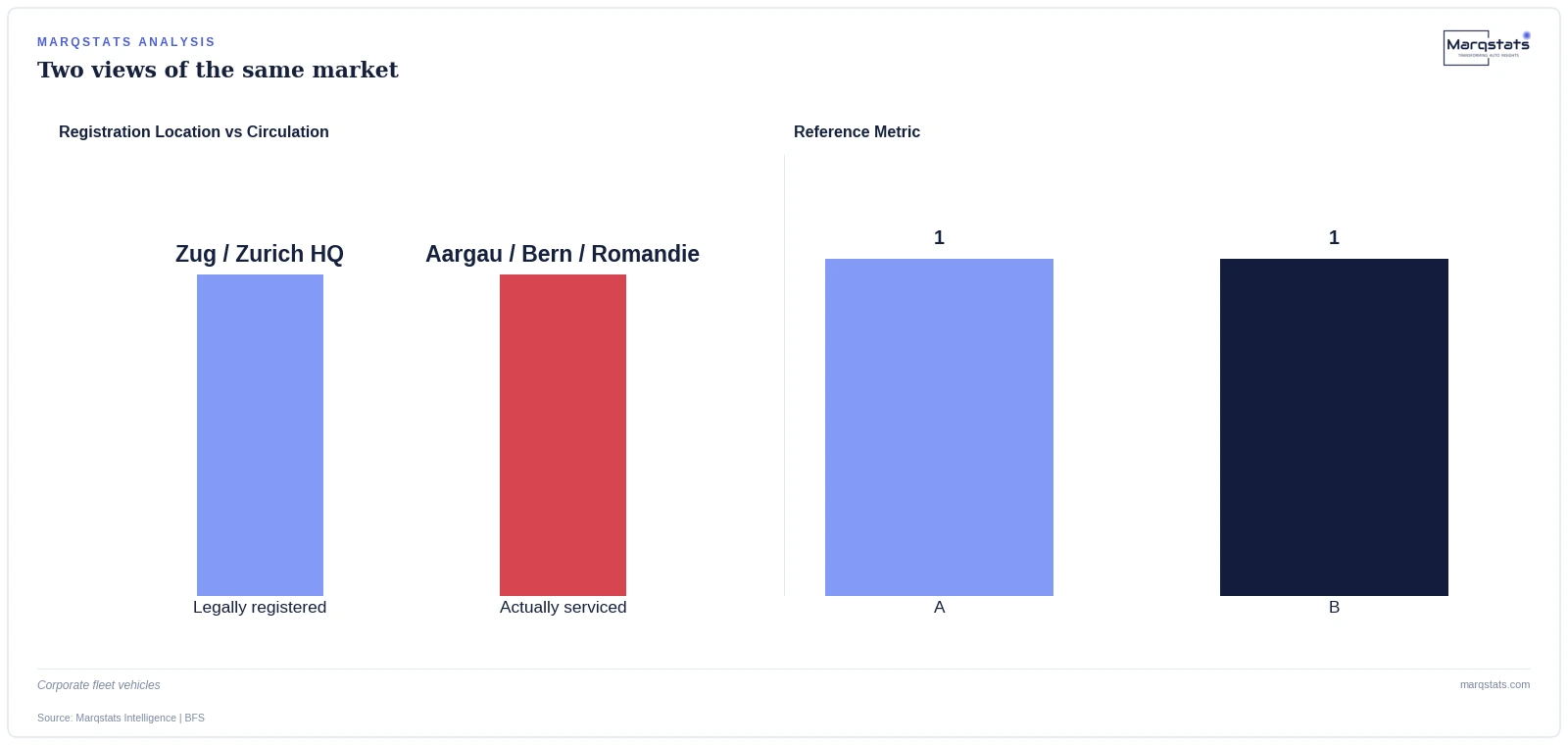
In brief: Zug and Zurich post some of Switzerland's highest EV registration figures. Read that as a direct measure of local driving and servicing demand, and you'll be wrong — not because the numbers are false, but because of what they're actually counting.
Why Corporate Headquarters Distort the Picture
This isn't a small statistical footnote either -- corporate and commercial fleets account for a meaningful share of Switzerland's active BEV population, meaning the distortion touches a genuinely significant portion of the national fleet, not just a handful of outlier vehicles.
Major leasing companies, commercial fleet operators and long-term rental corporations maintain statutory administrative headquarters in Zug and Zurich for tax and regulatory reasons unrelated to where their vehicles actually operate. Every vehicle in their fleet gets registered at that headquarters address — regardless of which canton the vehicle is actually driven and serviced in day to day.
Where the Vehicles Actually Go
That distinction genuinely matters for anyone budgeting workshop expansion.
The registration plate says Zug. The service history says Aargau.
— Marqstats Analyst Team
The vehicles themselves are frequently driven and serviced across suburban commuter belts in Aargau, Bern and the Romandie — regions whose registration-based fleet share genuinely understates their actual servicing demand as a direct consequence.

A Named Comparison: Why This Differs From Ordinary Statistical Noise
Most regional data has some noise around the edges — a vehicle registered near a border, a driver who commutes across cantons occasionally. This is structurally different: it's a systematic, predictable distortion driven by where corporate fleets choose to headquarter, not random variation. That predictability actually makes it more useful once recognized — anyone building a workshop investment model can adjust for it deliberately, rather than treating it as unmodelable noise.
Why This Pattern Should Persist
Corporate headquartering decisions are driven by tax and regulatory considerations that have nothing to do with automotive servicing logistics, meaning there's little reason to expect this registration-versus-circulation gap to narrow on its own as the fleet continues to grow.
What This Means for Workshop and Parts Investment Planning
The practical takeaway: workshop investors and parts distributors should weight actual circulation patterns — commuter corridors, suburban driving routes — more heavily than headline cantonal registration statistics when siting new high-voltage service capacity, since registration data alone will systematically point capital toward the wrong cantons.