A Minority Fleet Generating the Majority of Revenue
That gap is worth pausing on, since it runs directly against the intuitive assumption that whichever powertrain has more vehicles on the road should also generate more aftermarket revenue.
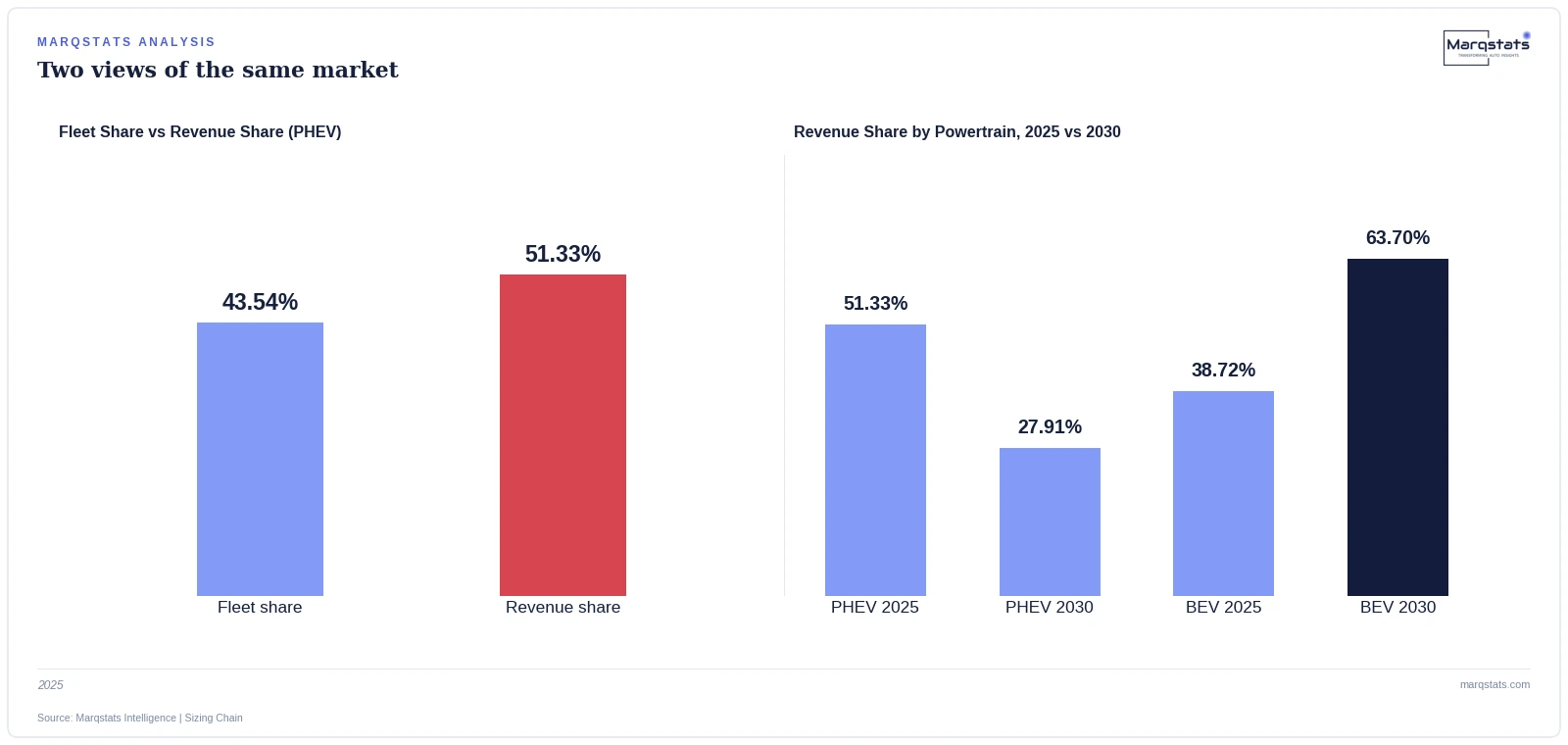
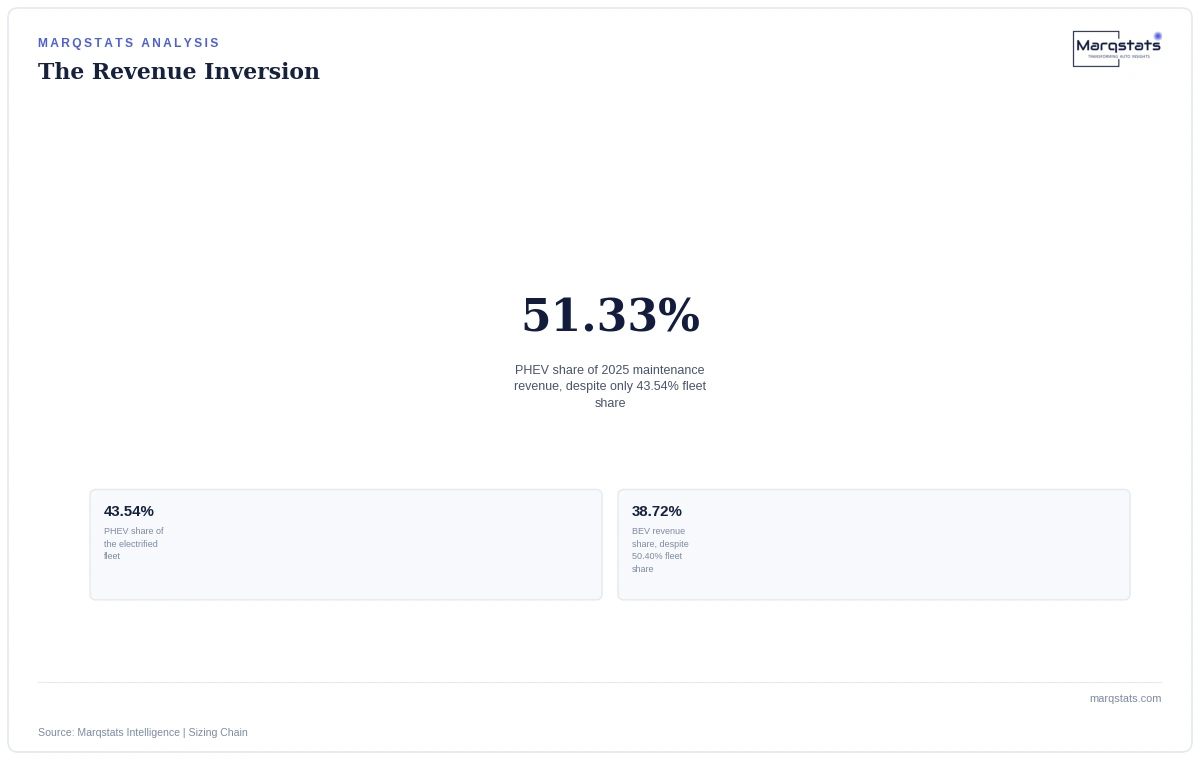
Plug-in hybrids make up 43.54% of Sweden's electrified vehicle population — fewer units than pure battery electric vehicles, which hold a slightly larger 50.40% share. Yet PHEVs generate more maintenance revenue than any other powertrain segment in the country.
The Numbers Behind the Inversion
These figures aren't modeled estimates either -- they come directly from the underlying research's own reconciled market sizing chain, cross-checked against fleet population data.
PHEVs generated SEK 3,326.93 million in 2025 maintenance turnover — 51.33% of the total market — while pure BEVs, despite a larger fleet share, generated only 38.72% of revenue.
Why the Smaller Fleet Segment Costs More to Service
The mechanism is architectural, not accidental. A PHEV retains a complete combustion engine, requiring the same oil changes, spark plugs, drive belts and emissions diagnostics any petrol car needs. But it also carries a genuine high-voltage battery and electric motor, requiring the same isolation checks, inverter cooling flushes and auxiliary battery maintenance a pure BEV needs. A PHEV owner effectively pays for both maintenance regimes on a single vehicle.
A Named Comparison: Why This Won't Last
This isn't a permanent structural feature of the Swedish market — it's a specific, dated snapshot. The underlying research's own forecast shows this exact relationship reversing by 2030: as the BEV population scales toward 1.25 million vehicles and PHEV sales plateau near 380,000, BEV revenue share is projected to climb to 63.70% while PHEV share falls to 27.91%. Workshops building a long-term strategy around today's PHEV revenue concentration should plan for that reversal explicitly, not assume it persists.
Why the Timing Window Matters More Than the Rule
What makes this genuinely actionable rather than just an interesting statistic is the explicit timeline attached to it. The underlying research doesn't just note the current inversion -- it names the specific fleet milestones (1.25 million BEVs, 380,000 plateaued PHEVs) that mark when the reversal actually completes, giving workshops a concrete planning horizon rather than an open-ended trend to guess at.
Workshops that recognize this now have a genuine window to build the specific dual-powertrain diagnostic capability the current market rewards most.
What This Means for Workshops Right Now
The practical takeaway: workshops operating in the current window should weight PHEV dual-powertrain servicing capability specifically, not just pure-BEV high-voltage work, since it represents the segment generating the most revenue per vehicle in today's Swedish market — while recognizing this is a transitional advantage tied to today's fleet composition, not a permanent one.