The Numbers That Don't Match Intuition
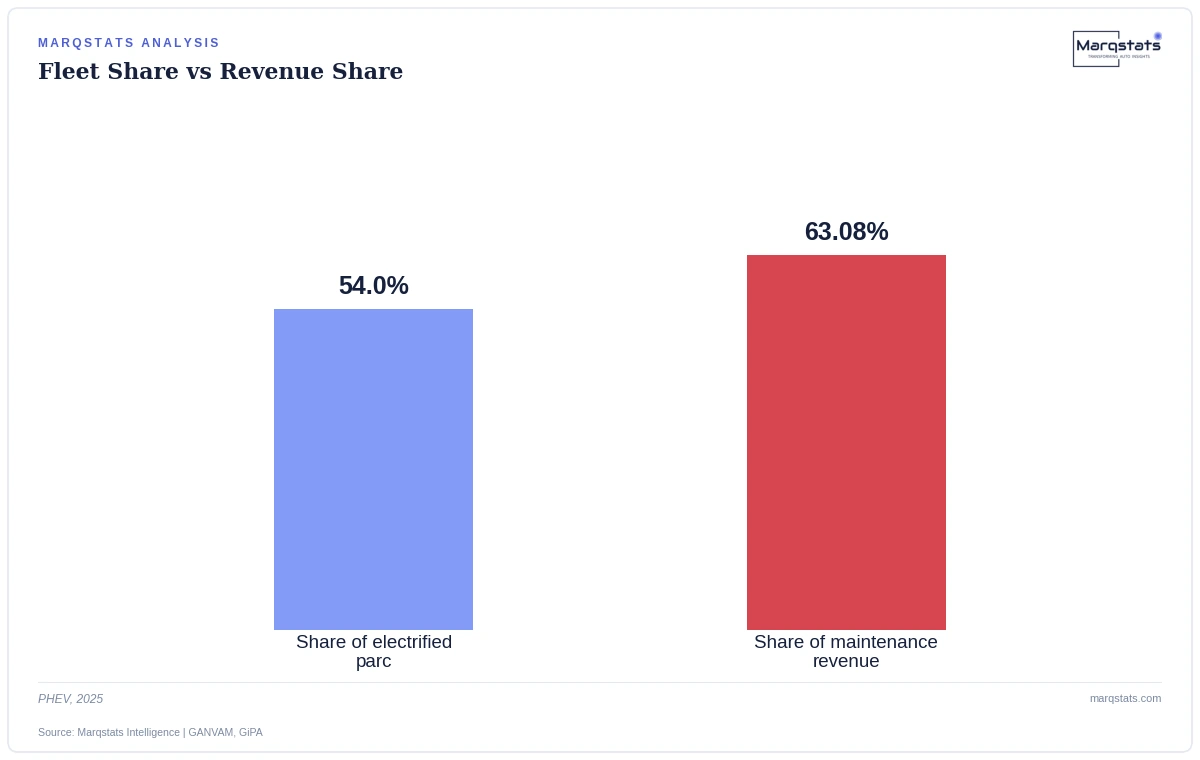
In brief: plug-in hybrids make up just over half of Spain's electrified vehicle fleet, but generate nearly two-thirds of the maintenance revenue that fleet produces. If you assumed battery electric vehicles — the more technically complex, higher-voltage platform — would carry the larger maintenance bill, the data says otherwise.
Why PHEVs Cost More to Maintain
The explanation is structural, not incidental. A plug-in hybrid combines two complete maintenance profiles in a single vehicle: a downsized internal combustion engine with its own lubrication, cooling and exhaust systems, paired with an electric motor, inverter, onboard charger and lithium-ion traction battery. A PHEV owner in Spain pays for both profiles simultaneously — annual motor oil, oil filter, spark plug and auxiliary belt replacements on the combustion side, alongside the high-voltage diagnostics and dual-circuit thermal management a battery electric platform also requires.
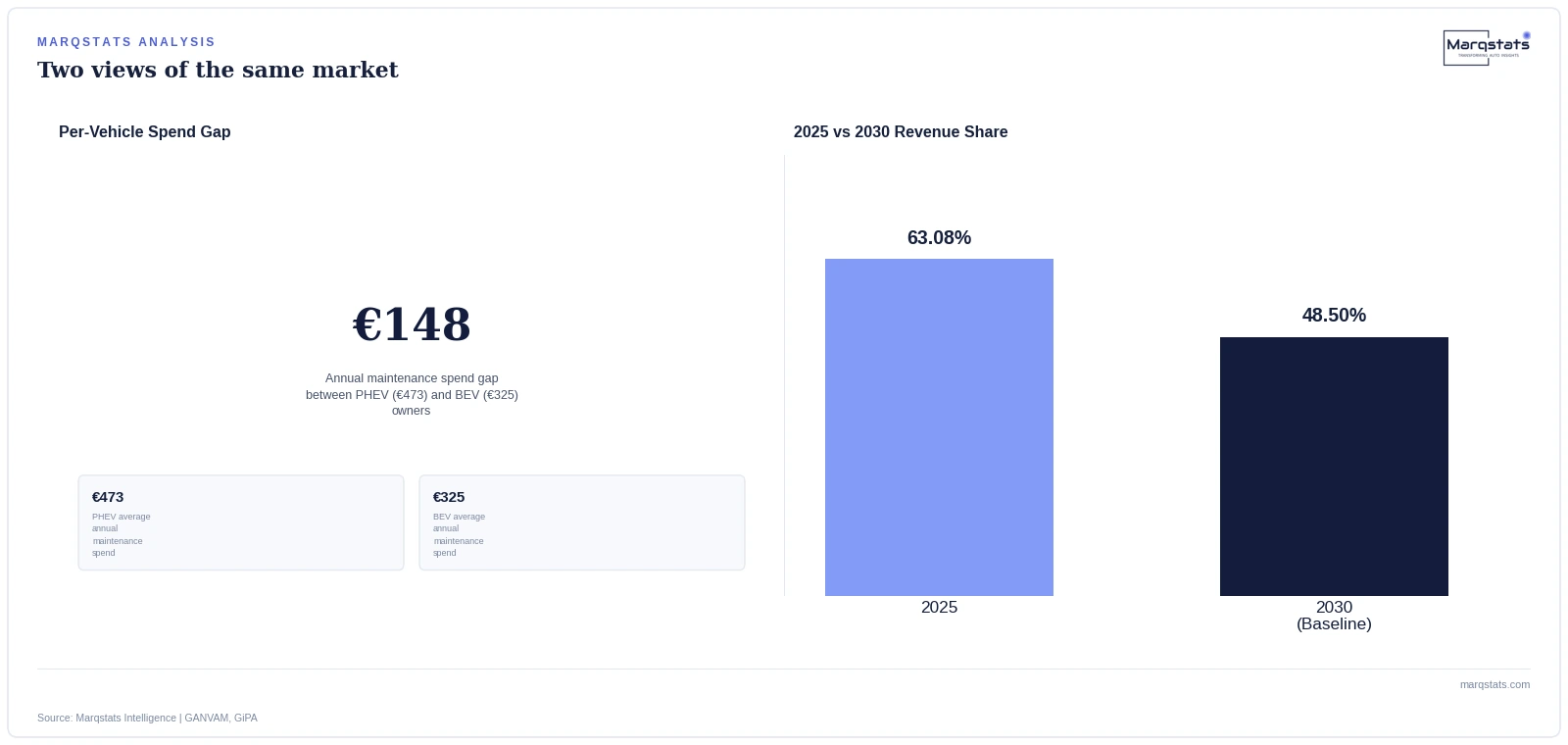
A pure BEV, by contrast, sheds the entire combustion-engine maintenance profile. No oil changes, no spark plugs, no exhaust servicing, no multi-ratio gearbox. What remains is the electric platform alone — fewer distinct systems to maintain, which shows up directly in the average annual spend: €325 for BEVs against €473 for PHEVs.
The Revenue Consequence for Workshops
For Spanish workshops today, the plug-in hybrid customer is worth more than the pure electric one — and that won't stay true for long.
— Marqstats Analyst Team
For a workshop operator, this means the PHEV segment of the customer base — rather than the more headline-grabbing BEV segment — currently generates outsized per-vehicle revenue. In 2025, PHEVs generated €186.20 million against BEVs' €108.98 million, even though BEVs and PHEVs sit reasonably close in absolute unit count within the parc.
Why This Won't Last
Spain's own subsidy architecture is actively working against this dynamic. Plan Auto+'s EEE framework provides 50% base aid to qualifying BEVs against just 25% for PHEVs, a policy design specifically intended to accelerate pure electric adoption. Under the market's own Baseline Electrification Scenario, BEV circulating units are projected to reach 1,750,000 by 2030 — overtaking PHEVs in both unit count and, for the first time, maintenance revenue share, at 51.50% against PHEVs' 48.50%.
What a Workshop's Service Mix Actually Looks Like Today
Translate the percentages into a concrete picture: for every 100 electrified vehicles a Spanish workshop services in 2025, roughly 54 are PHEVs and 46 are BEVs by count — but the revenue those 100 vehicles generate splits closer to 63/37 in favor of the PHEV group. A workshop that staffs and prices purely by vehicle count, without accounting for this revenue-per-vehicle gap, is systematically underpricing its PHEV service capacity relative to the actual demand on technician time and diagnostic complexity those vehicles require.
A Named Comparison: The Transitional-Technology Pattern
This isn't unique to Spain — plug-in hybrids function as a genuine transitional technology across multiple European markets, valued by corporate fleets and suburban buyers specifically because they reduce public charging dependence while regulatory and subsidy frameworks still favor pure electric adoption longer-term. What's distinctive about Spain's case is how clearly quantifiable the revenue consequence is: a 9-point gap between fleet share and revenue share is a genuinely large, measurable effect, not a marginal statistical curiosity.
What Workshop Operators Should Do With This
The practical takeaway for a workshop planning service capacity or technician training priorities over the next two to three years: don't let BEV headlines distract from where today's actual revenue sits. PHEV owners remain the higher-value customer on a per-vehicle basis right now, even as the multi-year trend clearly points toward BEV volume and revenue dominance by the back half of this decade.