A Number That Sounds Like a Skills Problem
South Korea's independent repair sector has seen a 24.9% decline in shop counts. Read that statistic on its own, and it's easy to assume the cause is competitive pressure, changing consumer habits, or shops simply failing to keep up with new technology.
The actual cause is far more specific, and far less about capability than it sounds.
The Line the Law Draws
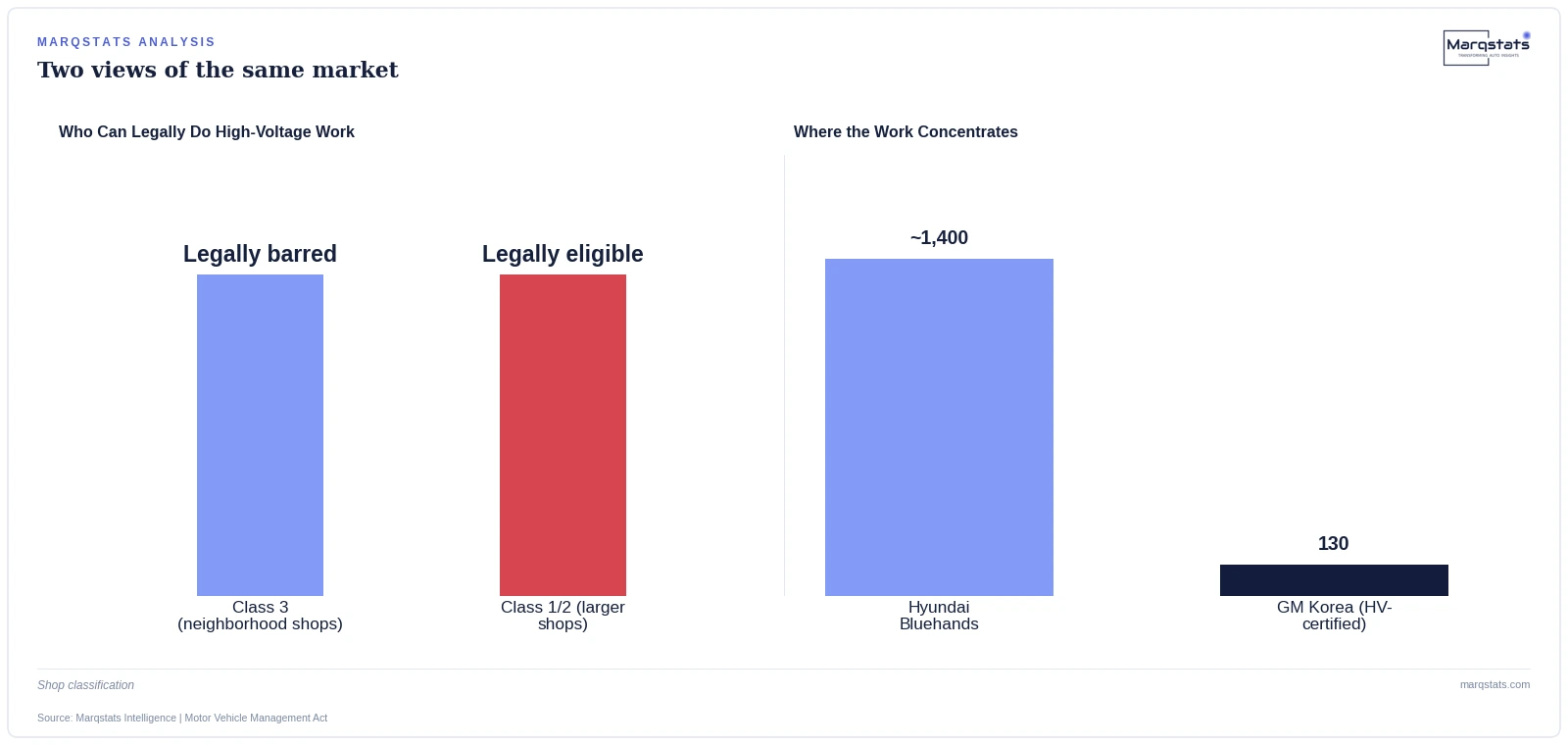
South Korea's Motor Vehicle Management Act draws a hard legal line at 60 volts. The country's 2,786 licensed Class 3 neighborhood repair shops — the small, local garages most drivers think of as their default mechanic — are legally prohibited from servicing any system above that threshold. Not discouraged. Not disadvantaged by cost. Prohibited.
Why This Isn't a Training Problem
Every registered EV's high-voltage system operates well above 60 volts, as a basic matter of how electric drivetrains work. That means this isn't a case where a Class 3 shop could send a technician to a course, invest in some equipment, and start competing for EV service work. The exclusion is categorical and legal, not a matter of catching up technically.
Where the Work Actually Goes Instead
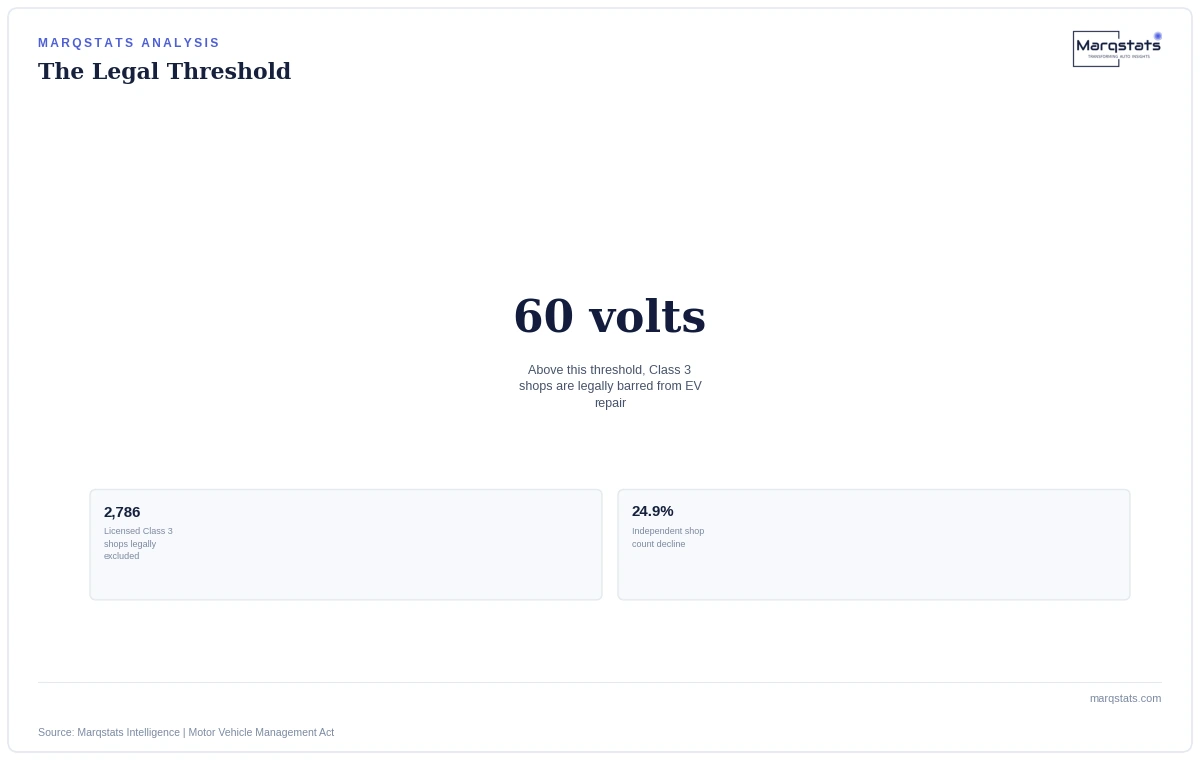
With 2,786 shops legally excluded from the largest and fastest-growing category of automotive service work, that demand doesn't disappear — it concentrates. Hyundai's Bluehands network, at roughly 1,400 locations, and GM Korea's 130 high-voltage-certified hubs out of 380 total centers, absorb the volume Class 3 shops legally cannot touch.
A Named Comparison: How This Differs From a Market Where Investment Would Help
In many countries, independent workshops face a genuine but surmountable barrier to EV servicing — the cost of insulated tools, certification training, and safety equipment. Shops that invest can eventually compete. South Korea's Class 3 exclusion is structurally different: no amount of capital investment changes a shop's legal classification. The barrier isn't financial. It's categorical.
Who This Actually Leaves Room For
The exclusion doesn't apply to South Korea's roughly 5,000 licensed Class 1 and Class 2 repair shops, which face a different, genuinely surmountable barrier instead: fewer than 12% of them have actually invested in the high-voltage safety gear, ground-isolation testing, and insulated lift equipment needed to compete for this work — a real but addressable capital gap, distinct from Class 3's legal wall.
What This Means for Anyone Reading Korea's Repair Industry Statistics
The practical takeaway: a 24.9% independent shop decline in South Korea is a story about regulatory classification, not competitive failure. Anyone assessing this market should separate the legally excluded Class 3 segment from the technically underinvested but eligible Class 1 and Class 2 segment — they face genuinely different paths forward, if any.