A Savings Case That Should Be Obvious
It's the kind of cost comparison that should be a straightforward win for electric vehicles, and it's worth understanding exactly why it isn't in this specific market.
Electric vehicles eliminate engine oil changes, spark plugs, and multi-ratio transmissions. Regenerative braking extends brake pad life well beyond typical replacement intervals. On paper, that should add up to a clear maintenance-cost advantage over a comparable gas-powered car. In Saudi Arabia, it doesn't.
The Numbers Behind the Parity
These specific figures trace directly to the underlying research's own blended cost analysis, not a rough estimate.
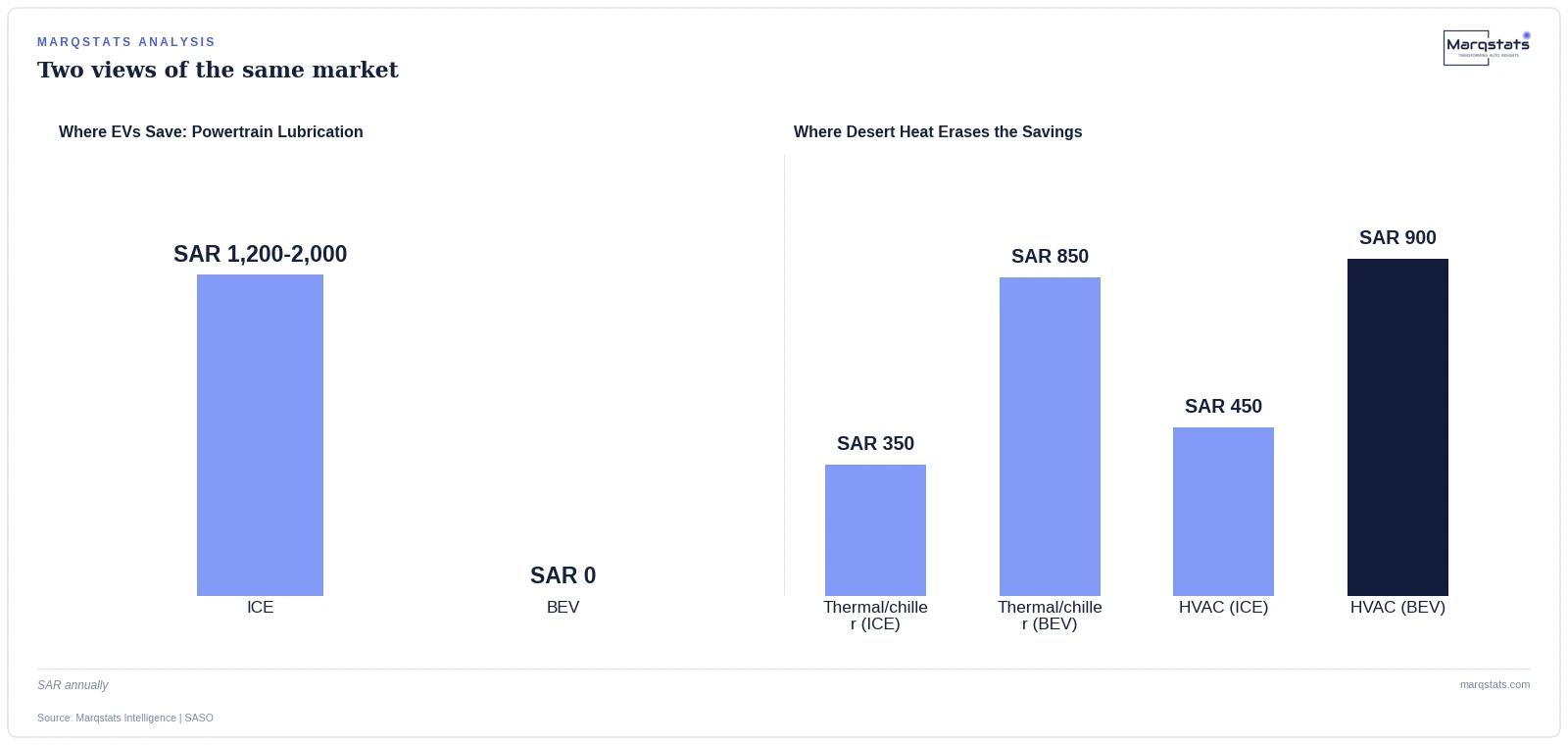
A blended cost comparison shows a mid-size ICE utility platform and its battery-electric equivalent both landing at exactly SAR 4,900 (roughly USD 1,307) in total annualized maintenance spend. That's not a rough approximation converging on similar figures -- it's the same number.
Where the EV Actually Wins
The savings categories work exactly as expected -- it's worth being precise about where they show up before explaining where they disappear.
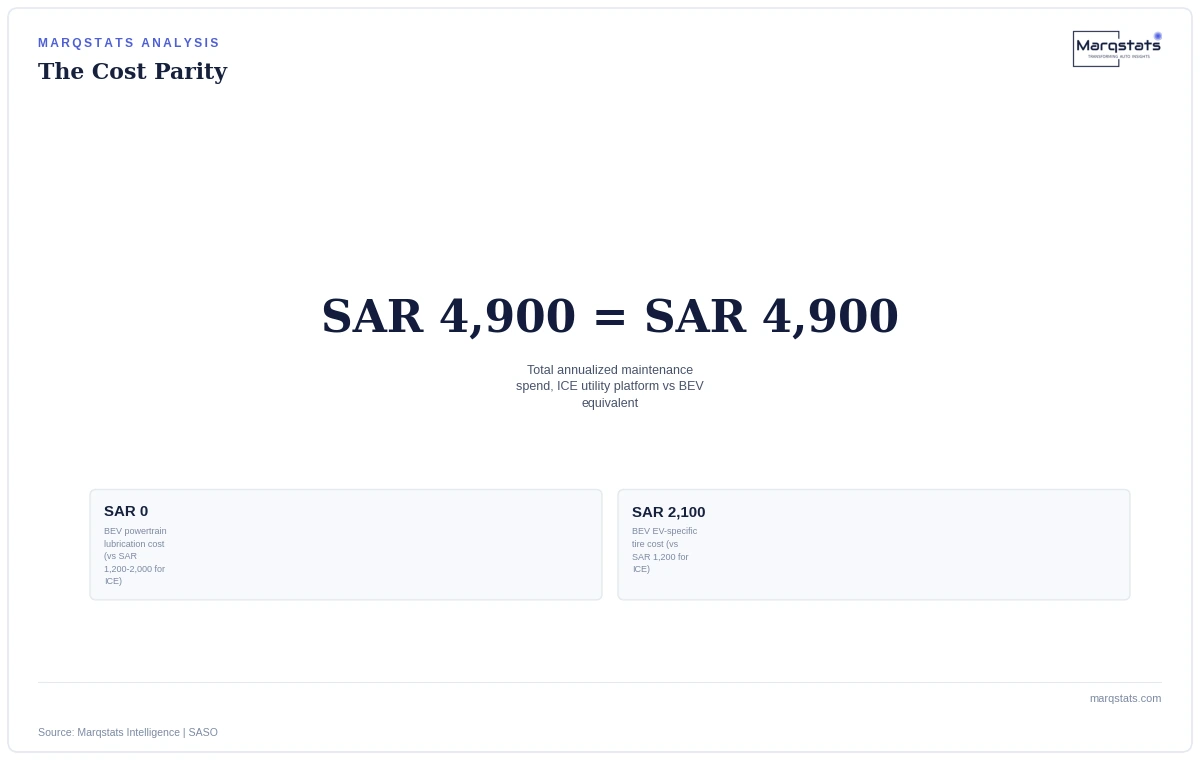
Powertrain lubrication and servicing falls from SAR 1,200-2,000 annually to zero, since electric drivetrains simply don't need it. Friction brake servicing drops from SAR 1,400 to SAR 400, as regenerative braking dramatically reduces pad and rotor wear. Those are genuine, substantial savings -- exactly what an EV buyer would expect.
A Named Comparison: Where the Desert Takes It Back
The offsetting costs aren't scattered randomly across the maintenance schedule -- they cluster in exactly the systems Gulf heat stresses hardest.
Battery thermal and chiller servicing more than doubles, from SAR 350 for a conventional radiator loop to SAR 850 for the active heat pump systems EVs require to keep battery cells below thermal-degradation thresholds. HVAC maintenance doubles, from SAR 450 to SAR 900, as the high-voltage dual-zone scroll compressor works harder in summer ambient temperatures exceeding 45C to 50C. EV-specific tire replacement nearly doubles, from SAR 1,200 to SAR 2,100, as the combination of heavy curb mass and instant motor torque accelerates tread wear on asphalt surfaces that can pass 65C.
Why This Isn't a Data Quirk
The offsetting categories are large enough, and specific enough to Gulf conditions, that this looks like a genuine structural feature rather than statistical noise.
Each offsetting cost traces to a specific, well-documented desert operating mechanism -- not a rounding coincidence. The mechanism is consistent enough across component categories that this cost-parity outcome should be expected to persist as the fleet matures, rather than resolving itself as EV technology improves generically.
What This Means for Anyone Selling EVs on Cost Savings
The practical takeaway: dealers, fleet advisors and marketers positioning EVs on lower total maintenance cost specifically should recalibrate that pitch for the Saudi market, since the actual comparable-total-cost data doesn't support it here the way it does in temperate climates.