
A Market Share Swing Too Large to Be Noise
Brand share in a national truck market rarely moves by double digits in a single year without a structural cause behind it. Russia's heavy-commercial-vehicle segment just did exactly that, in both directions at once.
The Numbers
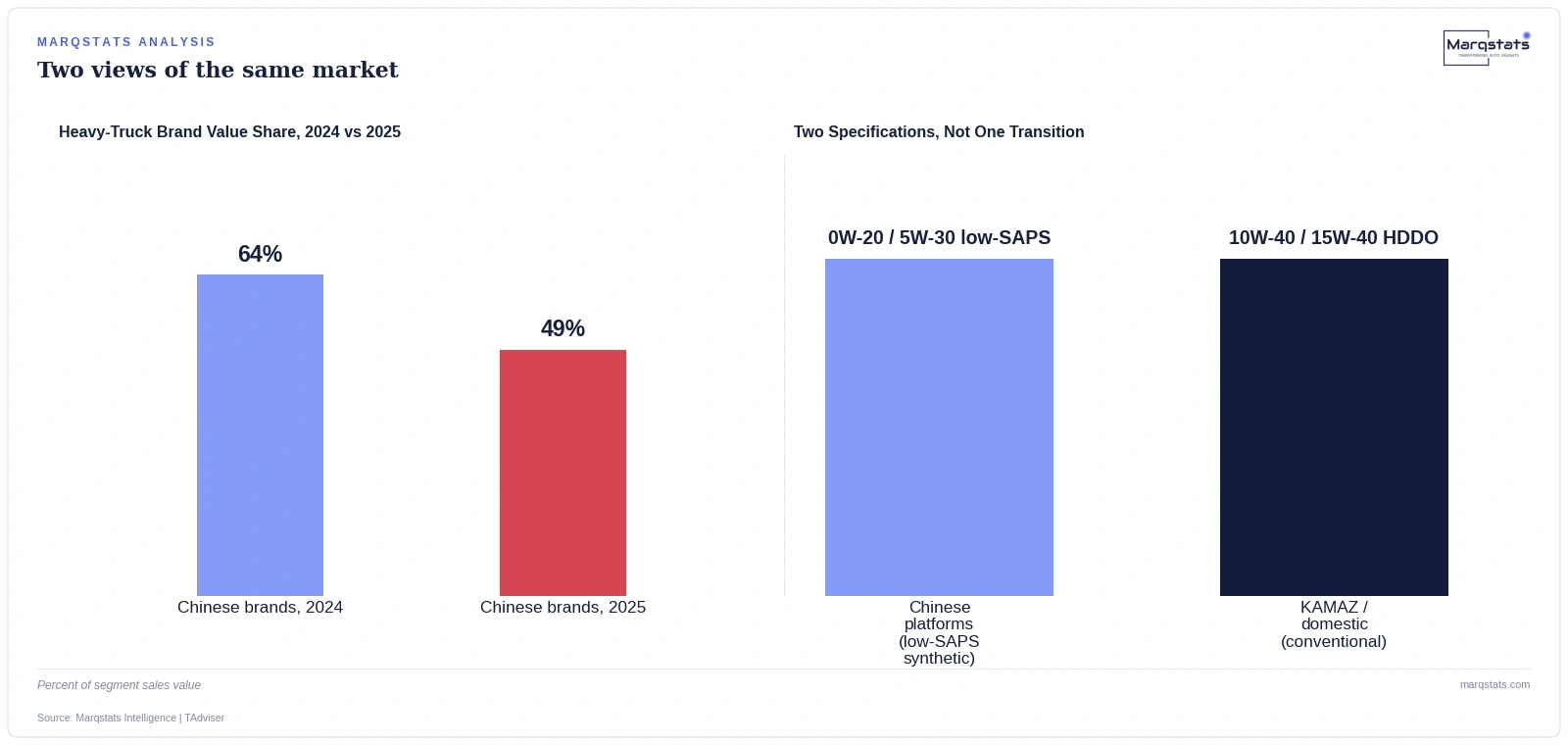
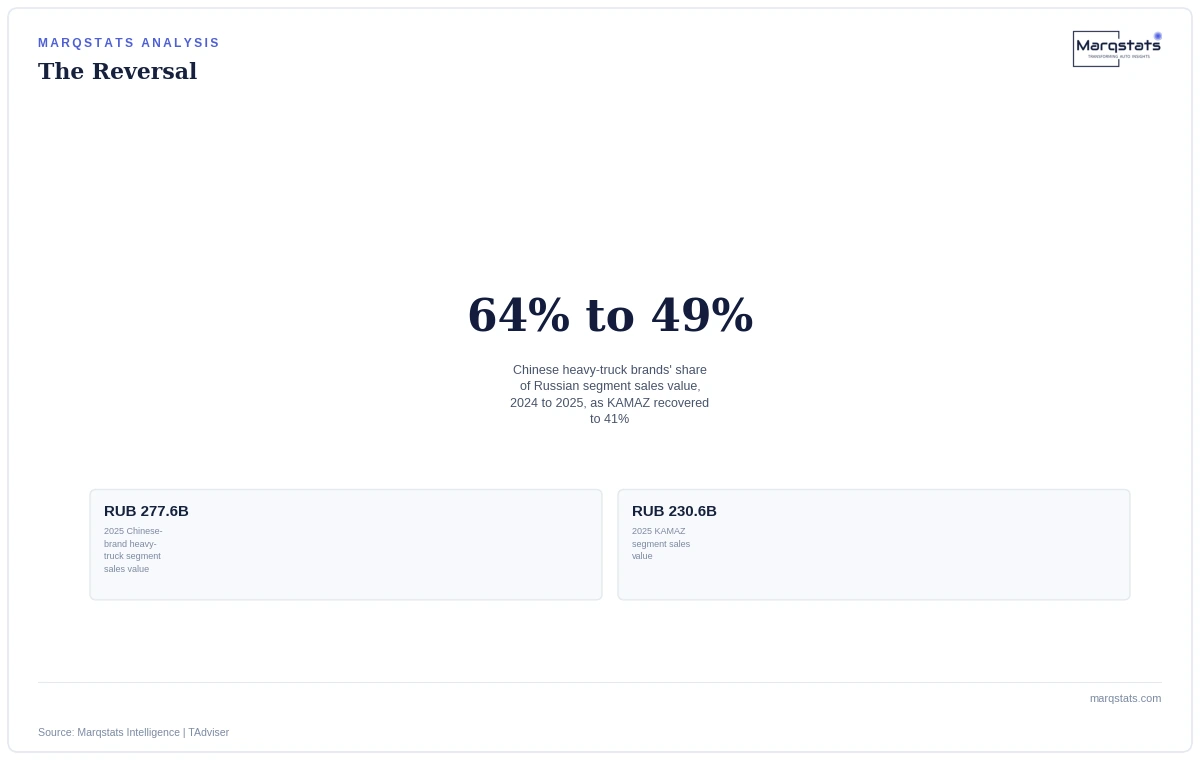
Chinese commercial truck brands, led by Sitrak, Shacman and FAW, captured 64% of Russia's heavy-commercial-vehicle segment sales value in 2024. In 2025 that share fell to 49%, still RUB 277.6 billion in value, as domestic manufacturer KAMAZ recovered to 41% of segment value, RUB 230.6 billion. Neither side of this swing is small.
Why This Matters More for Lubricant Blenders Than for Truck Dealers
A brand-share swing this size would matter to any parts supplier. For lubricant blenders specifically, it matters more, because Chinese and domestic heavy-truck platforms do not share a fluid specification.
Chinese heavy-truck platforms typically specify low-viscosity, low-SAPS synthetic formulations aligned with newer emissions architecture and modern common-rail diesel engines. KAMAZ and other established domestic heavy trucks continue to run on more conventional higher-viscosity HDDO grades built around legacy engine tolerances. A swing in brand share is not just a swing in whose badge is on the truck. It is a swing in which oil specification that truck's fleet manager needs to keep stocked.
What a Blender Actually Has to Do About It
The practical consequence is that neither side of this swing can be treated as the settled outcome. A blender that read 2024's 64% Chinese share as a permanent shift and cut back domestic-spec HDDO inventory would have been caught short within a year. The same is true in reverse: reading KAMAZ's 2025 recovery to 41% as evidence the Chinese wave has crested would be premature given how quickly the prior year's number moved.
The Safer Read: Plan for Both Specifications, Permanently
Russia's heavy-truck fleet is not transitioning from one specification family to another. It is running two specification families side by side, and which one dominates new sales in a given year is evidently volatile enough that betting the inventory plan on either one is a real risk. Extended eastward freight corridors toward China and Central Asia are lengthening average haul distances regardless of which brand wins a given year's sales, which means aggregate heavy-duty diesel oil demand keeps growing even as the specification mix underneath it keeps moving.