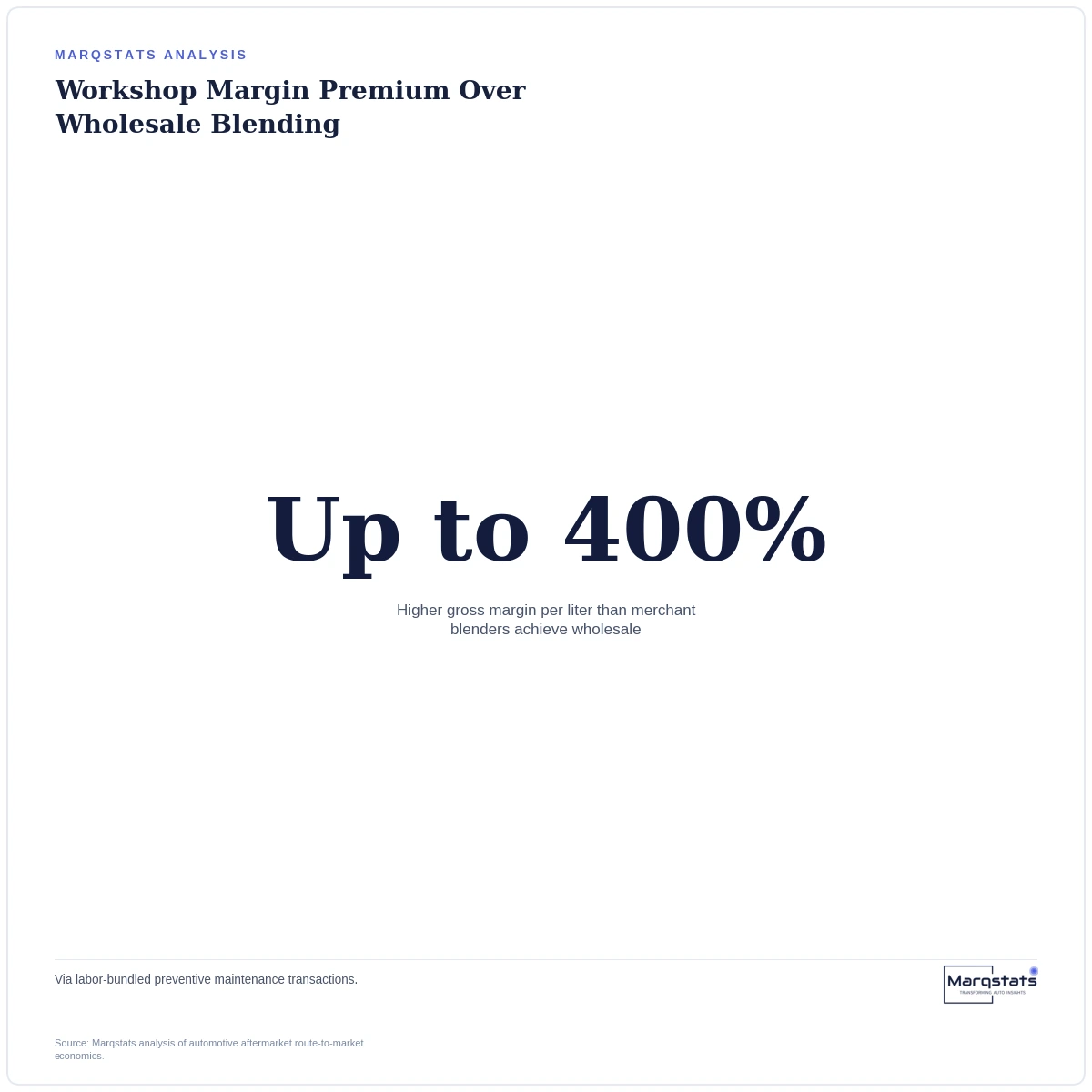
The shop that changes your oil can make 4 times more per liter than the company that made the oil
There's a genuine, quantified gap between what a lubricant manufacturer earns selling oil wholesale and what the workshop actually changing your oil earns on that same liter. It's a large enough gap that it reshapes where the smart capital in this industry is actually flowing.
Two very different businesses selling the same product
A merchant lubricant blender sells oil the traditional way: drums and intermediate bulk containers, shipped wholesale to distributors and workshops, competing on price against comparable products from other manufacturers. It's a genuinely commoditized transaction at that level, with margins constrained by competition and by the underlying cost of base oils and additives.
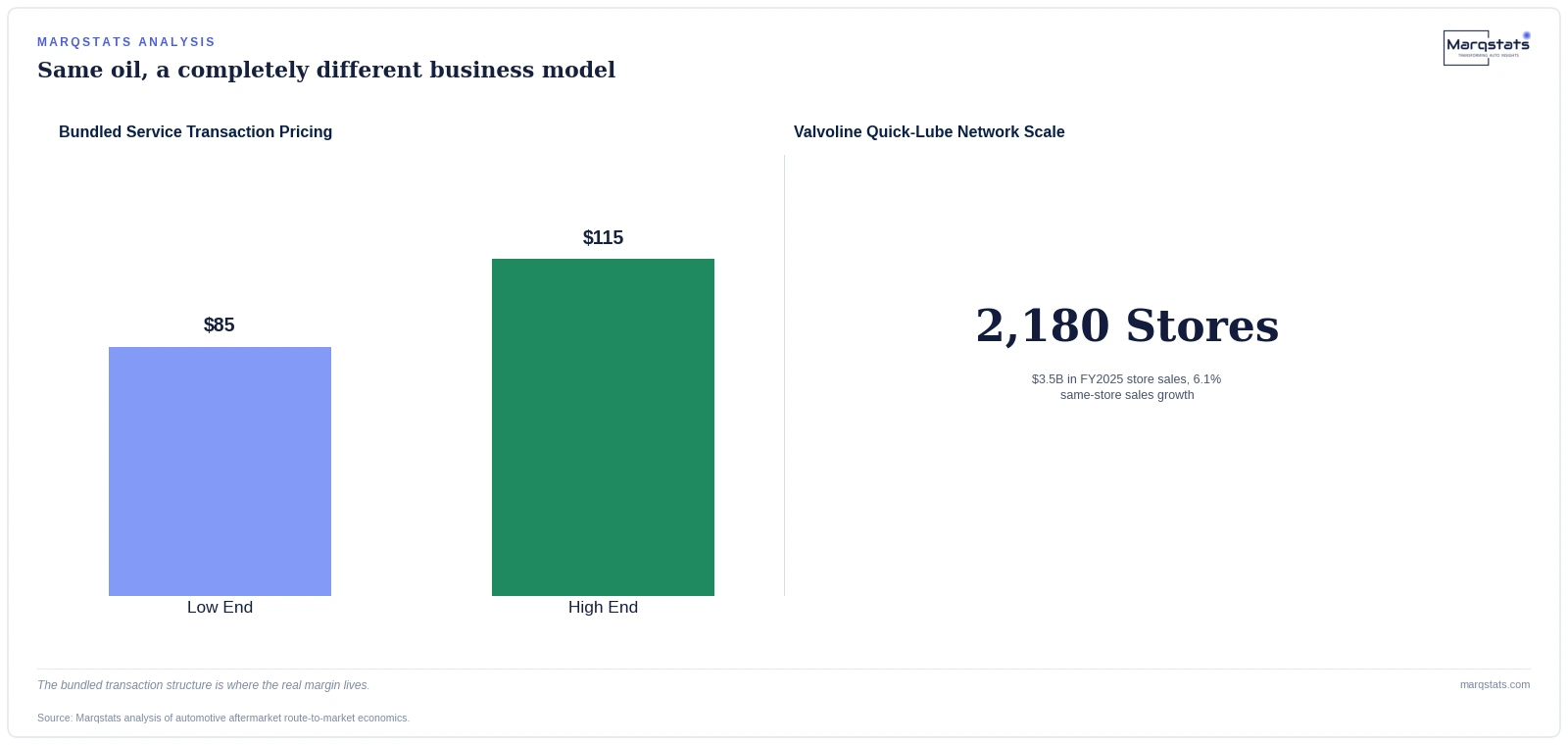
A franchised workshop or quick-lube chain sells something structurally different, even though the fluid inside the bottle is identical. By bundling 4.73 liters of fully synthetic crankcase oil with a filter exchange into a rapid drive-through service transaction, typically priced between $85 and $115, these operators achieve fluid-level markups exceeding 75%. That's not a modest premium - it's a fundamentally different pricing structure than wholesale distribution.
Same oil, same bottle. Completely different business model wrapped around it.
— Marqstats Analyst Team
Why customers pay it
The premium isn't simply price gouging that customers tolerate reluctantly. A bundled service transaction includes genuine value beyond the physical liters of oil: labor to actually perform the change, a filter exchange, a quick visual inspection, and the convenience of a 15-minute drive-through appointment that doesn't require the customer to source, transport and dispose of oil themselves. Customers are paying for a complete, convenient service outcome, not simply for a commodity liquid, and that service bundling is precisely what allows workshops to charge meaningfully more than the sum of the individual component costs.
What this looks like at real operational scale
This isn't a small, niche business model - it operates at genuine national scale. Valvoline Inc., after restructuring away from its blending assets, now operates as a downstream retail maintenance specialist with 2,180 system-wide quick-lube locations across North America, reporting $3.5 billion in store sales and 6.1% same-store sales growth in fiscal 2025. That's a company that made a deliberate strategic choice to focus specifically on the higher-margin downstream service layer rather than competing in wholesale blending.
Why this margin gap should reshape where capital flows in this industry
For anyone deciding where to allocate capital within the broader automotive lubricants aftermarket, this margin differential is a genuinely important signal. A dollar invested in downstream service capacity, additional quick-lube bays, franchise locations, drive-through infrastructure, appears to generate meaningfully higher returns per liter of oil handled than the same dollar invested in additional wholesale blending capacity. That's precisely why market entrants are increasingly advised to pursue asset-light business models, developing mobile or digital DIFM service fleets that serve commercial delivery fleets directly, bypassing traditional wholesale distribution channels entirely to capture this downstream margin from the start.
The counter-argument: doesn't the manufacturer still capture value through brand loyalty and repeat wholesale volume, even if per-liter margin looks smaller?
A fair objection is that comparing per-liter margin in isolation understates the manufacturer's actual position, since a strong wholesale brand can command premium pricing even within the wholesale channel, generate high repeat volume across thousands of workshop relationships, and benefit indirectly when its own brand is the one featured in a high-margin bundled service transaction at a franchised or co-branded location. This is a legitimate consideration, and brand equity genuinely does have real economic value that a simple per-liter margin comparison doesn't fully capture. What the comparison still usefully illustrates, though, is that the specific act of bundling labor with product, the transaction structure itself, is where the largest incremental margin actually gets captured, regardless of which brand's oil sits inside that bundled transaction, which is precisely why downstream service capacity specifically, not just brand strength, has become such an attractive target for capital allocation in this industry.
What this means for entrants and investors
- Capital allocators evaluating this industry should weight downstream service capacity, quick-lube bays and franchise locations specifically, given the documented margin advantage over wholesale blending capacity.
- New market entrants should consider asset-light, mobile or digital service models that capture this downstream margin directly, rather than competing in already-commoditized wholesale distribution.
- Established blenders should evaluate forward integration into direct-to-consumer service channels as a genuine strategic option, following the model demonstrated by companies restructuring toward retail maintenance operations.
The full market picture
Marqstats' complete global automotive lubricants aftermarket analysis, including the full route-to-market distribution channel breakdown, is available in the linked report below.
Related reportGlobal Automotive Lubricants Aftermarket Size, Share & Forecast 2026 – 2030