
A Rulebook That Already Existed
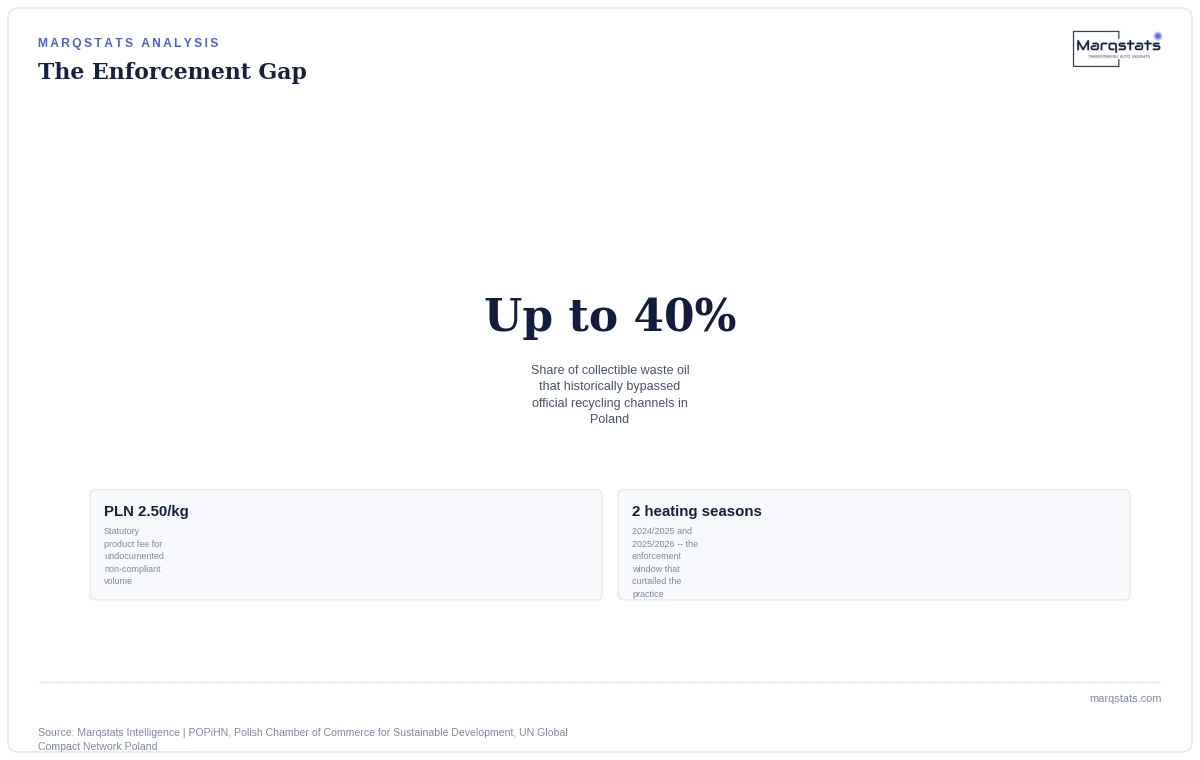
Poland's environmental law on used lubricants is not new. Extended Producer Responsibility rules have required a minimum 50% recovery and regeneration target for used oil for years, backed by a statutory product fee of up to PLN 2.50 per kilogram for undocumented non-compliant volume, and tracked through the BDO electronic waste registry, which requires a digital transfer record for every batch of waste oil leaving a workshop. On paper, the system was already built to catch this.
What Was Actually Happening
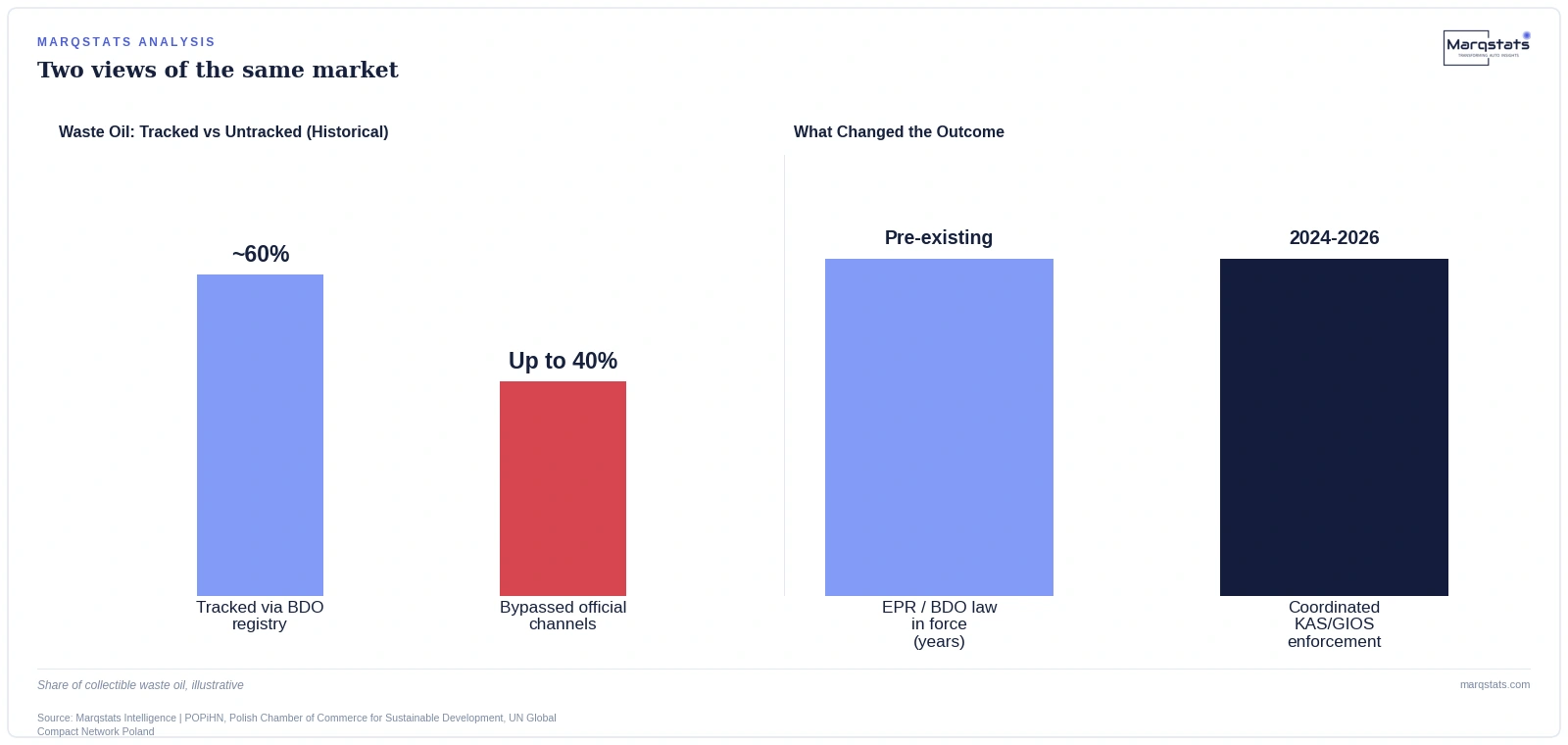
Research from POPiHN, the Polish Chamber of Commerce for Sustainable Development, and the UN Global Compact Network Poland found that up to 40% of collectible waste oil historically bypassed official recycling channels entirely. A meaningful share of that volume was burned illegally in small space heaters, in unmonitored workshops and agricultural buildings, concentrated in the winter heating season.
Why the Law Alone Didn't Stop It
A digital tracking requirement only works if someone checks the paperwork against the oil that actually moved. For years, the gap between what BDO records showed and what workshops were physically generating went largely unenforced at the point that mattered: small, informal garages and rural facilities where a drum of used oil quietly became winter heating fuel instead of a documented waste transfer.
What Changed: Enforcement, Not the Rulebook
Coordinated action by the National Revenue Administration (KAS) and the Chief Inspectorate of Environmental Protection (GIOS), backed by higher non-compliance fines, has curtailed unauthorized waste oil burning across the 2024/2025 and 2025/2026 heating seasons. The law did not change. What changed was that someone started checking, and started fining, at the scale needed to move behavior.
Where the Redirected Volume Is Going
This enforcement has pushed a meaningful volume of previously untracked used oil into authorized industrial re-refining capacity, including the ORLEN Poludnie plant in Jedlicze, which operates hydro-refining capacity able to regenerate used oil into circular Group II and Group II+ re-refined base oils. That is not a minor technical footnote: it is new, certified feedstock supply entering the domestic base-oil market at exactly the moment European circularity rules under the Renewable Energy Directive (RED III) are pushing blenders to secure high-viscosity-index re-refined base oil for ESG-driven purchasing requirements.
What This Means for Re-Refiners and Compliant Blenders
The practical takeaway: for re-refiners and blenders already investing in certified circular base-oil capacity, Poland's addressable feedstock supply is expanding for reasons that have nothing to do with new regulation and everything to do with enforcement finally catching up to rules that were already on the books. That is a more durable signal than a policy announcement, because it reflects volume that is measurably moving, not volume a new law merely promises to redirect.