A Number That Gets Repeated More Than It Gets Checked
It's one of the most common claims in EV marketing, and it's worth tracing back to where it actually came from before repeating it.
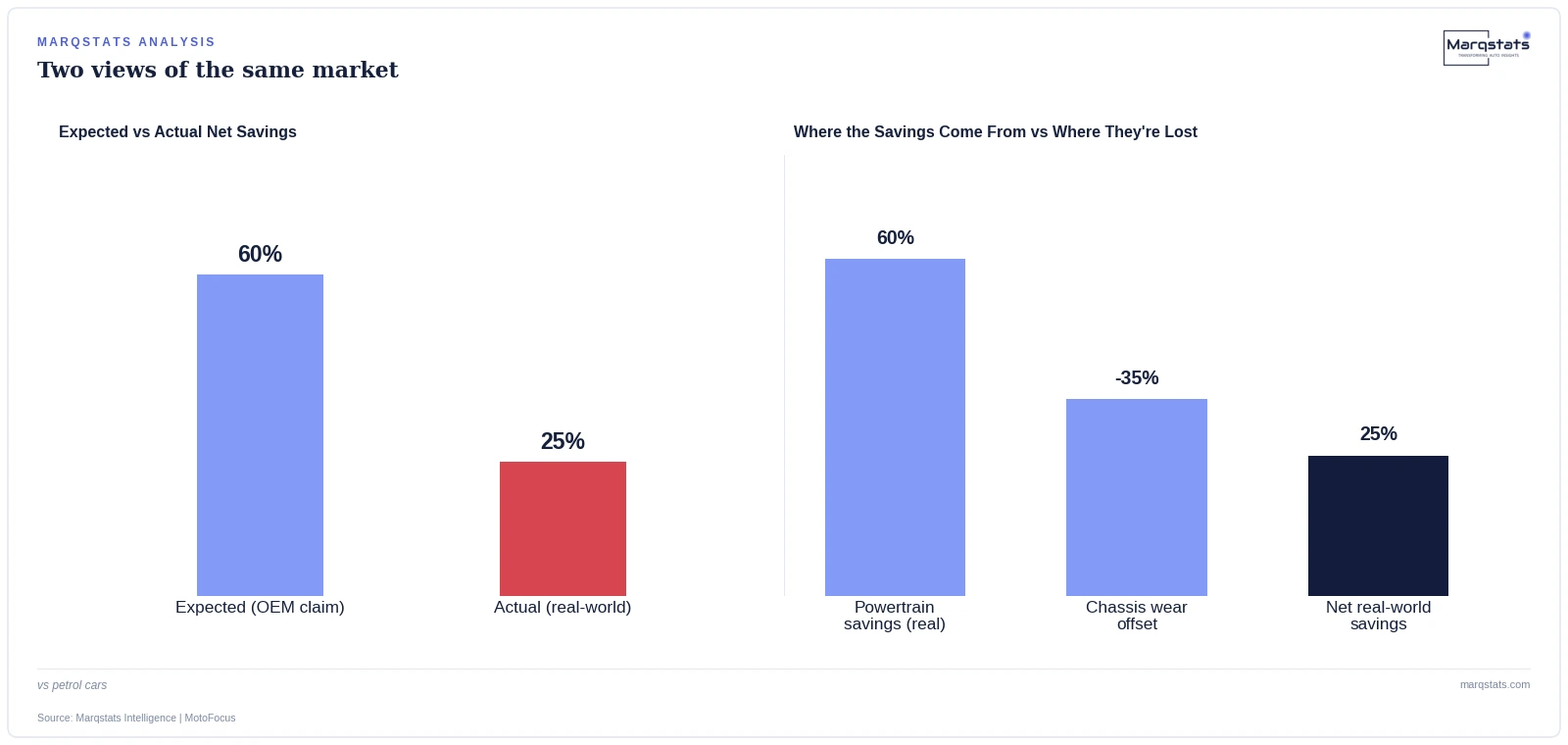
Electric vehicles, the pitch goes, cost 60% less to maintain than a comparable petrol car. That figure shows up in manufacturer brochures, sales conversations and plenty of secondhand market commentary across Poland. Real independent workshop data doesn't back it up.
What Polish Workshops Actually Record
These specific figures trace directly to the underlying research's own compiled workshop data, not a marketing estimate.
The 60% figure resolves back to early OEM whitepapers -- manufacturer-published estimates based on eliminated engine oil changes, spark plugs, timing belts and exhaust servicing. Real-world data compiled by MotoFocus from actual Polish independent workshop billing shows net savings closer to 20% to 30%, roughly half of what the original claim suggested.
Where the Other 35% Actually Goes
The gap isn't a measurement error -- it traces to a specific, physical cause the powertrain-only comparison never accounted for.
BEVs carry substantial additional weight from their traction battery packs, and electric motors deliver instant torque from a standstill. Both factors combine to accelerate tire and suspension component wear by roughly 35% compared to an equivalent petrol car. The powertrain side of the ledger really does show the savings manufacturers advertise -- no oil changes, no spark plugs, no timing belt replacements. But the chassis side of the ledger works against it, and the original 60% figure only ever counted one side.
Why This Isn't an Argument Against EV Ownership
A smaller savings number is still a real savings number -- the correction here is about accuracy, not about reversing the conclusion.
A 20% to 30% real-world maintenance saving is still a genuine, meaningful advantage over a petrol car -- it just isn't the 60% figure still circulating in sales conversations and older marketing material. Prospective buyers comparing total cost of ownership deserve the accurate number, not the more flattering one.
The same pattern applies in reverse for plug-in hybrids specifically, which carry the full combustion maintenance schedule on top of high-voltage diagnostics rather than replacing it -- meaning a PHEV buyer expecting EV-level savings from the electric side of the powertrain should budget closer to petrol-car maintenance costs overall, not the reduced figure often associated with electrification broadly.
What This Means for Buyers and Workshops
The practical takeaway: EV buyers and sellers in Poland should budget and market around a 20% to 30% real-world maintenance saving specifically, and workshops quoting service costs should set expectations using actual billing data rather than the older 60% figure still circulating from early OEM materials.