
A Market Moving One Way, and One Engine Moving the Other
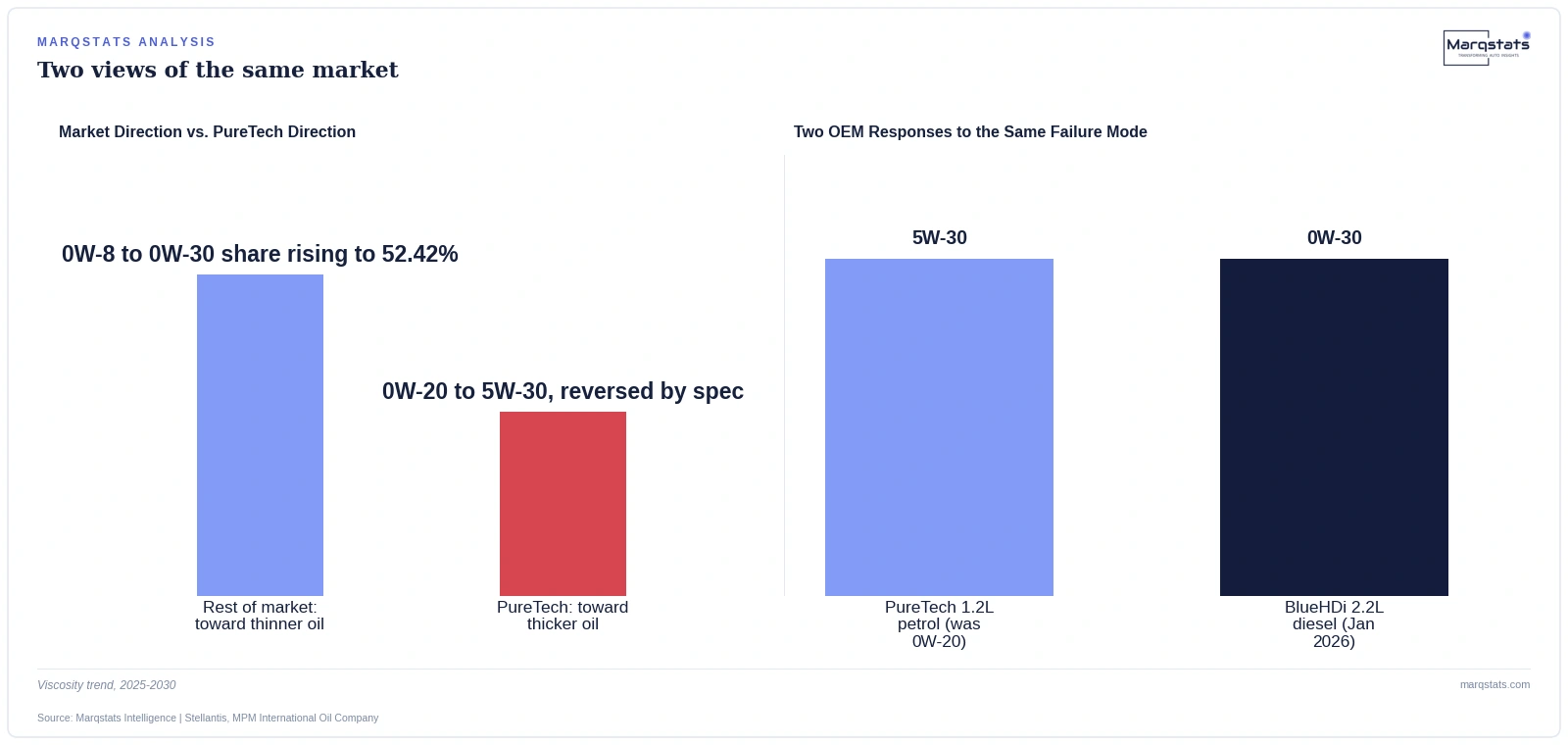
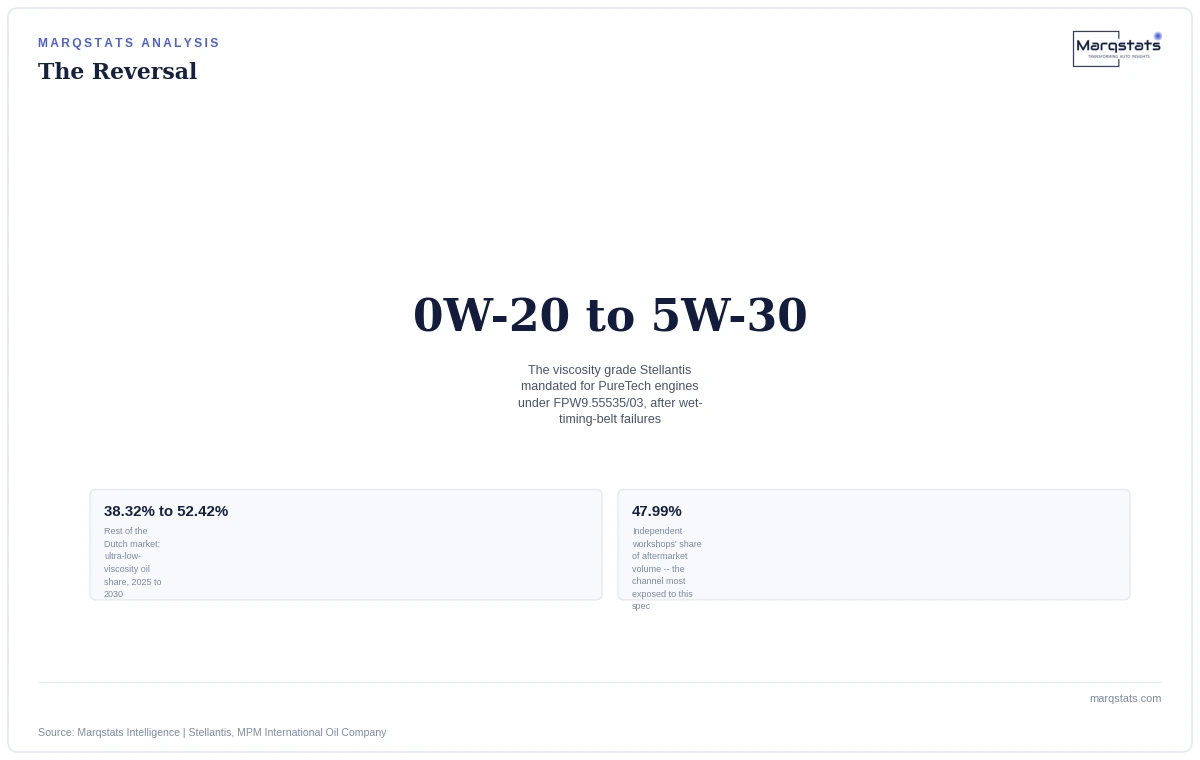
Across the Dutch aftermarket, the direction of travel is unmistakable. Ultra-low-viscosity oils, grades as thin as 0W-8, are rising from 38.32% of volume in 2025 to 52.42% by 2030, pushed by WLTP fuel-efficiency targets and OEM downsizing. One widely sold engine family just went the opposite way, and a mechanical failure, not a regulation, is why.
Where the Failure Starts
Stellantis' 1.2-litre PureTech engine, fitted across a large share of the group's small and mid-size European models, runs its timing belt submerged in engine oil rather than in a dry housing. The design saves space and reduces friction under normal conditions.
It also means the belt's elastomer compound is in constant contact with whatever oil is in the sump. Using an incorrect or degraded oil can cause that elastomer to soften, swell or delaminate. The resulting debris clogs the oil pickup strainer, starving the engine of oil pressure and risking catastrophic failure, not a routine repair.
The Fix Runs Against the Trend
Stellantis had originally recommended a 0W-20 grade for the PureTech engine, in line with the industry-wide push toward thinner oils. Following the wet-belt failures, the company introduced a dedicated specification, FPW9.55535/03, mandating a 5W-30 oil instead, across both dealer and independent service networks. That is a move toward a thicker, not thinner, oil, at the exact moment the rest of the market is shifting the other way.
Why the Independent Channel Cannot Ignore It
Independent workshops handle 47.99% of Dutch aftermarket volume, the largest single channel, and they serve exactly the older, post-warranty vehicles most likely to be running a PureTech engine past its original service plan. A garage that defaults to a generic 0W-20 synthetic on a PureTech car, because that is what the shelf stocks for most modern engines, risks accelerating the same belt degradation the specification change was meant to prevent.
A Second Response, From a Different Angle
The same mechanical vulnerability shows up in Stellantis' commercial diesel line. In January 2026, blender MPM International Oil Company launched MPM 05000SPC, a 0W-30 oil engineered specifically for 2.2-litre Stellantis BlueHDi commercial diesel engines, aimed at mitigating both timing-belt degradation and particulate-filter clogging in high-load vans. Two different viscosity responses, one from the OEM and one from an independent blender, converging on the same underlying failure mode.
What This Means for Blenders and Garages
The practical takeaway: workshops need to treat OEM-specific viscosity mandates as overriding the general trend toward thinner oils, and blenders should expect more of these narrow, engine-specific specifications as wet-belt and other close-tolerance designs proliferate, not fewer.