The Claim That Changes Everything
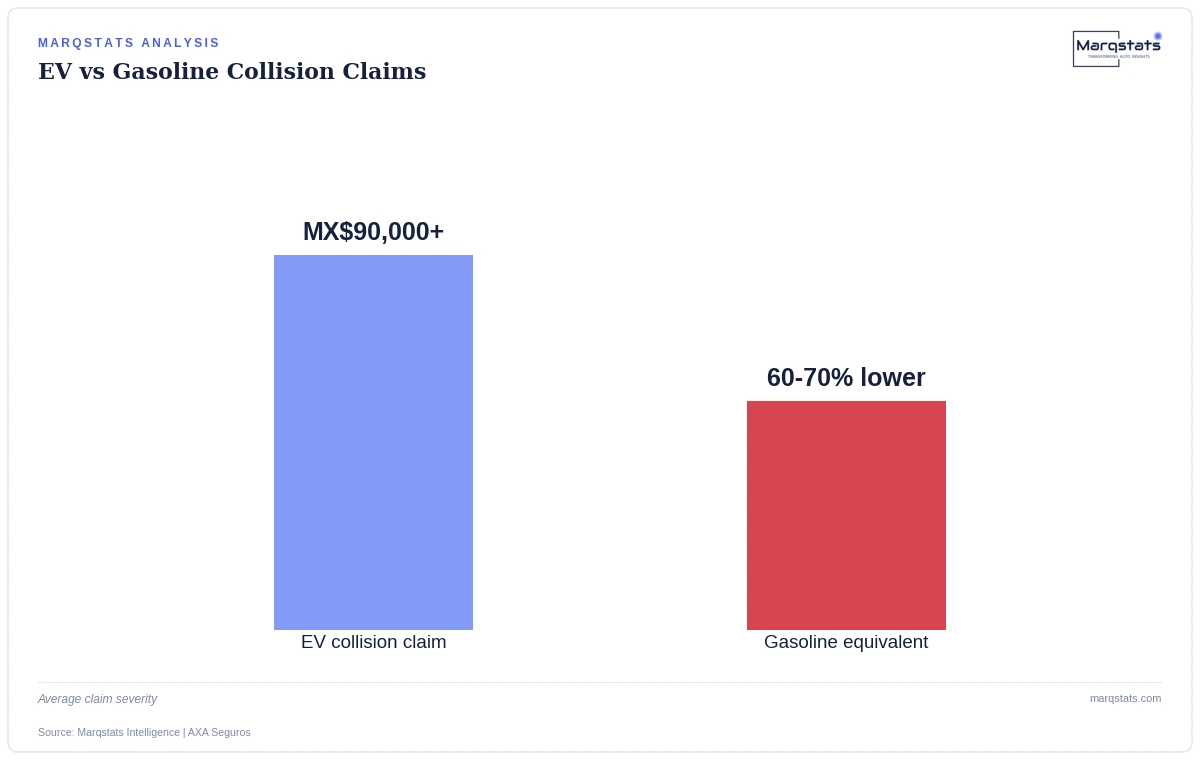
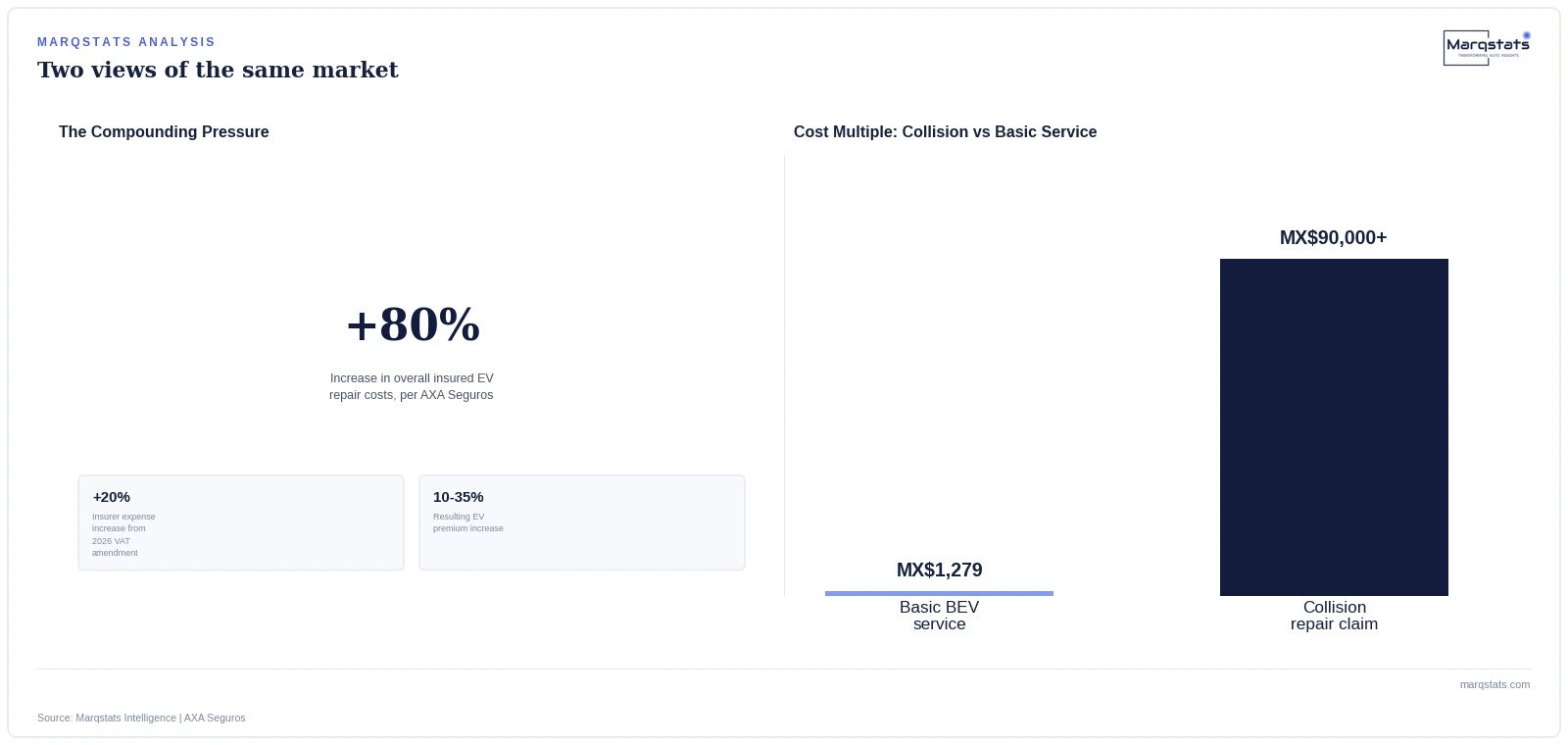
In brief: AXA Seguros S.A. de C.V., one of Mexico's major insurers, published its own EV collision repair and claims severity study in August 2026. The finding was stark — complex EV collision claims average over MX$90,000, a full 60% to 70% higher than equivalent gasoline-vehicle claims.
Why EV Collision Repair Costs So Much More
The driver is specific and structural: most EV manufacturers enforce total-pack replacement policies rather than allowing module-level or cell-level repair after significant collision damage. A relatively contained impact that might require a localized repair on a gasoline vehicle can trigger a full battery pack replacement on an EV — and imported battery packs and ADAS sensor components carry genuinely substantial costs.
How Insurers Are Actually Responding
A car crash used to total the bumper. Now it can total the battery.
— Marqstats Analyst Team
AXA Seguros's response has been two-pronged: raise premiums to reflect genuine claims experience, and simultaneously demand local module repair standards from the repair industry — pushing toward repair options that don't automatically default to full pack replacement for every significant incident. This second part matters as much as the premium increase itself: it's a direct attempt to change the cost structure driving claims severity, not just price around it.
The Fiscal Policy Layer Making This Worse
A 2026 amendment to the Ley del Impuesto al Valor Agregado compounds this pressure directly: by treating insurance VAT as an unrecoverable operational cost, the change increased insurer expenses by 20%, pushing EV insurance premiums up an additional 10% to 35% on top of the underlying claims-severity pressure.
A Named Comparison: Why This Differs From Standard ICE Underwriting
Conventional gasoline-vehicle collision underwriting has decades of accumulated claims data and a mature, standardized repair ecosystem with clear parts and labor cost benchmarks. EV collision underwriting in Mexico is still being built in real time, with insurers like AXA actively shaping repair standards rather than simply pricing around an already-established industry norm — a genuinely different, more active role than insurers typically play in a mature vehicle category.
Why This Trend Is Likely to Continue
Nothing in the underlying data suggests this pressure is temporary. The fleet of EVs on Mexican roads is still expanding rapidly, meaning the pool of vehicles eventually generating collision claims will keep growing too, and the imported-component cost structure driving claim severity has no clear near-term resolution absent the kind of local module-repair standards AXA is now actively pushing for.
What This Means for EV Owners and Fleet Operators
The practical takeaway: anyone budgeting for EV ownership or fleet operation in Mexico should treat collision insurance premium trajectory as a genuinely dynamic, still-rising cost line — not a fixed assumption based on current pricing — given both the underlying claims-severity pressure and the compounding fiscal policy change working in the same direction.