
A Savings Number That Comes With Fine Print
This isn't a flaw in the 70% figure itself — it's a completely accurate result for the usage pattern it was measured under. The issue is only ever in how a single headline number gets applied without checking whether it actually matches the situation it's being used to justify.
TIP Mexico's own fleet operational data shows electric vehicles can deliver 70% running-cost savings compared to gasoline equivalents. That's a genuinely compelling number for any fleet operator evaluating electrification. It also comes with a specific condition most headline summaries leave out.
The Threshold That Makes the Math Work
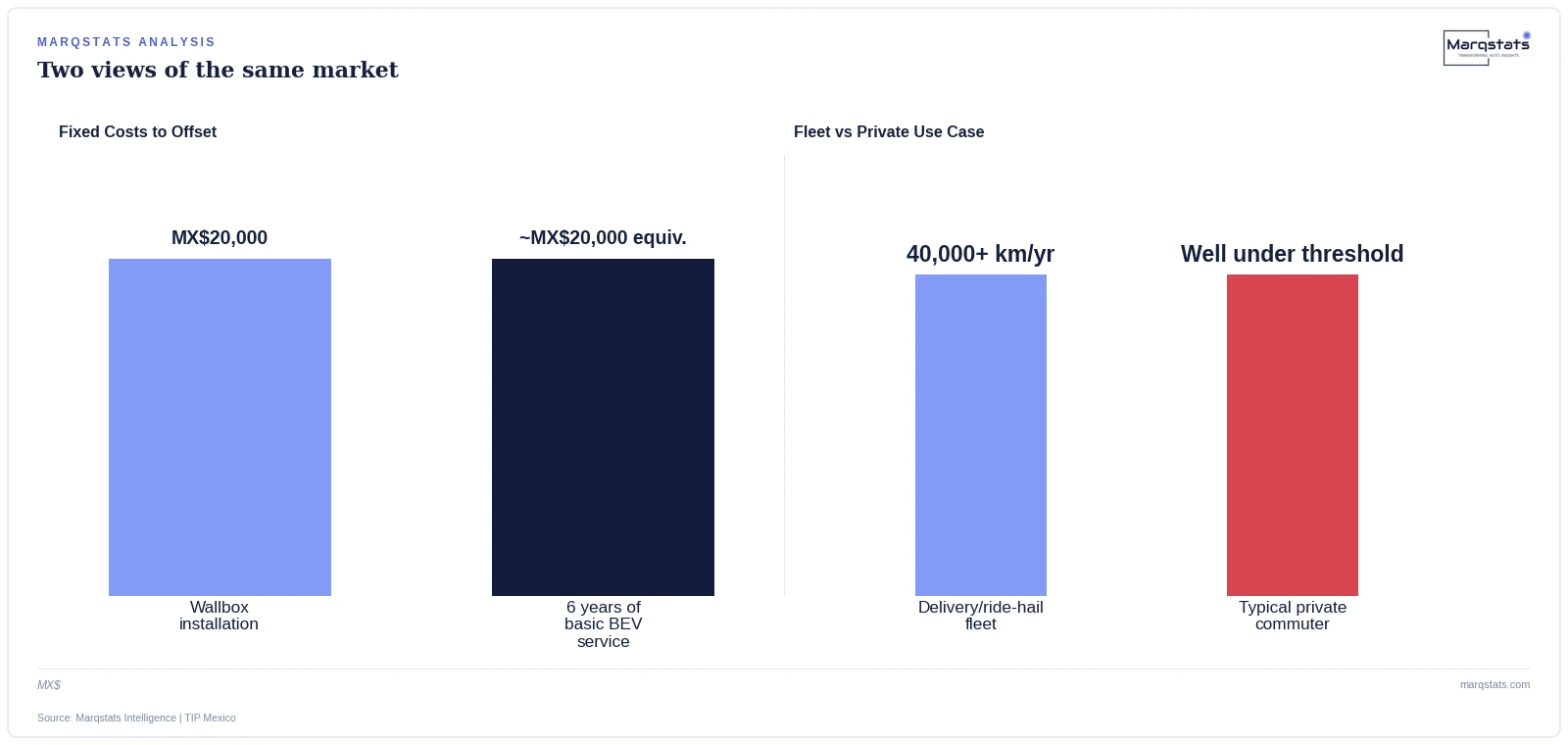
That 70% savings figure is only achievable above 40,000 annual kilometers of use. Below that threshold, the math looks meaningfully different — because the savings have to absorb two specific fixed costs first.
The Two Fixed Costs Doing the Absorbing
The first is the higher initial insurance premium EVs currently carry in Mexico, itself elevated by claims severity and a 2026 VAT policy change. The second is the home wallbox charger installation cost, averaging MX$20,000 upfront — a fixed capital outlay that, on its own, exceeds six years of basic preventative BEV servicing menu fees.
Why High-Mileage Use Changes the Calculation
Both of these costs are fixed, one-time or annual expenses that don't scale with how much a vehicle is actually driven. A vehicle covering 40,000-plus kilometers a year spreads that fixed cost across enough usage that the per-kilometer savings from lower fuel and maintenance costs genuinely overwhelm it. A vehicle covering far fewer kilometers annually is still carrying the same fixed costs, just without enough usage volume to offset them as effectively.

A Named Comparison: Fleet Use vs Private Ownership
This threshold matters far more for fleet and commercial use than for typical private ownership specifically because commercial vehicles are the ones genuinely capable of hitting 40,000-plus kilometers annually — delivery vans, ride-hailing vehicles, service fleets. A private commuter vehicle averaging a fraction of that mileage is a fundamentally different economic case, one where the same 70% savings figure simply doesn't apply in the same way.
The Segments Most Likely to Clear the Bar
Ride-hailing vehicles, last-mile delivery vans, and dedicated service fleets are the most obvious candidates for reliably exceeding 40,000 kilometers annually in Mexican urban markets, which is exactly why VEMO and similar operators have focused their earliest hub deployments on exactly these use cases rather than broader consumer charging.
What This Means for Anyone Evaluating Fleet Electrification
The practical rule for Mexican fleet operators: model total cost of ownership against actual projected annual mileage specifically, rather than applying a headline savings percentage uniformly. A fleet segment reliably clearing 40,000 km a year is a strong electrification candidate on cost grounds alone. A lower-mileage segment needs a more careful case built on factors beyond running costs.