
The Number Everyone Cites
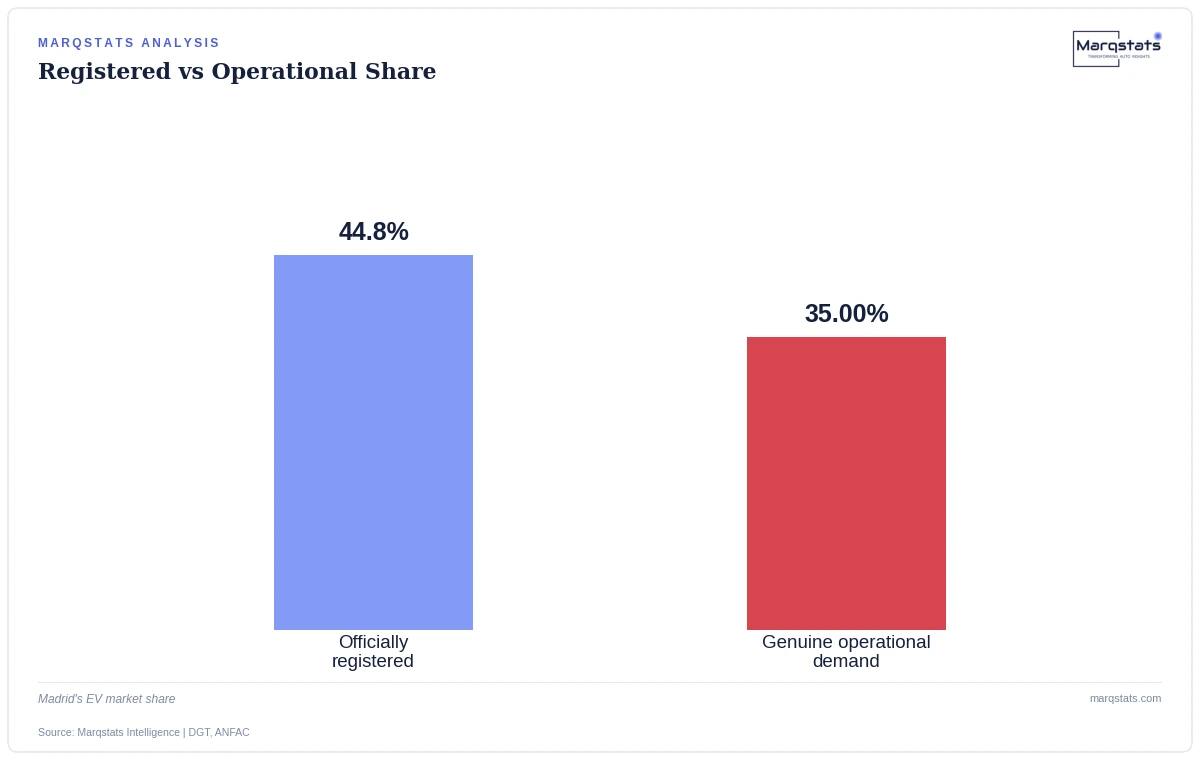
Open any summary of Spain's electric vehicle market and you'll find the same statistic: the Community of Madrid accounts for 44.8% of the country's electrified vehicle registrations, per data compiled by the Directorate-General for Traffic (DGT) and published by the Spanish Association of Automobile and Truck Manufacturers (ANFAC). It's a genuinely striking number — nearly half of Spain's entire electrified fleet, concentrated in one region.
It's also, for anyone planning workshop capacity, parts inventory or diagnostic equipment investment by region, the wrong number to use.
Why Registration Address Isn't Operating Address
Spain's major automotive leasing companies, long-term corporate rental (renting) operators, and short-term car rental firms are headquartered in Madrid — not because that's where their vehicles drive, but because Madrid offers favorable regional tax policies and municipal vehicle tax (IVTM) rates. These companies register their fleets centrally in Madrid, then distribute the actual vehicles across commercial branches, logistics corridors and regional delivery hubs nationwide.
Doing the Reconciliation
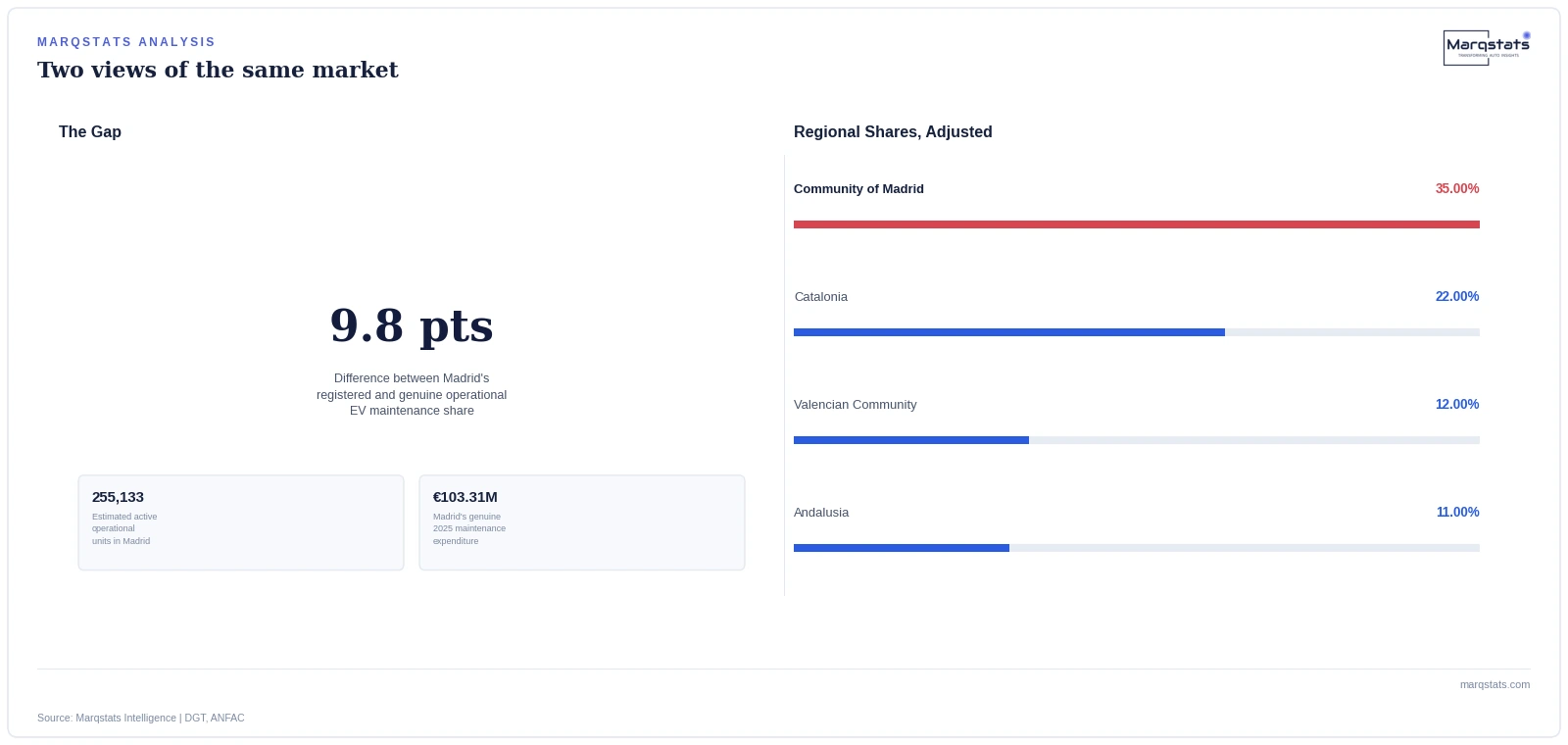
Adjusting registration figures to reflect circulating operational fleets — where vehicles actually generate maintenance demand, not where their paperwork sits — brings Madrid's genuine share down to 35.00% of national EV maintenance expenditure. Still the largest single region. Still a meaningful lead. But a materially smaller one than the headline registration statistic implies, and the difference matters for anyone making a capital allocation decision based on it.
Who Actually Gets This Wrong
This isn't a hypothetical risk. A parts distributor sizing regional warehouse capacity, a diagnostic equipment supplier planning technician training rollouts, or a fast-fit chain deciding where to open its next dedicated EV service bay would all, if they used raw DGT registration data directly, systematically over-invest in Madrid itself and under-invest in the corridors and cities — across Catalonia, the Valencian Community, Andalusia and beyond — where leased and rental vehicles registered in Madrid actually spend their operating lives.
The Scale This Represents in Practice
Madrid's estimated 255,133 active operational units still represent Spain's single largest regional maintenance opportunity by a comfortable margin over Catalonia's estimated 160,369 units — the correction narrows Madrid's lead, it doesn't erase it. The point isn't that Madrid is overrated as a market; it's that the specific magnitude of its lead was overstated by a registration statistic that measures something other than what most readers assume it measures.
A Named Comparison: This Pattern Recurs Across Markets
Corporate fleet-titling distortion isn't unique to Spain. Comparable registration-versus-operational gaps show up wherever a country's commercial vehicle-titling rules create a tax or fee incentive to register centrally rather than locally — the specific mechanism differs by market, but the underlying lesson is consistent: a region's registration share and its genuine service demand are two different numbers, and conflating them is one of the more common sizing errors in regional automotive aftermarket planning.
Why This Distortion Specifically Concentrates in Madrid
Not every Spanish region shows this pattern, and that's itself informative. Catalonia, the Valencian Community and Andalusia all show registration shares that broadly track their genuine population and economic activity — because none of them offer the specific combination of favorable corporate tax treatment and municipal vehicle tax rates that makes centralized fleet titling in Madrid specifically worthwhile for a national leasing or rental operator. The distortion is a function of Madrid's particular tax environment, not a general feature of how Spanish vehicle registration works everywhere.
What This Means for Capacity Planning
The practical fix isn't complicated once you know to look for it: treat registration data as a starting point requiring adjustment, not a direct proxy for operational demand, and weight actual population density, freight-corridor traffic and metropolitan commuter patterns alongside it when allocating workshop, parts or diagnostic capacity regionally.