
Oil volume will barely grow through 2030. Revenue will grow $11 billion anyway.
In brief:
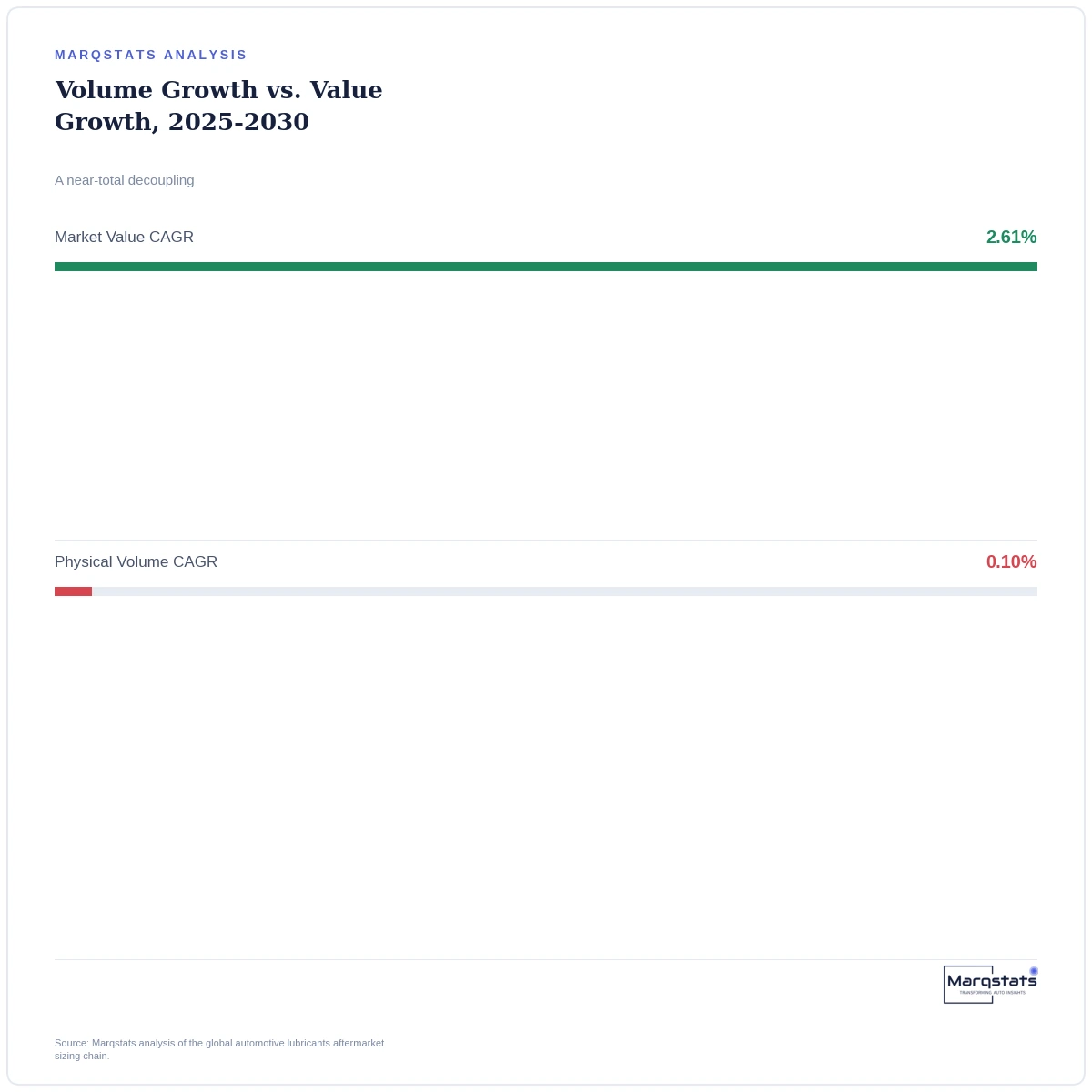
- Global automotive lubricants aftermarket volume grows from 20.508 to just 20.608 million metric tonnes by 2030, a 0.10% CAGR.
- Market value grows from $79.858 billion to $90.858 billion over the same period, a 2.61% CAGR.
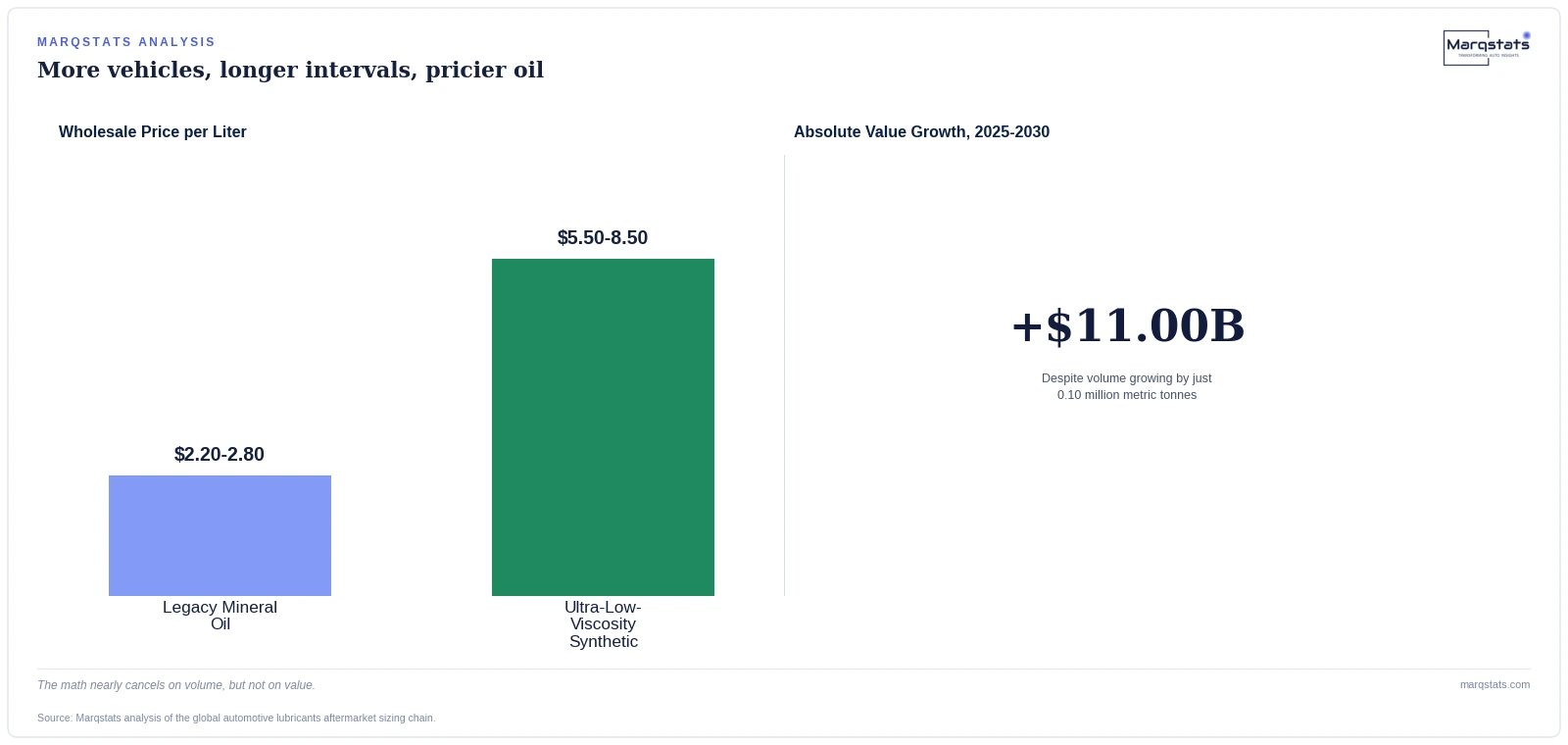
- Fully synthetic oils sell for $5.50 to $8.50 per liter, compared to $2.20 to $2.80 for legacy mineral oils.
A market can grow in dollars without selling meaningfully more of the underlying product. The global automotive lubricants aftermarket is a clean, well-documented example of exactly that pattern playing out over the next five years. Most industry commentary still treats volume and value as if they move together. Here, they've genuinely split apart.
Why volume is staying flat even as the vehicle fleet grows
The global on-road motorized fleet is expanding from 1.42 billion vehicles in 2025 toward 1.55 billion by 2030, a genuine, substantial increase in the number of cars, trucks and motorcycles that need oil changes. Despite that fleet growth, total lubricant volume barely moves. The explanation is extended oil drain intervals: catalytic hydrocracked Group III and synthesized polyalphaolefin base oils have pushed passenger car service intervals from a legacy cadence of 5,000 kilometers to current thresholds of 15,000 to 25,000 kilometers, and heavy commercial trucking now regularly exceeds 100,000 kilometers between changes.
More cars on the road, changing oil less often. The math nearly cancels out.
— Marqstats Analyst Team
Where the $11 billion actually comes from
If volume isn't growing, value growth has to come from price. That's exactly what's happening. Ultra-low-viscosity synthetic grades, the SAE 0W-20, 0W-16 and 0W-8 formulations increasingly required to meet fuel economy and emissions specifications, carry wholesale realization levels between $5.50 and $8.50 per liter. Legacy Group I and Group II mineral oils, by comparison, generate only $2.20 to $2.80 per liter. A liter of oil sold today, on average, commands meaningfully more revenue than the same liter would have a decade ago, even though it's doing the same basic job of lubricating an engine. That's a meaningfully different business than the one this industry ran a decade ago.
Why this isn't a temporary pricing anomaly
It's worth being clear that this isn't simply inflation or opportunistic pricing. The premium reflects genuine, regulator-mandated chemical complexity. ILSAC GF-7, which opened commercial licensing on 31 March 2025, requires engine oils to maintain Low-Speed Pre-Ignition suppression after severe thermal aging and fuel exposure across extended drain intervals, a materially stricter requirement than the fresh-oil-only testing that satisfied the prior GF-6 standard. Meeting that bar requires more sophisticated, more expensive base stocks and additive packages than legacy mineral formulations can deliver, which is precisely why mineral oils are contracting at a negative 4.35% annual rate while fully synthetic formulations expand at 6.87% annually, on track to capture 49% of total market value by 2030.
Why this pattern matters beyond this one market
This value-volume decoupling pattern is worth recognizing because it shows up whenever a mature physical product category faces a combination of extending product lifespan and rising regulatory performance requirements simultaneously. A market participant who only tracks unit volume, or who assumes dollar growth requires proportional volume growth, will systematically misread what's actually happening here: this is a market getting more valuable specifically because it's being asked to do more, chemically, with each individual liter sold.
The counter-argument: could extended drain intervals eventually erode value growth too, not just volume?
A fair question is whether the same dynamic pushing drain intervals longer, and therefore volume flatter, might eventually also compress pricing power, if consumers or fleet operators start viewing fewer, larger purchases as a reason to negotiate harder on price per liter. This is a reasonable consideration, and it's not entirely hypothetical: commercial fleet buyers already negotiate aggressively on bulk tender contracts. What appears to be holding up value growth despite this pressure is that the extended intervals themselves depend on the more expensive synthetic chemistry remaining in the oil, meaning buyers can't simply demand cheaper oil at the same extended interval without also accepting a shorter service life, a trade-off that keeps the premium chemistry commercially necessary rather than optional.
What this means for blenders, distributors and investors
- Blenders and distributors should track dollar-per-liter realization rates as the primary growth metric for this market, rather than unit volume, given how structurally decoupled the two have become.
- Investors evaluating this market should weight exposure toward fully synthetic and specialty formulation capacity specifically, since this is where nearly all forecast value growth is concentrated.
- Market participants relying on legacy Group I and Group II mineral oil production should treat the negative 4.35% annual contraction rate as a structural, regulation-driven decline rather than a cyclical downturn.
Where the volume that does exist is actually concentrated
It's worth being specific about which vehicles actually consume the flat-but-substantial volume this market still represents, since the answer isn't evenly distributed across the fleet. Heavy commercial vehicles account for 32.00% of global aftermarket economic value but a disproportionate 42.10% of total physical fluid volume, despite comprising under 8% of total motorized vehicles in operation. Class 8 diesel engines require 30 to 45 liter crankcase sumps, an order of magnitude larger than a typical passenger car's 3.5 to 5.5 liter sump, and even as these engines transition toward API PC-12 specifications, the underlying physical volume requirement per vehicle remains substantial.
This concentration matters for understanding where volume-based demand genuinely persists within an otherwise flattening market: heavy commercial trucking, not the much larger passenger car fleet, functions as the volumetric backbone of the entire industry, even though passenger cars generate the largest single share of dollar value.
How fleet aging works as a genuine buffer against further volume decline
A separate, related dynamic works to keep volume from declining even further than the near-flat trajectory this market shows. The average age of light vehicles in operation climbed to a historic high of 12.6 years in North America by 2025, with European fleets close behind at 12.3 years. Older internal combustion engines exhibit higher mechanical clearances and increased ring wear, meaning they consume approximately 1.2 to 1.5 liters of supplementary top-up oil between scheduled workshop flushes, on top of the oil replaced during those scheduled services. This creates a secondary retail jug market that specifically cushions overall volume from the market penetration of new battery-electric vehicle sales, since a vehicle that stays on the road longer keeps generating this top-up demand regardless of how many new EVs enter the market alongside it.
What the downstream service margin adds on top of the manufacturing story
The value story doesn't stop at the wholesale blending level, either. Franchised workshops and fast-lube service providers capture up to 400% higher gross margins per liter than merchant lubricant blenders achieve through wholesale drum shipments, by bundling 4.73 liters of fully synthetic crankcase oil with a filter exchange into a rapid drive-through service transaction priced at $85 to $115. That downstream markup layer, largely insulated from upstream crude oil and base stock price volatility, represents a second, distinct value-capture mechanism sitting on top of the manufacturing-level premiumization already discussed.
Put together, the two mechanisms compound: blenders capture more dollars per liter by shifting toward synthetic chemistry, and service providers capture disproportionately more margin on top of that already-elevated price point through bundled labor transactions. Neither mechanism alone fully explains the market's value trajectory - it's the combination of manufacturing-level premiumization and downstream service-level margin capture that produces the full $11.00 billion in forecast value expansion.
The full market picture
Marqstats' complete global automotive lubricants aftermarket analysis, including the full segmentation and three-scenario forecast through 2030, is available in the linked report below.
Related reportGlobal Automotive Lubricants Aftermarket Size, Share & Forecast 2026 – 2030