A Registration Rule That Quietly Changes the Numbers
The Philippines' EVIDA law extends tax privileges to a broad category of "electrified vehicles." That category includes pure battery electric vehicles (BEVs). It also includes non-plug-in hybrid electric vehicles (HEVs) — cars that still run a conventional internal combustion engine alongside a small electric assist motor, with no plug and no traction battery large enough to drive the car on electricity alone.
The Land Transportation Office groups both under the same registration umbrella. That administrative choice has a real, measurable consequence for how the EV maintenance market actually looks.
What Gets Hidden in the Aggregate Number
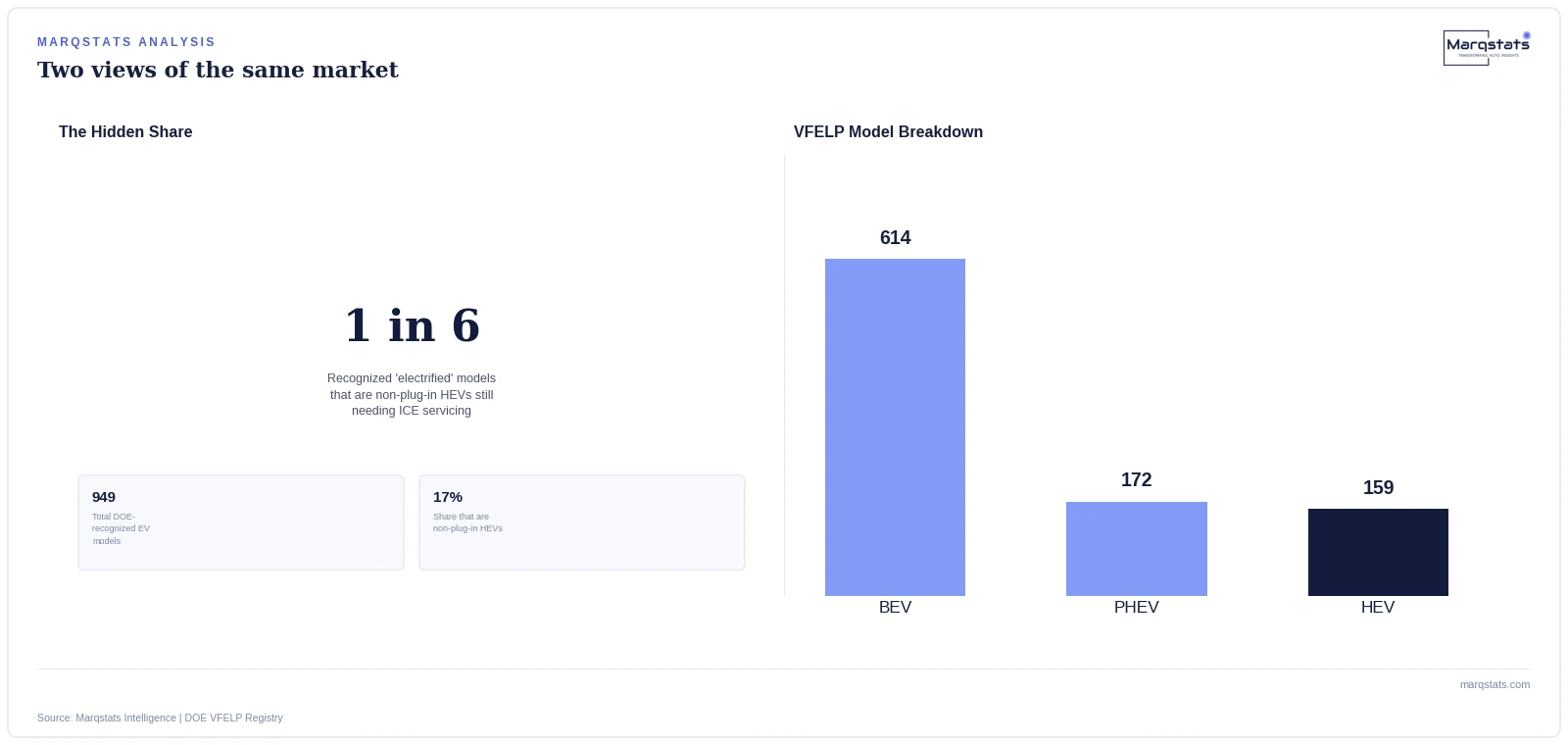
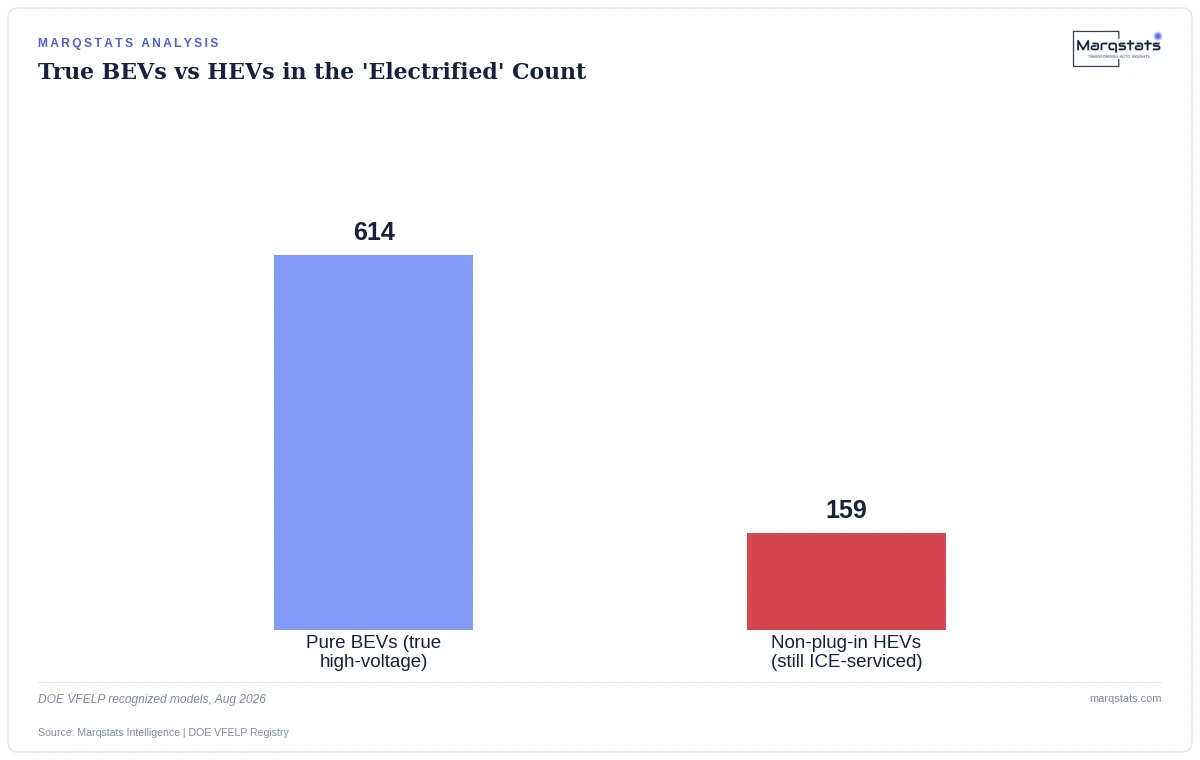
As of August 2026, the DOE's VFELP compliance registry catalogs 949 recognized EV models. Of those, 614 are true battery electric vehicles. But 159 are non-plug-in HEVs — vehicles that, mechanically, still need the oil changes, spark plugs and exhaust servicing a conventional gasoline car needs. When these get counted alongside pure BEVs in a single "electrified vehicle" statistic, the resulting number overstates how much of the fleet genuinely needs high-voltage, BEV-specific servicing.
Why This Isn't Just a Labeling Technicality
The consequence is concrete: independent workshop investment decisions. A workshop owner reading headline "electrified vehicle" growth statistics might reasonably conclude that high-voltage diagnostic tooling and certified technician training are urgently needed across a rapidly growing addressable market. The real picture is more nuanced — a meaningful share of that "electrified" fleet doesn't need any of that specialized capability at all, and can be serviced with the exact same tools and training a conventional combustion workshop already has.
A Named Comparison: How This Differs From a Pure-BEV Market
In a market where registration statistics cleanly separate BEVs from HEVs, a workshop can read the addressable high-voltage service population directly off the registry. In the Philippines, that separation doesn't exist at the registration level — anyone sizing the genuine BEV-specific opportunity has to go beneath the headline EVIDA registration count to the DOE's own separate VFELP model-type breakdown to find the real number.
The Scale of the Confusion This Creates
Put another way: roughly one in six models on the DOE's own "recognized EV" list doesn't actually need the specialized high-voltage diagnostic capability the phrase "EV maintenance" usually implies. For a market where genuine BEV servicing demand is still building the technician and tooling base to meet it, conflating that smaller, genuinely urgent population with the broader EVIDA-eligible fleet risks both overstating near-term BEV-specific opportunity and understating how quickly true high-voltage capacity actually needs to scale.
What This Means for Anyone Reading Philippine EV Statistics
The practical rule: when a Philippine EV statistic doesn't specify BEV versus PHEV versus HEV explicitly, treat it as a broader electrification indicator, not a direct proxy for high-voltage servicing demand — and go to the DOE's VFELP model registry specifically when the question is genuinely about battery-electric-specific maintenance capacity.