Germany's lubricant market is shrinking. LIQUI MOLY grew 8% and hit record production anyway.
Germany's automotive lubricants aftermarket is contracting by volume, down roughly 2% annually in recent years. Against that backdrop, one company just posted its best year yet. Understanding how reveals something genuinely important about where this market's real growth actually lives. That's the specific pocket of growth LIQUI MOLY has built its entire commercial strategy around.
What LIQUI MOLY actually reported
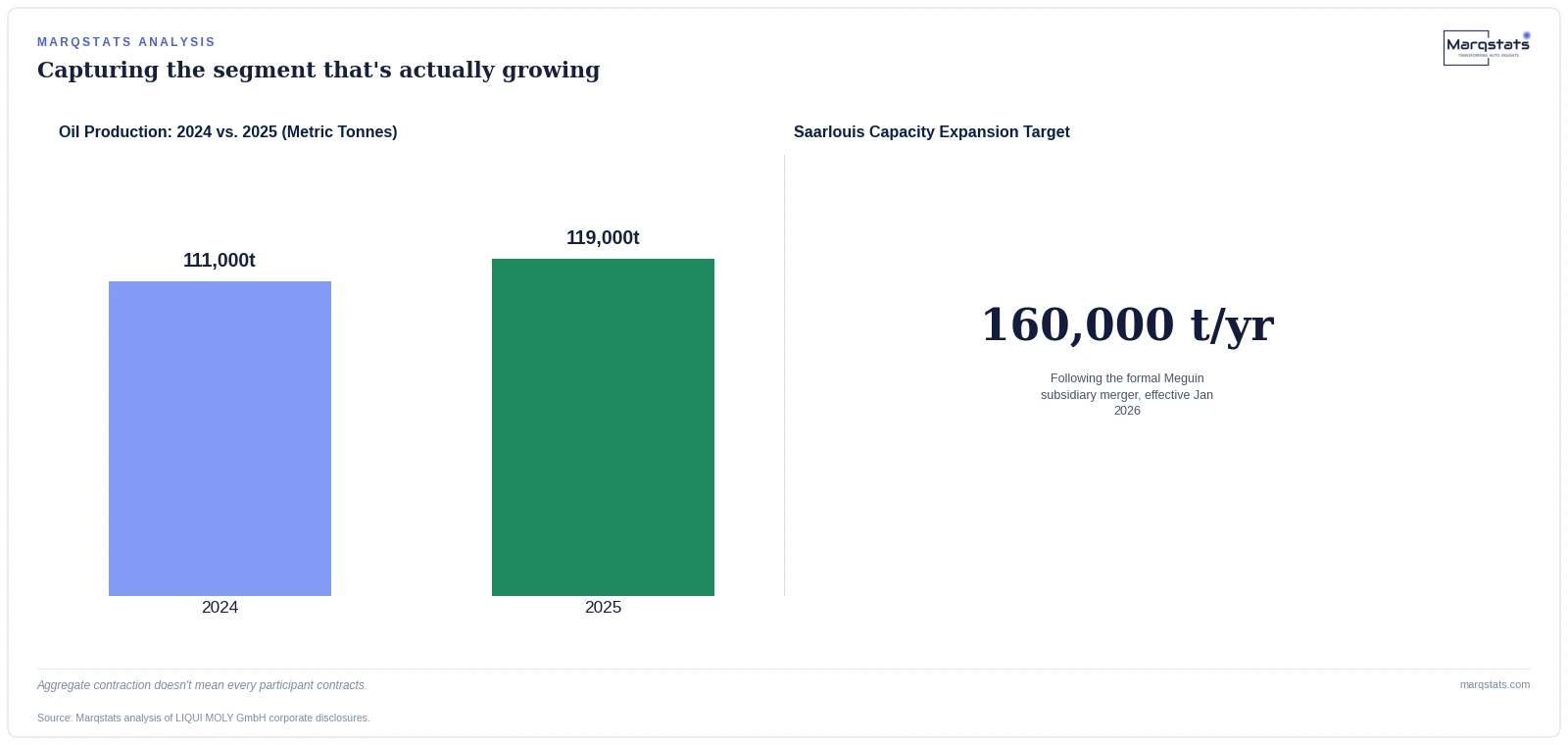
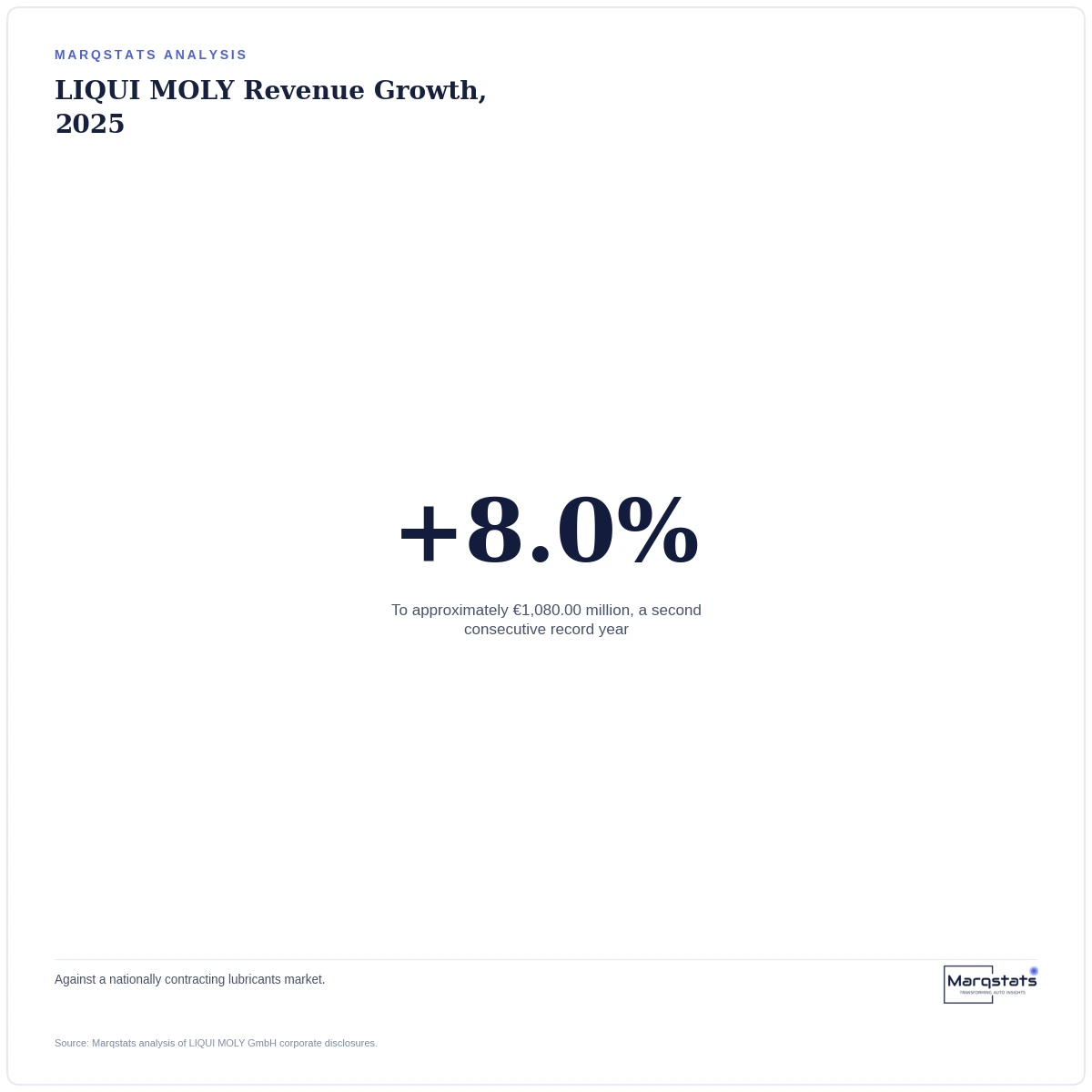
LIQUI MOLY GmbH, a fully integrated subsidiary of the Würth Group based in Ulm, surpassed €1.0 billion in sales revenue for the first time in 2024. Rather than plateauing, the company sustained that momentum into 2025 with an 8.0% revenue increase to approximately €1,080.00 million, while production reached a record 119,000 metric tonnes of oil and 40 million oil containers. That's genuine, accelerating growth in a market where aggregate volume is declining.
The market as a whole is shrinking. This one company is capturing a disproportionate share of what's still growing inside it.
— Marqstats Analyst Team
Why this isn't a contradiction
The apparent paradox resolves once you separate aggregate market volume from where the market's actual value is concentrating. Germany's automotive lubricants aftermarket is contracting in total tonnes sold, but it's simultaneously premiumizing, shifting toward fully synthetic formulations, ACEA C7-23-compliant ultra-low viscosity oils, and branded products carrying meaningfully higher wholesale prices per liter than the conventional formulations they replace. A company positioned to capture that premiumized segment specifically can grow its own revenue even while the market's total physical volume shrinks around it.
LIQUI MOLY's position as the branded market share leader within German independent aftermarket workshop and retail channels puts it precisely in that premiumized segment. Independent workshops, which capture 48.01% of total aftermarket volume, tend to favor recognized, technically differentiated brands over generic alternatives, exactly the positioning LIQUI MOLY has built over decades.
What the company is doing to sustain this growth
The corporate moves accompanying this growth are worth noting specifically. Effective 1 January 2026, LIQUI MOLY formally merged its Meguin GmbH & Co. KG blending subsidiary, integrating corporate legal structures and establishing a single balance sheet, a move that eliminates intercompany administrative overhead and presents a more unified financial picture to lenders and enterprise accounts. Simultaneously, the company commenced a capital investment program at its Saarlouis site specifically to expand finished lubricant blending throughput capacity to 160,000 metric tonnes per year, a genuine, forward-looking bet that demand, particularly export demand, will continue to justify expanded domestic production capacity.
Why this matters for understanding the broader market
LIQUI MOLY's results function as a useful test case for a broader principle: aggregate market contraction figures can mask genuinely different trajectories for individual, well-positioned participants within that market. A blender or investor reading only the headline -1.49% volume CAGR for Germany's aftermarket would miss the fact that specific segments, and specific companies capturing those segments, are growing meaningfully faster than the aggregate figure suggests.
The counter-argument: is LIQUI MOLY's growth mostly coming from exports rather than the German domestic market specifically?
A fair question is whether LIQUI MOLY's 8.0% growth genuinely reflects strength within the German domestic aftermarket this analysis covers, or whether it's driven primarily by international expansion and export volume that wouldn't actually validate the German market's premiumization story. This is a reasonable distinction to draw, since LIQUI MOLY does maintain meaningful export operations alongside its domestic business. What supports treating this as at least partly a genuine domestic signal, though, is that the company's core value proposition, technically differentiated, OEM-recognized branded formulations sold primarily through independent workshop channels, is built specifically around the German aftermarket's premiumization dynamics, ACEA specification compliance and workshop brand loyalty, meaning the underlying commercial logic driving growth applies to the domestic market even if a meaningful share of the actual revenue is booked internationally.
What this means for competitors and investors
- Competing blenders should study LIQUI MOLY's positioning specifically within premiumized, branded, independent-workshop-channel segments as a template for capturing disproportionate growth within an otherwise contracting market.
- Investors evaluating individual lubricant companies should weight company-specific premiumization positioning more heavily than aggregate market volume trends when assessing growth potential.
- Market analysts should track branded company performance data alongside aggregate market statistics, since individual company trajectories can diverge meaningfully from headline market figures.
How FUCHS shows the same pattern from a different angle
LIQUI MOLY isn't the only German blender demonstrating this dynamic, it's simply the most striking example. FUCHS SE, headquartered in Mannheim, stands as the world's largest independent lubricant manufacturer, generating global sales revenues of €3,525.00 million in 2024, with the EMEA region contributing €2,029.00 million. FUCHS has pursued a comparable strategy from a different angle, introducing its Advanced Circular Technologies framework in 2024 and 2025 to systematically incorporate re-refined base oils and bio-based synthetic esters across its automotive formulations, positioning itself specifically within the re-refined and circular economy segment the German market's own statutory Altölverordnung framework is actively expanding.
Both companies, despite pursuing somewhat different specific strategies, synthetic premiumization for LIQUI MOLY, circular formulation leadership for FUCHS, are executing the same underlying playbook: identifying which specific segment of a contracting aggregate market is actually growing, and building commercial capability specifically around capturing that segment rather than competing across the market's full, shrinking breadth.
Why the Saarlouis expansion specifically signals confidence beyond Germany
It's worth being precise about what the Saarlouis capacity expansion actually implies, since 160,000 metric tonnes is a genuinely large target relative to Germany's total 348,500-tonne domestic aftermarket. A capacity expansion of this scale can't be justified by domestic German demand alone, it implies a deliberate bet on export growth across Europe and beyond, treating the German-based production facility as a hub serving demand well outside Germany's own contracting national market. That's a meaningfully different strategic posture than simply defending domestic share, it's using German manufacturing infrastructure and brand credibility as a platform for growth in markets where the same aging-fleet and premiumization dynamics driving German value growth may be earlier in their own trajectory.
The full market picture
Marqstats' complete German automotive lubricants aftermarket analysis, including the full competitive landscape, is available in the linked report below.
Related reportGermany Automotive Lubricants Aftermarket Size, Share & Forecast 2026 – 2030