The Segment That Shouldn't Be Driving Growth, but Is
Market forecasters usually expect aftermarket revenue to track vehicle value: bigger, more expensive platforms with larger battery packs should generate more maintenance revenue per unit. Japan's own EV maintenance data shows the opposite pattern actually driving this market's growth.
The Number Behind the Reversal
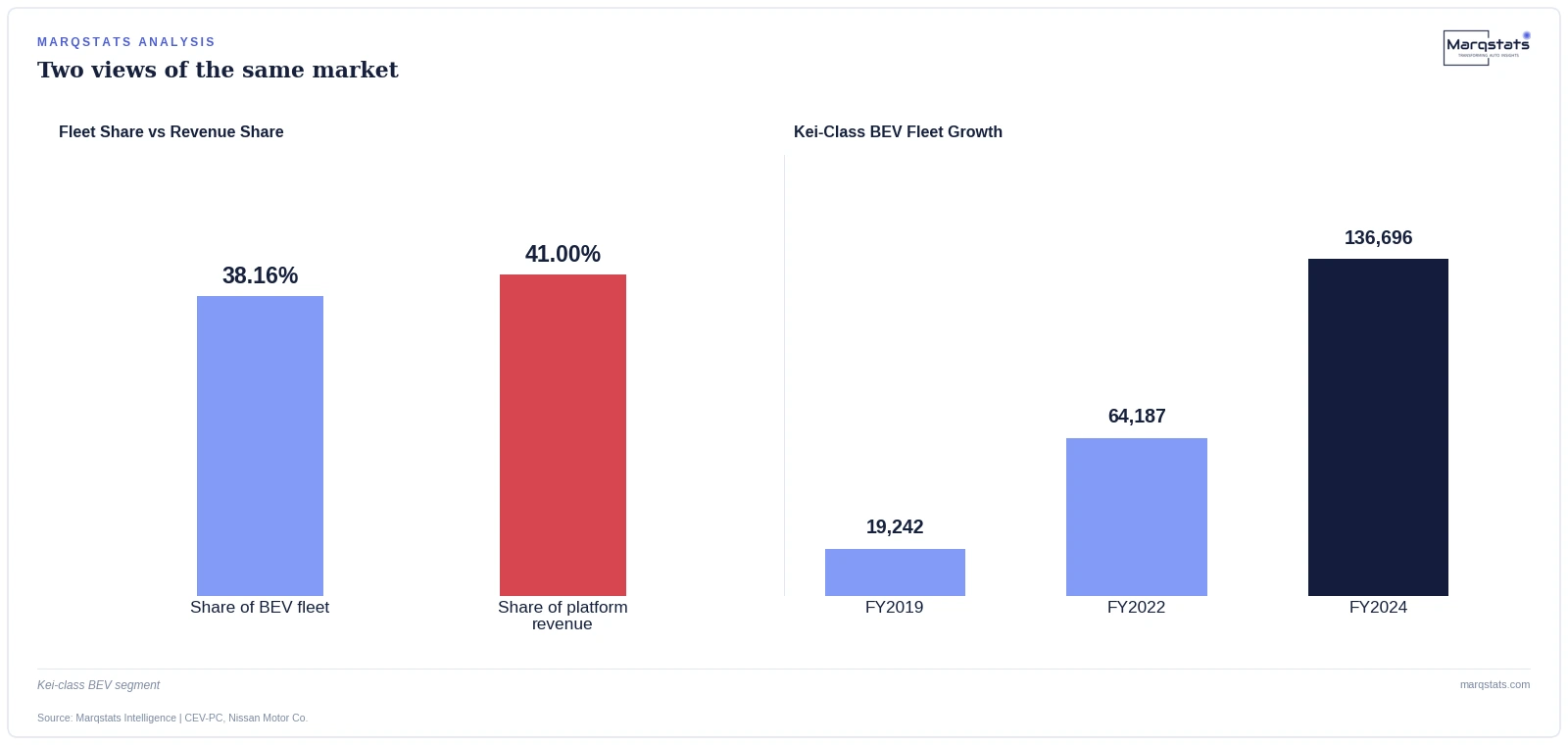
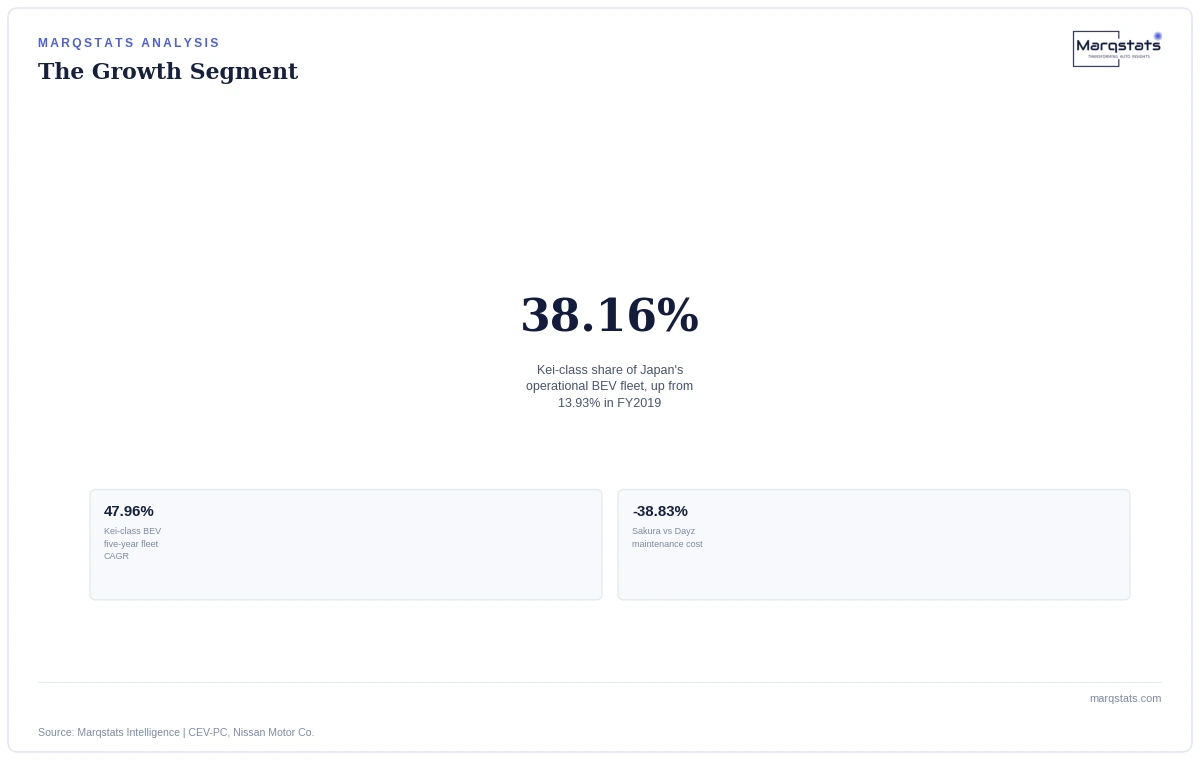
Kei-class micro-vehicles, led overwhelmingly by the Nissan Sakura, expanded from a negligible 19,242 units in FY2019 to 136,696 units by FY2024 — a 47.96% five-year CAGR that dwarfs every other segment in the market. These are precisely the vehicles generating the lowest per-unit maintenance revenue in the entire Japanese EV fleet.
The Catalyst: One Joint Venture, One Launch Date
The turning point traces to a specific date: May 2022, when Nissan and Mitsubishi launched their co-developed NMKV kei-class electric platform, commercialized as the Sakura and the eK X EV. Before that launch, kei-class BEVs were a rounding error. Within two years, they represented over a third of the entire operational BEV fleet.
Why This Segment Generates Less Revenue Per Vehicle
Nissan's own “Mente Pro Pack 18 with Shaken” pricing data makes the mechanism explicit. The kei-class Sakura's maintenance package costs 38.83% less than its ICE Dayz counterpart — the smallest cost reduction Nissan's own data shows across any platform tier, but still the lowest absolute maintenance bill in yen terms, since kei-class vehicles start from a smaller base cost than compact or crossover platforms.
A Named Comparison: Why This Isn't Actually Bad News
It would be easy to read “Japan's fastest-growing EV segment generates the least revenue per unit” as a warning sign. It's more accurately read as a straightforward volume-versus-value trade-off: kei-class vehicles are driving unit growth specifically because they're affordable and practical for Japan's dense urban and suburban commuting patterns, and workshops equipped to service high volumes of a simpler, more standardized platform can still build a viable business on throughput even at lower revenue per visit — a genuinely different strategic bet than chasing fewer, higher-value crossover and SUV service jobs.
How Long This Pattern Is Likely to Continue
The underlying research's own scenario framework projects kei-class platforms continuing to expand their share of the operating BEV fleet through 2029, meaning this volume-heavy, lower-revenue-per-unit growth pattern is not a temporary transition phase workshops should expect to fade -- it is closer to becoming the defining structural feature of Japan's EV aftermarket for the remainder of this decade.
What This Means for Workshops Planning Capacity
The practical takeaway: a workshop or parts supplier evaluating the Japanese EV market should weight kei-class servicing capability specifically, not just general BEV capability, since it represents the segment most likely to walk through the door in the coming years — even if each individual visit generates less revenue than a comparable crossover service appointment would.