Japan's tiniest cars need their oil changed every 2,500 kilometers
Kei cars, Japan's distinctive category of ultra-compact, small-displacement vehicles, are everywhere on Japanese roads. What's less obvious is how much more frequently these tiny cars actually need their oil changed compared to a standard passenger vehicle, and why that matters for anyone sizing the country's lubricant market.
What makes a kei car a kei car
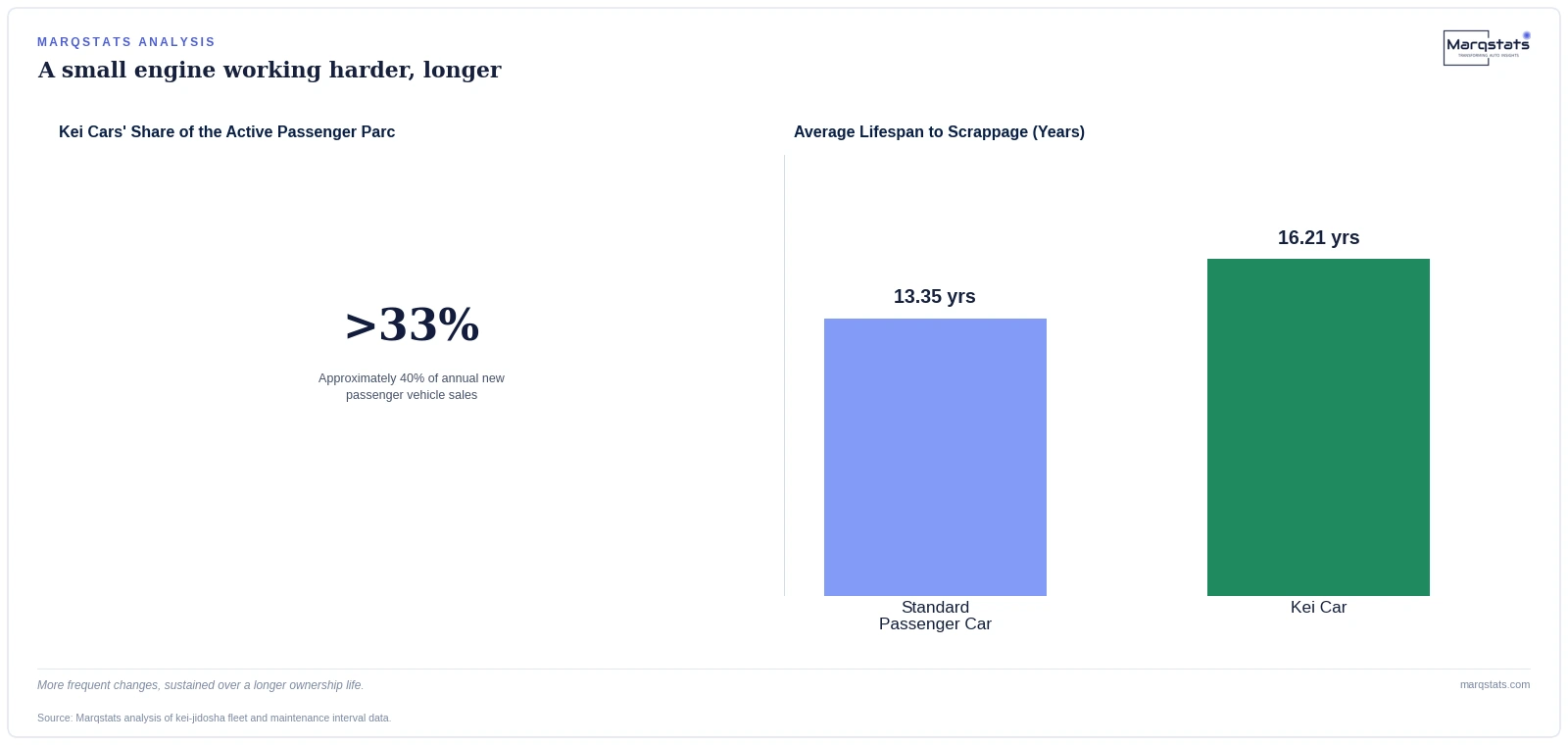
Light motor vehicles, kei-jidōsha, are defined by strict regulatory limits: engine displacement capped at 660cc and external dimensions under 3.4 meters. These aren't a niche category, they represent approximately 40% of annual passenger vehicle sales and over 33% of the active passenger car parc, having expanded by roughly 400,000 units between 2020 and 2025 alone.
A tiny engine working harder needs its oil changed more often than a bigger one working less.
— Marqstats Analyst Team
Why the small engine actually works harder
The core mechanical reality driving frequent servicing is straightforward: because kei engines are restricted to 660cc displacement, they have to operate at higher average RPMs than a standard passenger vehicle just to maintain normal highway speeds. That's a genuinely more demanding operating condition for the oil, since higher engine speeds generate more heat and more mechanical stress per kilometer traveled. Add widespread turbocharging, increasingly common in kei cars specifically to compensate for the small displacement limit, and the thermal conditions inside the crankcase become considerably more demanding still.
What that means for how often the oil actually gets changed
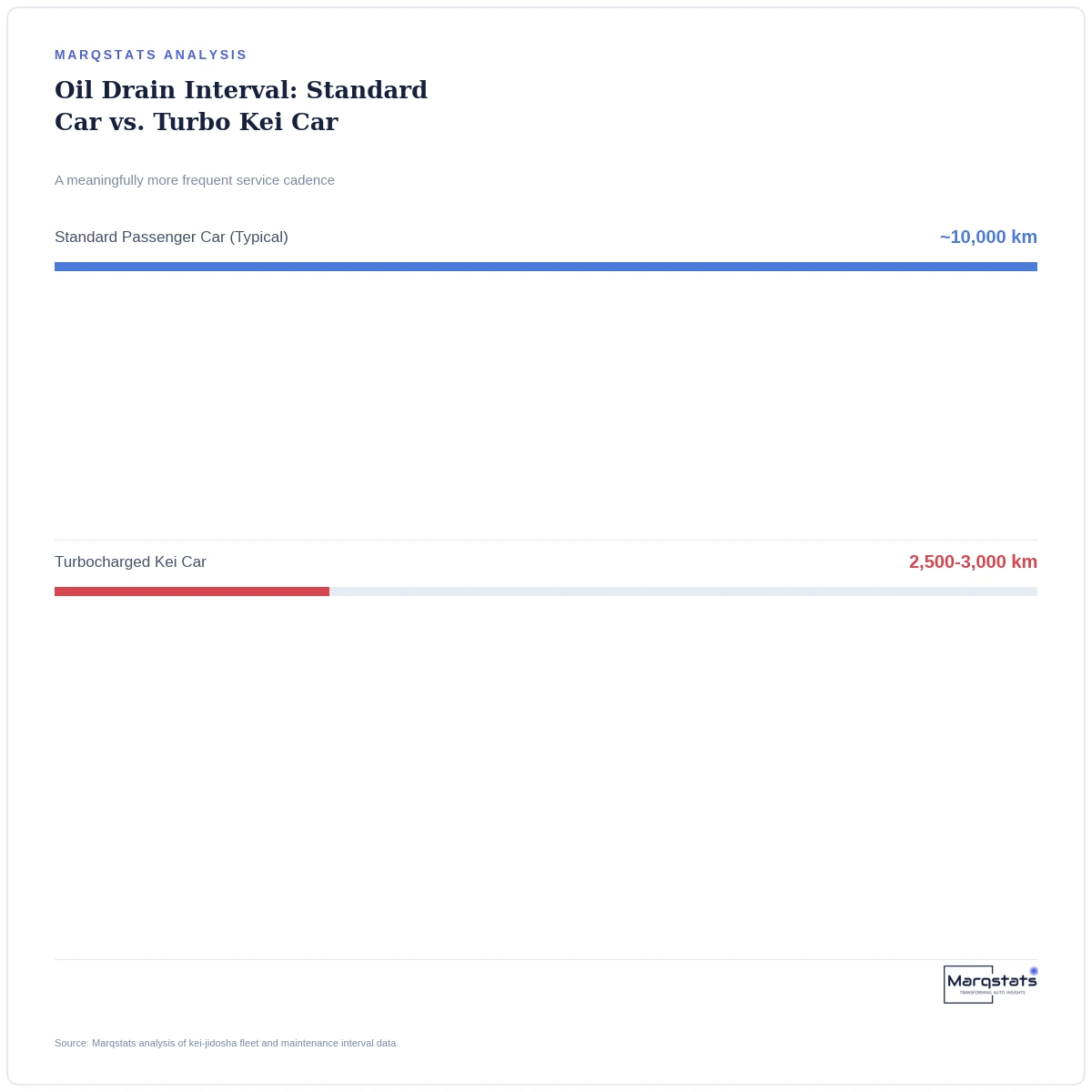
The combination of limited sump capacities, just 2.5 to 3.0 liters compared to 4.0 to 4.5 liters for a standard two-liter passenger car, elevated engine speeds, and turbocharging translates directly into shorter recommended drain intervals: typically 5,000 kilometers for naturally aspirated kei engines, but tightening to just 2,500 to 3,000 kilometers for turbocharged variants. That's a meaningfully more frequent service cadence than a comparable standard passenger car, whose larger sump and lower relative engine stress typically support longer intervals.
Why kei cars stay in the aftermarket longer, too
There's a second factor compounding this frequent-service dynamic: kei cars simply stay on the road longer. Their average operational lifespan reaches 16.21 years, genuinely longer than the 13.35-year average for standard passenger cars. That combination, more frequent servicing per vehicle, sustained over a longer ownership period, means kei cars generate a disproportionate volume of aftermarket service events relative to their individual engine size, even though each individual oil change uses a smaller quantity of fluid than a standard car's larger sump requires.
Why this matters for workshops and formulators specifically
For independent workshops and specialty retail service bays, this frequent-turnover dynamic is a genuine, structural source of recurring business, not simply incidental foot traffic. A kei car owner driving a turbocharged model on a regular commute could realistically need three to four oil changes annually if driving distances are substantial, compared to roughly 1.3 changes for an average standard passenger car under this market's broader sizing assumptions. For formulators, this creates specific technical demand: kei-appropriate formulations need to handle sustained high-RPM, high-heat operation within a genuinely small oil volume, a distinct technical challenge from formulating for a larger-displacement, lower-stress engine.
The counter-argument: won't kei car electrification eventually erode this specific demand driver?
A fair question is whether kei cars specifically might electrify faster than the broader passenger fleet, given their urban-commuter usage profile that suits battery-electric range limitations reasonably well, potentially eroding this frequent-service dynamic faster than the market's aggregate BEV projections suggest. This is a plausible consideration, urban kei car usage patterns genuinely do suit electric powertrains in principle. What tempers this concern somewhat is that Japan's overall BEV adoption, including within the kei segment specifically, has remained modest relative to the country's hybrid-focused strategy, and kei car manufacturers have shown comparable enthusiasm for hybrid kei variants as for the broader passenger fleet, meaning the segment's long service life and technical servicing requirements are likely to persist on a similar timeline to the rest of the internal-combustion-dependent market rather than accelerating away from it.
What this means for workshops and formulators
- Independent workshops and specialty retail chains should recognize kei car owners as a genuinely high-frequency, recurring revenue segment, not incidental traffic, given their shorter drain intervals and longer ownership periods.
- Lubricant formulators should prioritize kei-specific formulations engineered for sustained high-RPM, high-heat operation within genuinely small sump volumes as a distinct technical category.
- Market analysts sizing Japan's aftermarket should weight kei car service frequency explicitly rather than treating the segment as a simple proportional share of the broader passenger fleet.
The full market picture
Marqstats' complete Japanese automotive lubricants aftermarket analysis, including the full vehicle category segmentation, is available in the linked report below.
Related reportJapan Automotive Lubricants Aftermarket Size, Share & Forecast 2026 – 2030