
Japan's EVs stayed under 2% of the fleet. Its engine oil got more valuable anyway.
In brief:
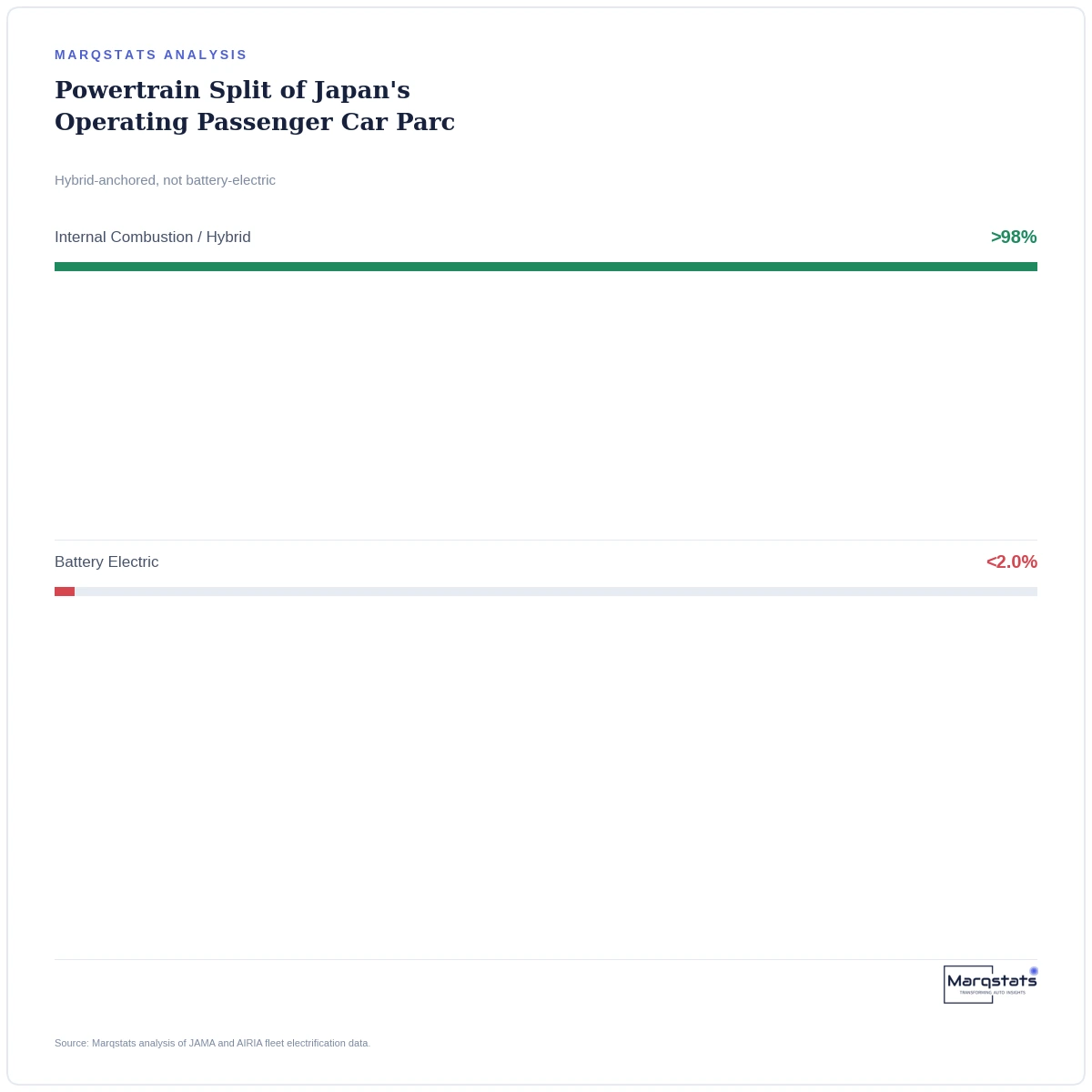
- Battery electric vehicles remain below 2.0% of Japan's operating passenger car parc.
- Internal combustion engines continue to power more than 98% of operating passenger vehicles.
- Japan's automotive lubricants aftermarket value grows +0.98% annually through 2030 even as physical volume contracts -1.15%.
Most major automotive markets treat electrification as a straightforward threat to lubricant demand: more EVs means less crankcase oil sold. Japan's numbers don't follow that script, and the reason is a genuinely different technology choice.
Why Japan chose hybrids instead of EVs
Rather than pursuing a battery-electric transition the way much of Europe and China have, Japan's automotive industry concentrated on full-hybrid electric vehicles, HEVs that pair a combustion engine with an electric motor rather than replacing combustion entirely. BEV registrations have grown from a modest baseline, but their cumulative share of the operating fleet remains below 2.0%, a genuinely small number next to the more than 98% of vehicles still relying on an internal combustion engine.
Most markets ask whether electrification will shrink the lubricant business. Japan's hybrid path is quietly growing it instead.
— Marqstats Analyst Team
Why hybrid engines are actually harder on oil, not easier
This is the part that reverses the usual electrification story. In a hybrid configuration, the combustion engine doesn't run continuously the way it does in a conventional car, it cycles on and off repeatedly as the vehicle shifts between electric and combustion power during ordinary urban driving. That intermittent operation prevents the crankcase from holding a stable, optimal operating temperature for extended stretches, which worsens fuel dilution, accelerates moisture condensation, and raises the risk of low-speed pre-ignition, a specific combustion knock condition that can damage pistons and rings.
Why that stress translates into higher-value oil, not lower demand
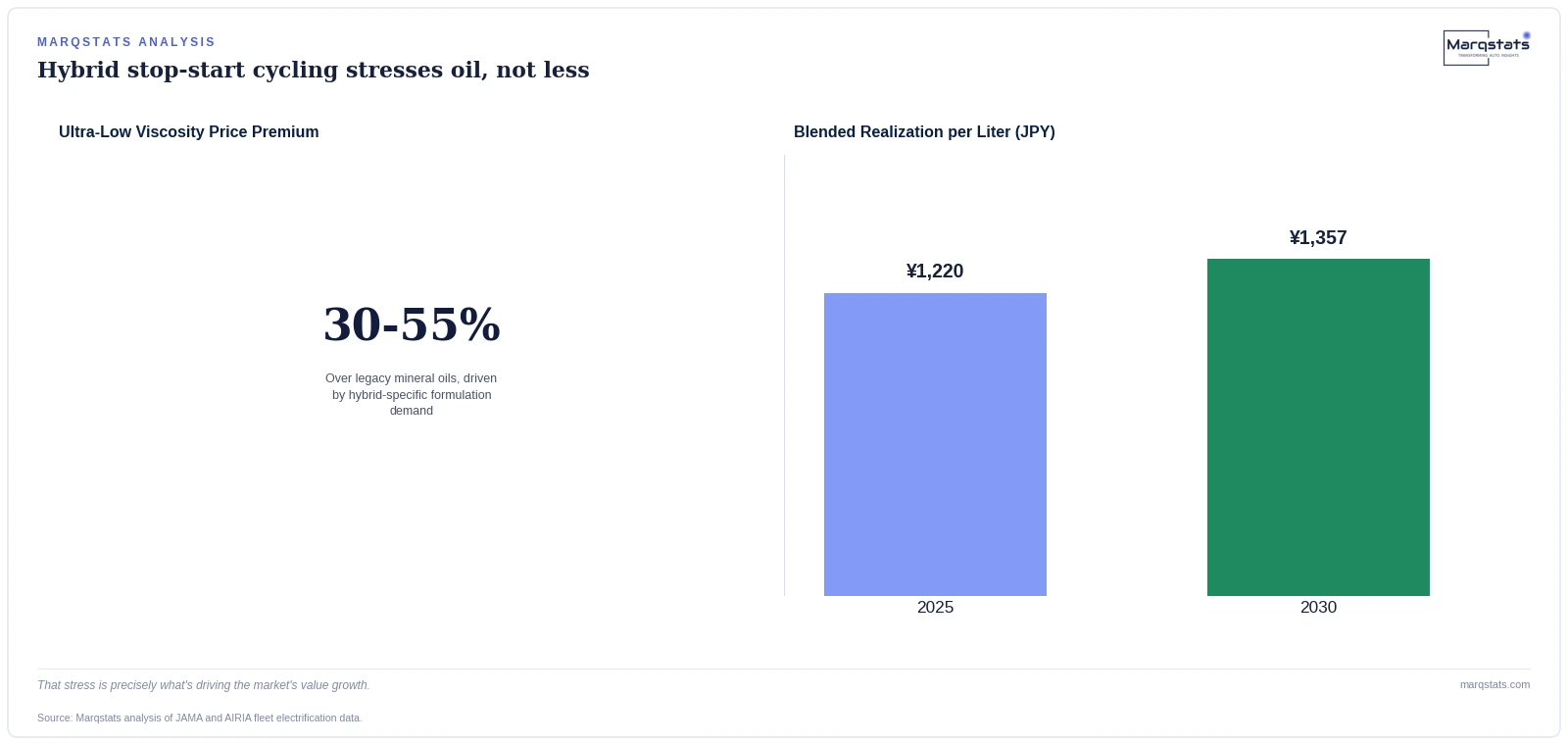
Formulators have responded with genuinely more sophisticated chemistry: specialized, low-viscosity, high-additive-density oils engineered specifically to handle this stop-start thermal cycling. These aren't simply thinner versions of conventional oil, they carry meaningfully higher additive loads and tighter formulation tolerances, and they command retail and wholesale prices 30% to 55% above legacy mineral products. Rather than eroding lubricant demand the way pure battery-electric adoption does elsewhere, Japan's hybrid-heavy fleet is pushing the market toward exactly the premium formulations that sustain value growth even as total engine runtime, and therefore total oil volume, gradually declines.
Why this pattern shows up clearly in the market's own numbers
The market-level arithmetic reflects this directly. Physical aftermarket volume contracts at -1.15% annually through 2030, driven by extended synthetic drain intervals and hybrid engines simply accumulating fewer operating hours per vehicle kilometer. But market value expands at +0.98% annually over the same period, reaching JPY 1,196.20 billion by 2030, because the blended realization per liter climbs from roughly JPY 1,220 to JPY 1,357 as ultra-low viscosity JASO GLV-1 and GLV-2 formulations expand from 58.40% to 73.50% of PCMO service-fill volume.
The counter-argument: could this value cushion disappear if Japan eventually pivots harder toward pure BEVs?
A fair question is whether Japan's hybrid-driven premiumization is a durable, multi-year pattern, or simply a temporary phase before the country eventually follows other major markets toward heavier battery-electric adoption, at which point the value cushion hybrid engines currently provide would start eroding instead. This is precisely the logic tested by the market's own Scenario B, which models accelerated municipal zero-emission mandates pushing BEV parc share above 6.5% by 2030, and even under that considerably more aggressive case, the market still holds a meaningfully large lubricant base, contracting to 840.10 million liters rather than collapsing, since hybrids retiring from the fleet still take years to fully displace, and value, while turning negative at -1.08% CAGR, does so only modestly relative to the accelerated -2.10% volume decline that scenario assumes.
What this means for formulators and investors
- Lubricant formulators serving the Japanese market should prioritize hybrid-specific, high-additive-density chemistry rather than assuming electrification broadly threatens demand the way it does in BEV-dominant markets.
- Investors evaluating Japan's aftermarket should track JASO GLV-1/GLV-2 penetration rates specifically, since formulation mix shift, not fleet growth, drives nearly all of the market's projected value expansion.
- Market participants should model Scenario B's accelerated BEV case explicitly when planning long-term capacity, since even meaningfully faster electrification narrows rather than eliminates Japan's structural value cushion.
How Shaken makes this a legally guaranteed servicing cycle, not just a trend
There's a structural mechanism reinforcing this hybrid-driven premiumization that goes beyond consumer or fleet-manager choice: Japan's statutory Shaken inspection system, which requires biennial mechanical evaluations across accredited workshops, and mandates fluid checks and component rectifications as part of passing inspection thresholds. Because fluid flushes are standard practice for clearing Shaken, hybrid vehicle owners can't simply defer the specialized oil change their vehicle's thermal stress profile calls for, the inspection cycle itself forces the servicing event, and workshops routinely stock the premium formulation appropriate to that specific hybrid model.
This regulatory backstop is part of why Japan's aftermarket demonstrates unusually stable, counter-cyclical servicing behavior compared to markets where oil changes are purely discretionary. A hybrid owner delaying maintenance for cost reasons elsewhere in the world still faces a hard Shaken deadline in Japan, which sustains the premium-formulation servicing volume this analysis identifies as the market's core value driver.
Why kei cars add a second, distinct layer to this premiumization story
Japan's kei car segment, light vehicles capped at 660cc engine displacement and representing roughly 40% of new passenger vehicle sales, compounds this dynamic further. Kei engines run at higher average RPMs than standard passenger vehicles to maintain highway speeds within their displacement limit, and turbocharged kei variants require oil drain intervals as short as 2,500 to 3,000 kilometers, meaningfully more frequent than a standard passenger car. That combination of small sump capacity, high RPM operation and frequent servicing creates its own premium-formulation opportunity, independent of the hybrid-specific dynamic already discussed, but reinforcing the same overall pattern: Japan's specific vehicle technology choices, kei displacement limits and hybrid powertrains alike, both push the market toward more frequent, more chemically sophisticated servicing than a simple fleet-size calculation would suggest.
The full market picture
Marqstats' complete Japanese automotive lubricants aftermarket analysis, including the full two-scenario forecast through 2030, is available in the linked report below.
Related reportJapan Automotive Lubricants Aftermarket Size, Share & Forecast 2026 – 2030