The Factories Shrank. The Oil Barely Moved.
Italy's car industry had a bad 2025, and its engine oil market largely did not notice.
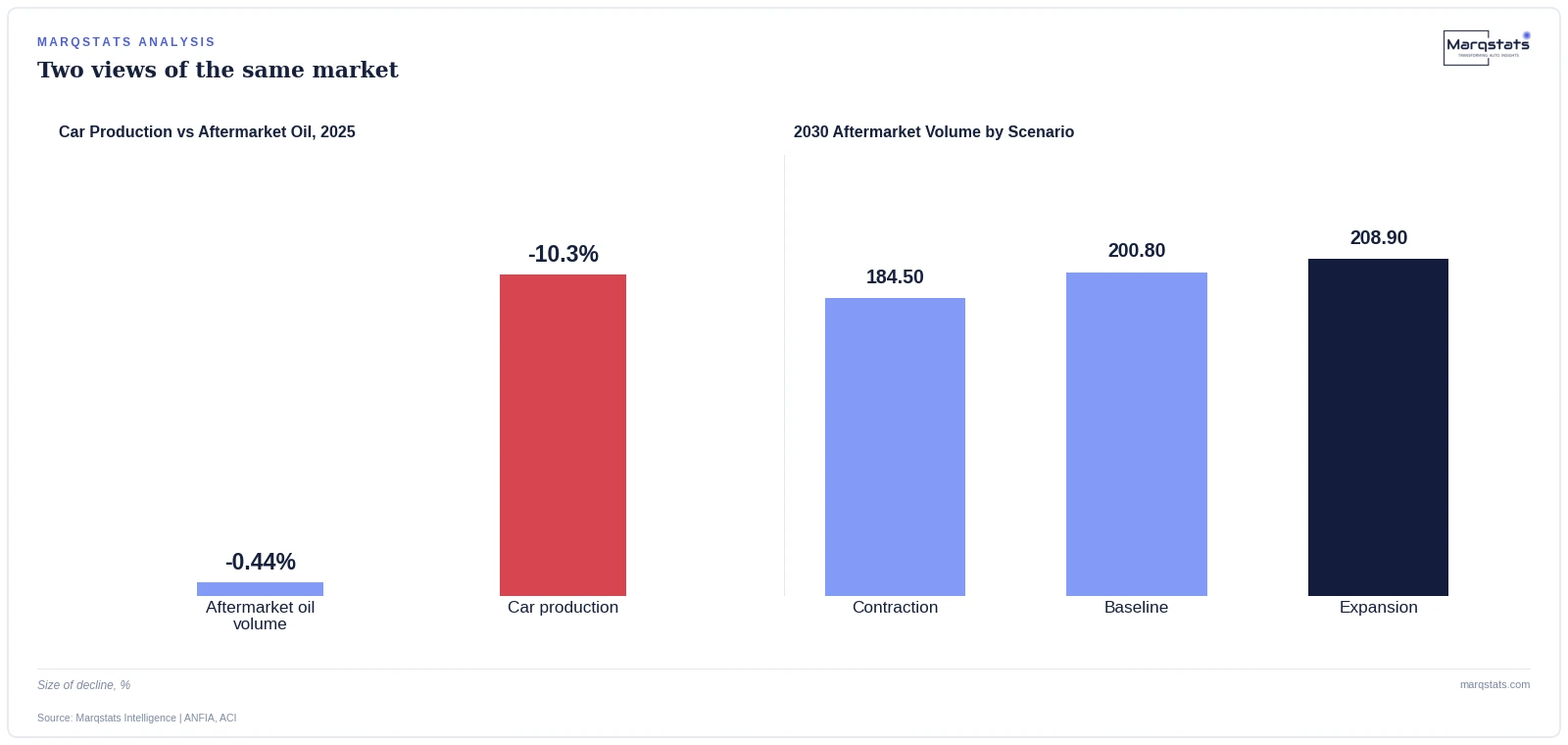
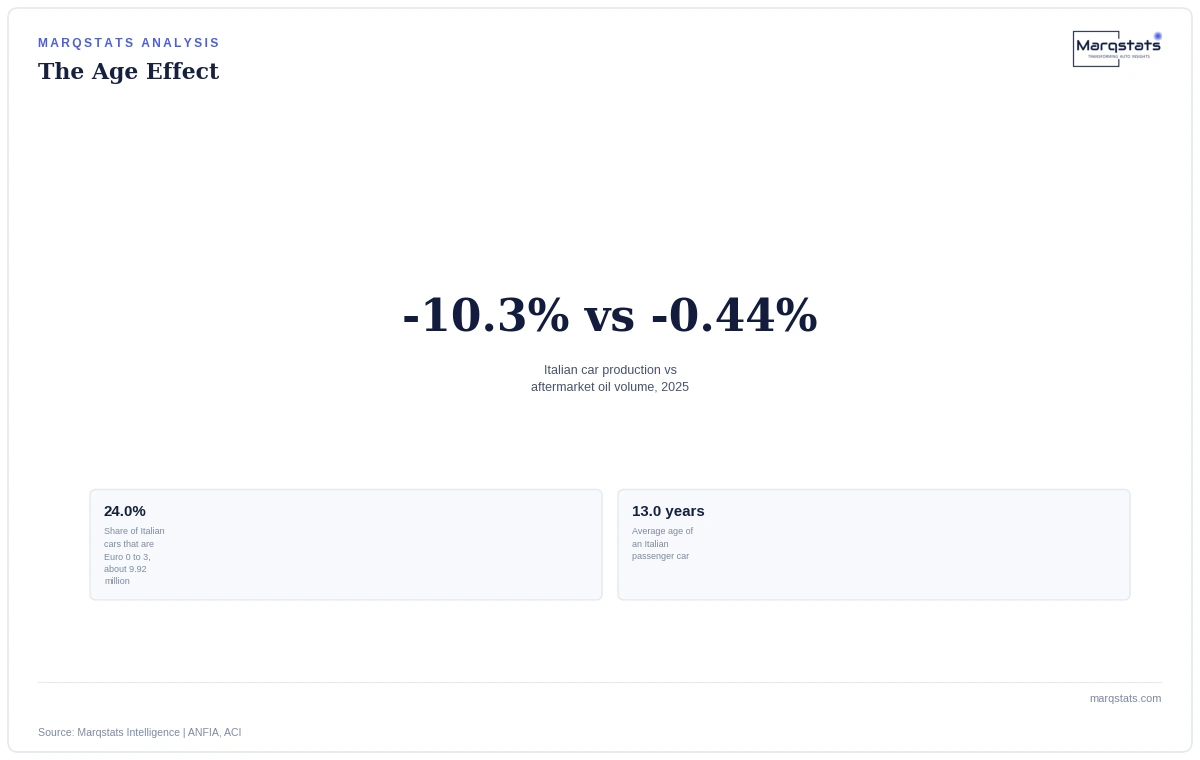
The industry body ANFIA reported that Italian automotive production fell 10.3% in 2025, with domestic car output below 300,000 units. In the research's sizing table, aftermarket oil volume fell only 0.44%, from 204.80 to 203.90 million litres. The reason is the cars already on the road.
One of Europe's Oldest Fleets
The numbers describe a fleet that is kept, not replaced.
Italy's 41.34 million passenger cars average 13.0 years old, and the median car scrapped in 2025 was 18 years and 9 months old. About 24.0% of cars, roughly 9.92 million, are Euro 0 to 3 vehicles that have run for at least 19 years. New-car sales have stabilised near 1.6 million a year, and spending on maintenance and repair passed EUR 29 billion.
Two Fleets, Two Different Oils
The age split shapes what the garage pours.
The oldest cars use high-viscosity SAE 10W-40 and 15W-40 oils with traditional zinc anti-wear additives, which suit looser engine tolerances and older seals. The 31.5% of cars at Euro 6 need SAE 0W-20 and 0W-16 synthetics that meet low-SAPS limits to protect gasoline particulate filters. Distributors therefore stock both ranges, and the mix is moving: fully synthetic oil rises from 54.00% to 60.00% of volume by 2030, lifting the wholesale price from USD 5.91 to USD 6.50 a litre.
A Named Comparison: Three Futures for the Fleet
Volume depends on how fast the old cars leave.
In the Baseline Scenario the fleet ages and is replaced at historical rates, and volume falls 0.31% a year to 200.80 million litres. In the Contraction Scenario, a national scrappage programme funded by the recovery plan removes 1.5 million Euro 0 to 3 cars and battery electric cars reach 20% of new sales by 2028, so volume falls 1.98% a year to 184.50 million litres and value grows only 0.16% a year, to USD 1,215.20 million. In the Expansion Scenario, a relaxed EU 2035 rule slows replacement, the average car reaches 14.5 years and volume rises to 208.90 million litres.
Why Value Still Holds Up
Even a contraction leaves value roughly flat rather than falling.
Synthetic price premiums cushion the loss of litres. The research puts the synthetic premium at USD 2.35 a litre, and dedicated fluids for electric and thermal systems grow from USD 30.15 million to USD 39.14 million. The research does not say which customers a scrappage scheme would remove first.
What This Means for Blenders and Workshops
The practical takeaway: workshops should keep both a legacy 10W-40 range and a low-SAPS 0W-20 range, and blenders should watch the scrappage decision and the 2026 EU review of the 2035 rule, the two triggers that separate the futures. The volume base behind these figures is an estimate that could not be independently verified, so read the scenario gaps as direction, not precision.