Two Numbers, Same Car, Opposite Directions
Ask an Italian EV owner whether their car is cheaper or more expensive to maintain than a combustion equivalent, and the honest answer is both — depending entirely on whether anything actually goes wrong.
The Good News, Confirmed by Independent Testing
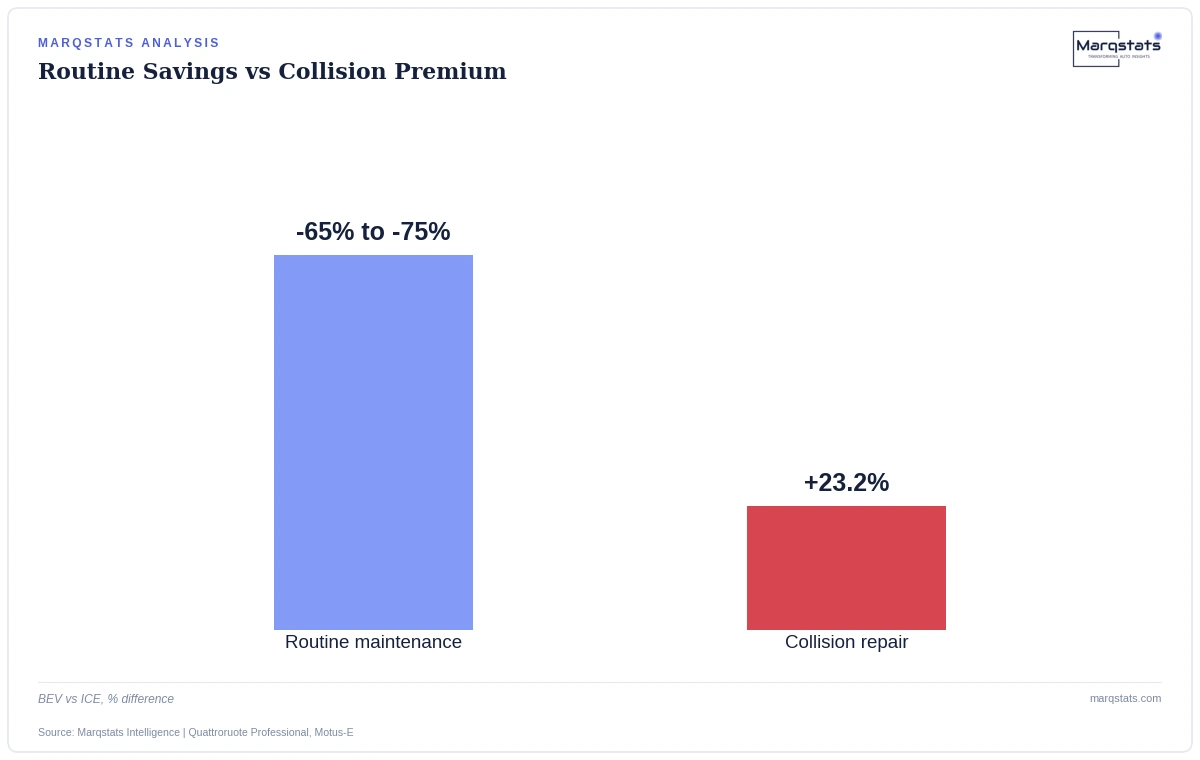
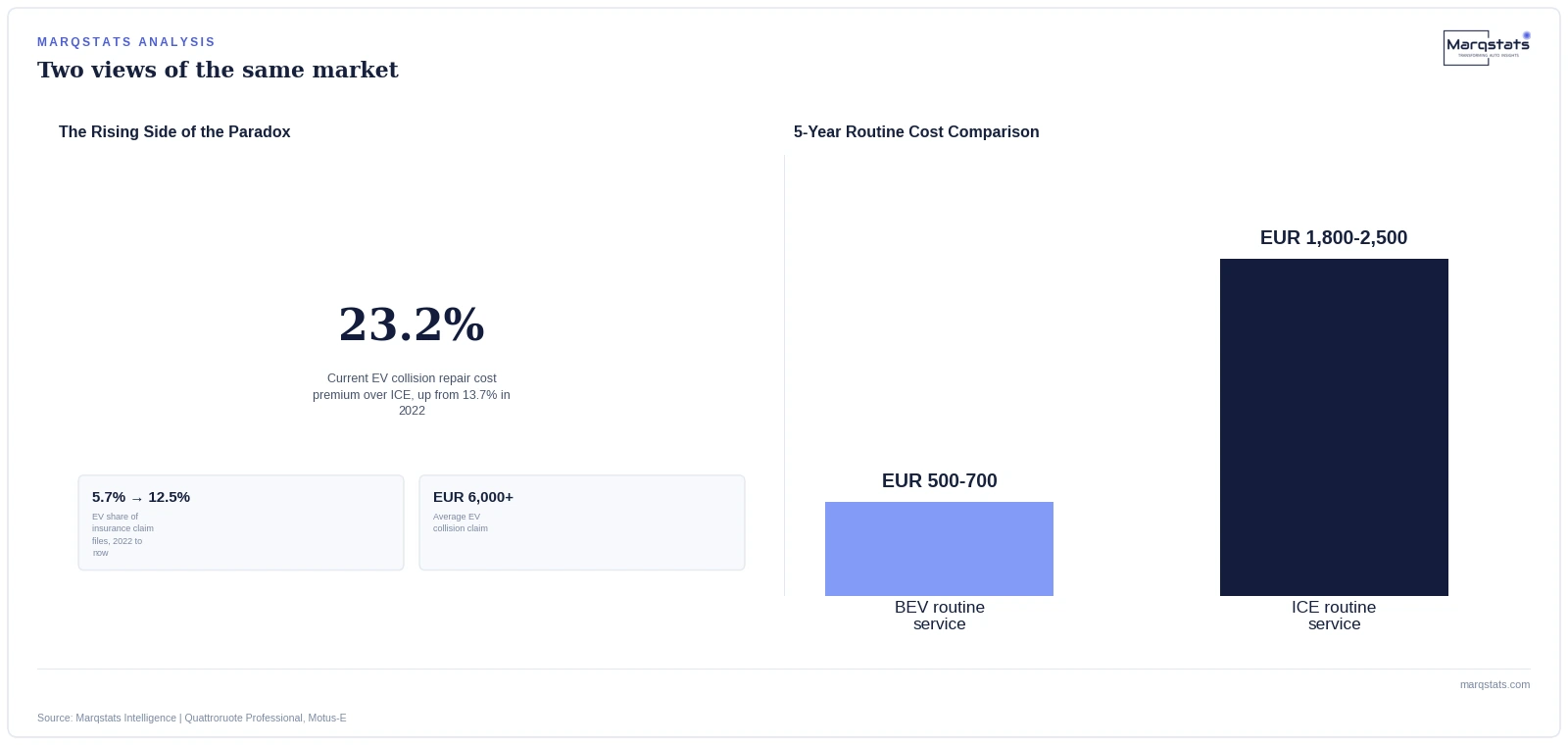
Empirical cost studies by Quattroruote Professional and Motus-E found routine servicing for a C-segment BEV over 3 years or 45,000 km costs 69% less than an equivalent ICE vehicle. Over a full 100,000 km lifecycle, a BEV requires inspection routines costing between EUR 150 and EUR 300 per visit, totaling EUR 500 to EUR 700 — against EUR 1,800 to EUR 2,500 for a comparable combustion vehicle needing oil, filter, spark plug and transmission fluid changes.
The Number That Flips the Story
That savings story holds only as long as nothing goes wrong. Italian insurance loss telemetry shows the average cost premium for EV collision claims rose from 13.7% in 2022 to 23.2% currently — the same vehicle, in a body shop instead of a service bay, now costs meaningfully more to fix than an equivalent ICE vehicle would.
Why the Reversal Happens
Four specific mechanisms drive the collision-side inflation. High-voltage safety protocols require a qualified technician to formally de-energize the vehicle before any structural or panel work can begin. Complex structural aluminum castings and high-voltage wiring harnesses raise component costs. Battery enclosure integrity checks require non-destructive or acoustic emission testing after any significant impact. And specialized high-voltage labor bills at EUR 75 to EUR 80 per hour against EUR 45 to EUR 46 for standard mechanical work.
A Named Comparison: Why Both Numbers Deserve Equal Weight
It would be easy to treat the routine-savings figure as the "real" EV cost story and the collision premium as a smaller footnote. The data doesn't support that framing. With the EV share of Italian claim files more than doubling, from 5.7% to 12.5% over the same period, collision exposure is a genuinely and rapidly growing category, not a rare edge case — exactly the kind of variable that should carry real weight in any EV total cost of ownership model, not get treated as background noise next to the more flattering routine-maintenance number.
What This Means for Anyone Modeling EV Ownership Costs
The practical takeaway: a single blended "EVs cost X% less to own" figure genuinely misrepresents Italian EV economics. Anyone building a total cost of ownership model, whether for personal budgeting, fleet planning, or insurance underwriting, needs both numbers — the routine savings and the collision exposure — modeled separately and weighted by actual incidence, not collapsed into one misleadingly simple average.