A Registration Share That Outweighs Jakarta's Population Share
It's worth pausing on this number specifically, since it's larger than Jakarta's share of the national population or the national vehicle fleet generally.
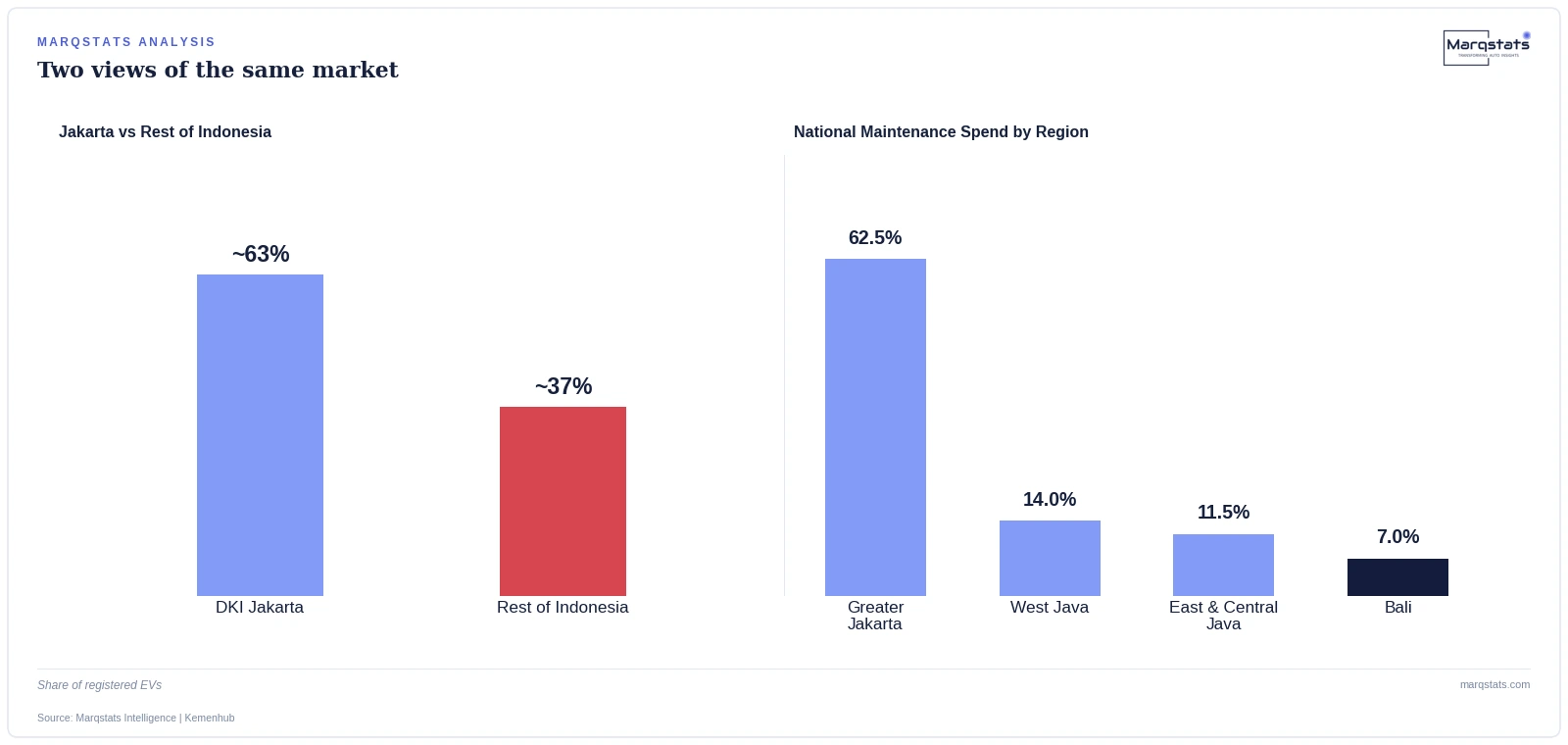
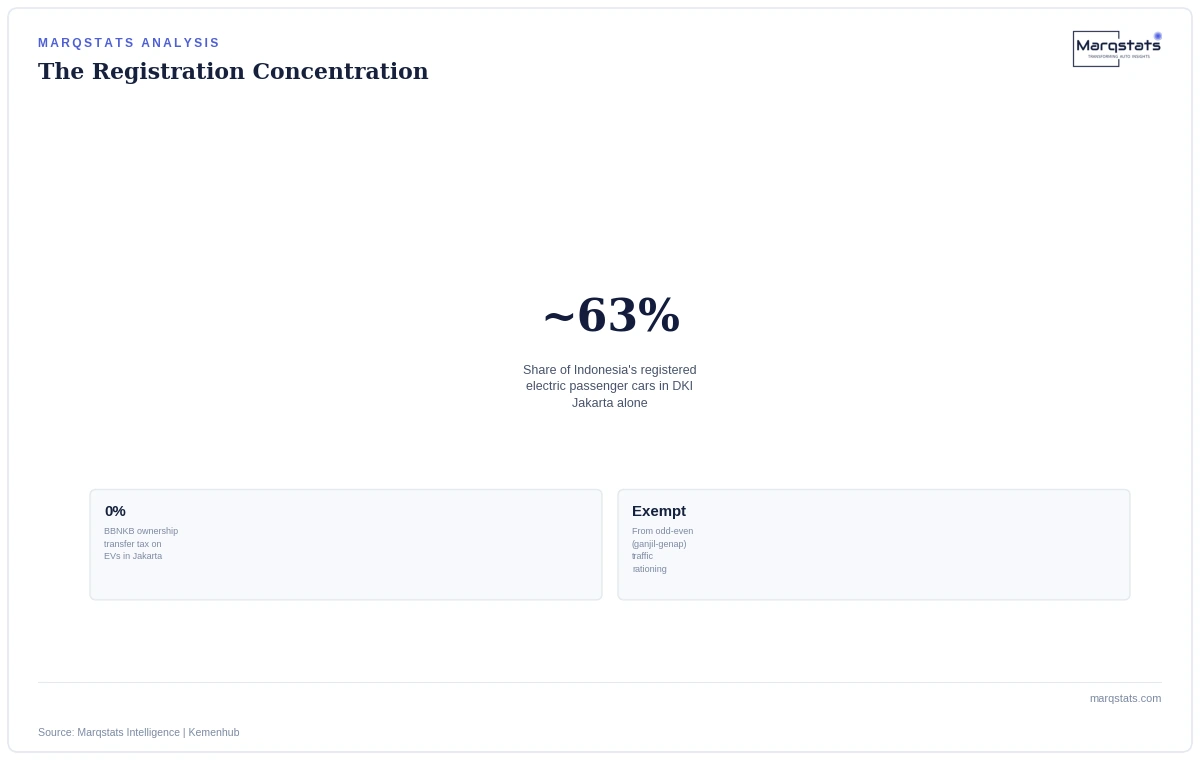
DKI Jakarta alone accounts for approximately 63% of all registered electric passenger cars in Indonesia -- a concentration far beyond what the province's share of national population or overall vehicle ownership would predict on its own.
The Specific Policies Driving That Concentration
This isn't a general urban-adoption pattern -- it traces to two named, deliberate provincial policy choices.
Jakarta grants electric vehicles complete exemption from the municipal odd-even (ganjil-genap) traffic rationing system that restricts conventional vehicles from the road on alternating days, and zero-rate motor vehicle ownership transfer taxes (BBNKB) that apply to ICE vehicle resales. Combined with dense public charging coverage, these two policies alone make owning an EV in Jakarta specifically more convenient and cheaper to transact than owning one almost anywhere else in the country.
Why Workshops Followed the Registrations, Not the Other Way Around
The service infrastructure buildout is a direct, traceable consequence of where the vehicles already were.
Automotive dealer groups, independent multi-brand networks, and specialized high-voltage facilities have established their initial workshops across South Jakarta, North Jakarta, Tangerang and Bekasi specifically because that's where the registered fleet already concentrated. Workshop investment followed vehicle density, not the reverse -- meaning Jakarta's tax policy, not any national infrastructure plan, effectively decided where Indonesia's EV service capacity would build out first.
A Named Comparison: Why Other Provinces Can't Simply Copy This Model
This concentration pattern is genuinely specific to Jakarta's provincial-level authority, not something every region can replicate on its own.
Motor vehicle ownership transfer tax and traffic rationing systems are set at the provincial level in Indonesia, meaning other provinces would need their own separate policy decisions to replicate Jakarta's incentive structure -- and most, so far, have not, leaving Jakarta's EV service infrastructure advantage structurally difficult for other regions to close quickly.
West Java, East Java and Central Java together account for a meaningfully smaller combined share of the national maintenance market than Jakarta alone, despite covering a far larger geographic area and population base, which underscores how much of that gap traces specifically to policy choice rather than to population density or general economic development differences between regions.
What This Means for Workshop Investment Outside Jakarta
The practical takeaway: workshop investors evaluating expansion into secondary provinces should treat local provincial tax and traffic policy specifically as a leading indicator of future EV service demand, given how directly Jakarta's own incentive structure -- not general economic development -- explains its outsized share of the national fleet.