A Fleet Share That Doesn't Match Its Revenue Line
It's the kind of mismatch that looks like a data error until the underlying mechanics are traced through carefully.
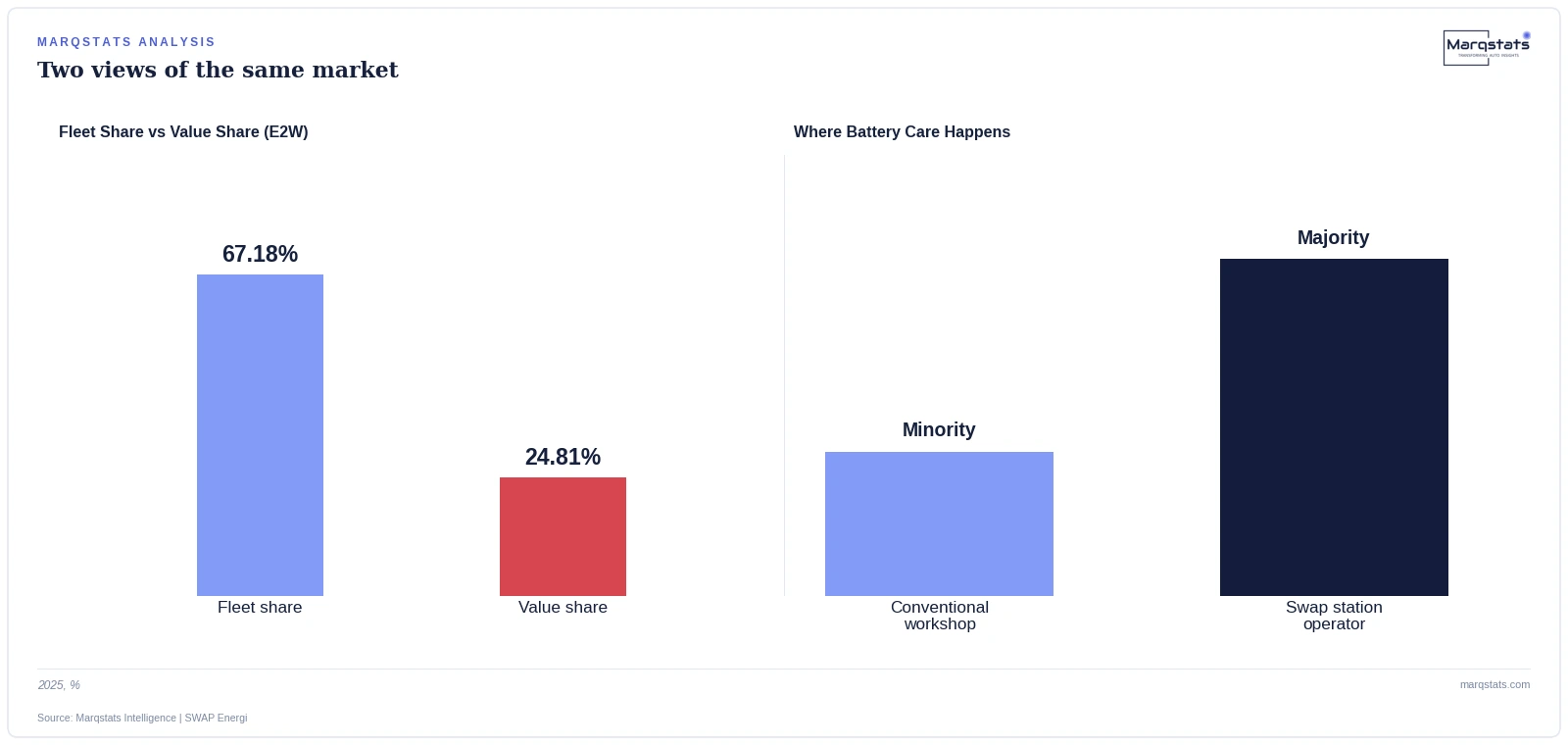
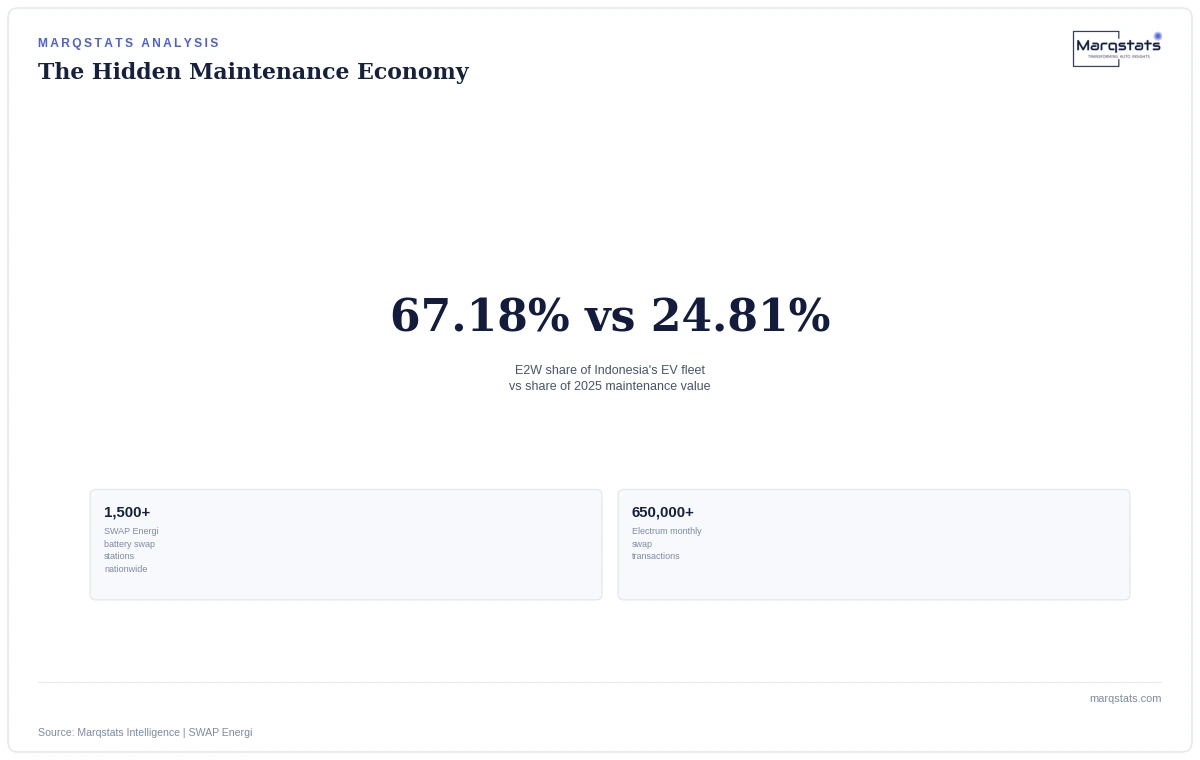
Electric two-wheelers make up 67.18% of Indonesia's entire EV fleet by unit count -- nearly seven in ten electrified vehicles on Indonesian roads. Their share of national maintenance value is a fraction of that.
The Numbers Behind the Gap
These specific figures trace directly to the underlying research's own fleet and market-sizing data, not a rough estimate.
In brief: electric two-wheelers generate just 24.81% of this market's 2025 maintenance value despite dominating the fleet by unit count. Part of that gap is the usual story -- smaller vehicles need simpler service. But that alone doesn't account for the size of the gap.
Where the Rest of the Maintenance Economy Actually Went
The missing piece isn't missing demand -- it's demand that's been rerouted entirely outside the measurement this market tracks.
For the meaningful share of that two-wheeler fleet running on swappable battery platforms, the single highest-value maintenance task a battery ever requires -- health monitoring, cell balancing, degradation management -- doesn't happen at a conventional repair workshop at all. It happens automatically every time a rider swaps a depleted pack for a charged one. PT SWAP Energi Indonesia alone operates more than 1,500 active swapping stations nationwide, while Electrum's centralized hubs process over 650,000 monthly swap transactions for its commercial fleet alone.
A Named Comparison: Why Conventional Workshop Statistics Can't See This
This isn't a measurement error in the underlying research -- it's a structural feature of how battery swapping works.
A conventional aftermarket maintenance market is built on a simple assumption: vehicle owners pay workshops to service their vehicles. Battery swapping breaks that assumption at its foundation. The battery never belongs to the rider in the first place, and its health management is bundled into the price of every swap transaction rather than billed as a separate service. Workshop billing data, by design, cannot see activity that never passes through a workshop.
Why This Matters More as Swap Networks Keep Scaling
The measurement gap doesn't shrink as the market matures -- if anything, it should widen.
As battery-swap infrastructure continues expanding across Indonesia's urban centers, an increasing share of the country's largest EV fleet segment by count will have its primary maintenance need handled entirely outside the conventional workshop economy this market measures -- meaning the true scale of Indonesia's EV battery-care economy is, and will remain, larger than this market's own headline figure suggests.
What This Means for Anyone Sizing This Market
The practical takeaway: analysts, investors and workshop operators evaluating Indonesia's EV two-wheeler segment specifically should treat swap-station infrastructure scale as a parallel indicator worth tracking alongside conventional workshop revenue, since the two together -- not workshop billing alone -- describe the segment's real economic activity.