
A Fuel Policy That Sends More Oil Into the Sump
Most governments that change fuel rules expect lubricant demand to fall. In Indonesia the change to diesel is doing the opposite for trucks.
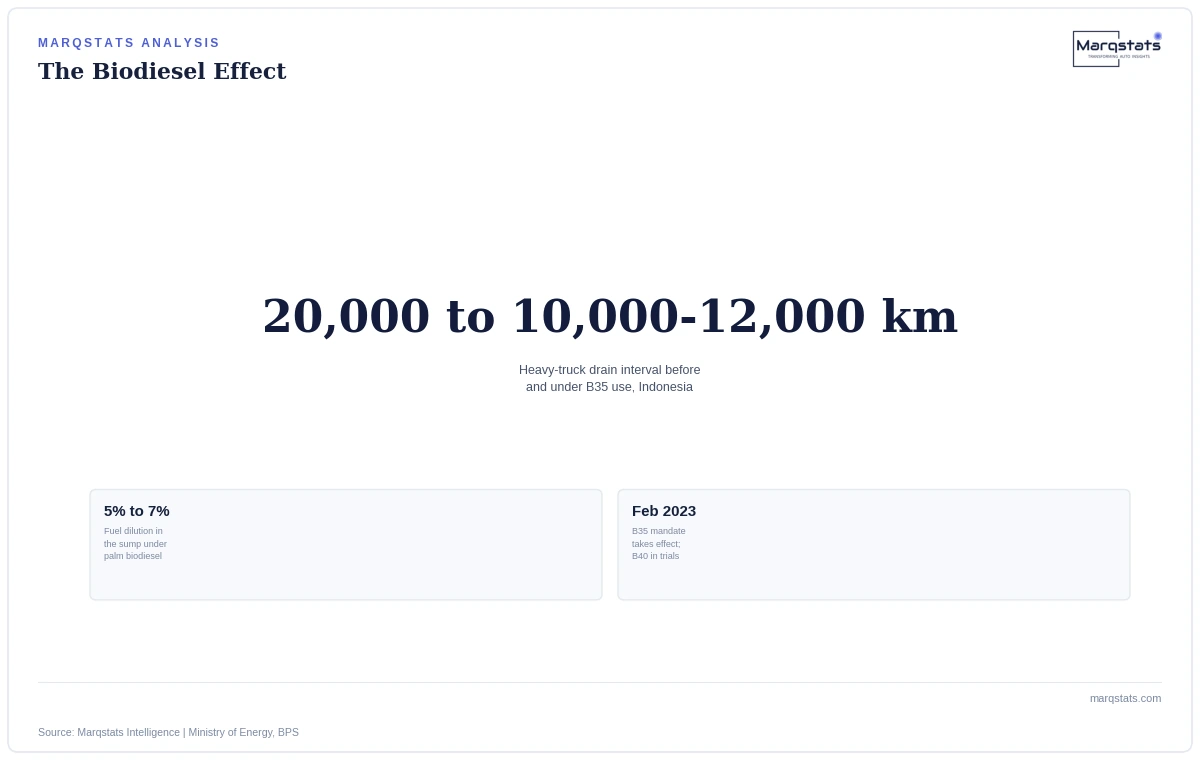
The energy ministry raised the palm methyl ester content of road diesel from 30% to 35%, called B35, in February 2023. Technical fleet trials of B40 have run through 2025 and 2026. The research reports that the mandate has forced commercial fleets to change oil far more often.
Why Palm Biodiesel Is Hard on Engine Oil
The problem is the boiling point of the fuel.
Palm ester boils at 330 to 360 degrees Celsius, higher than petroleum diesel. Fuel that slips past the piston rings during normal running does not evaporate out of the sump, so dilution passes 5% to 7%. The unsaturated fatty acid chains polymerise, which thickens the oil and forms sludge. The ester also attracts water and oxidises into acids, which use up the oil's alkaline reserve, its total base number, faster than petroleum diesel does.
What Fleets Have Done
Operators have shortened the interval between oil changes.
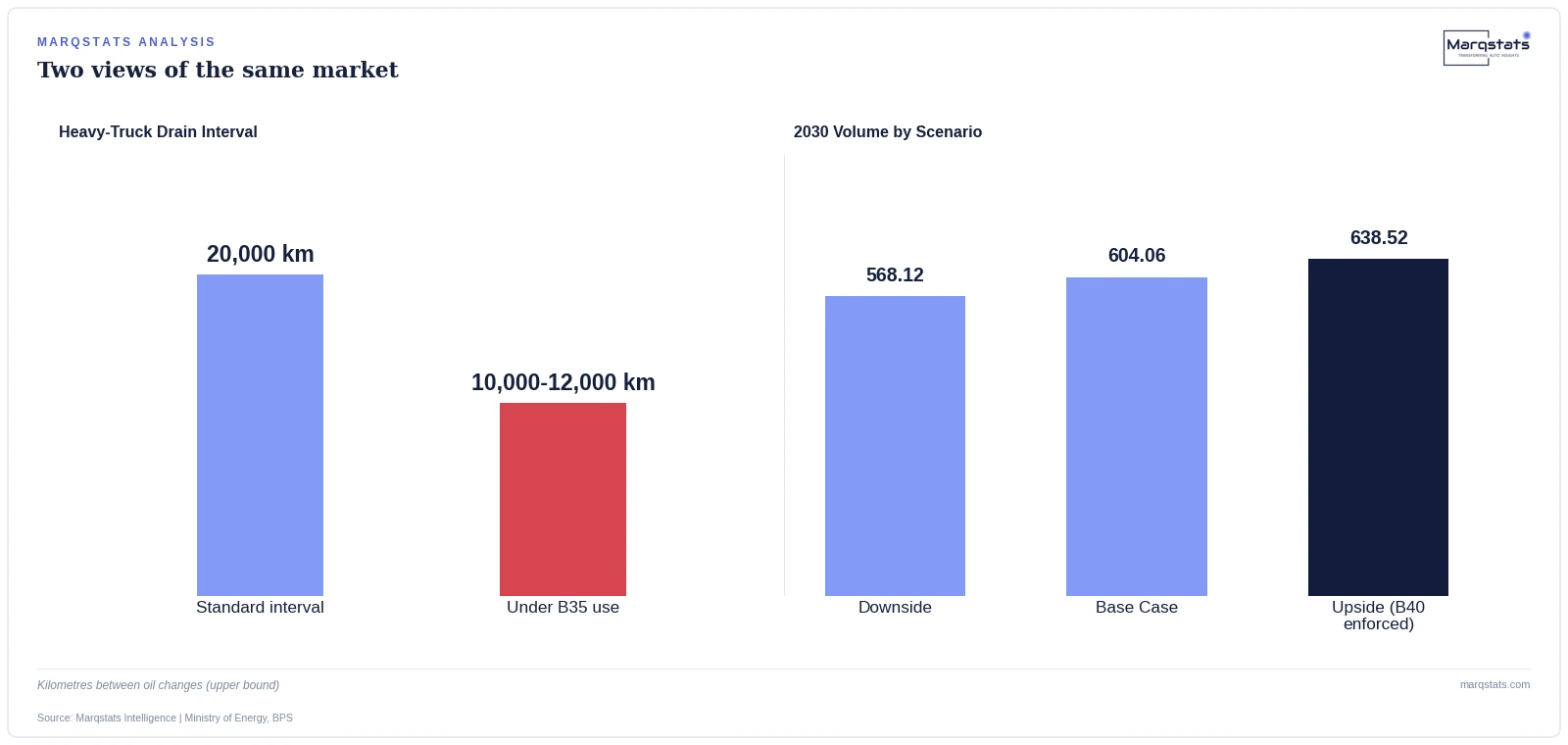
Fleets running heavy trucks have cut standard drain intervals from 20,000 km to 10,000 to 12,000 km. The research's severe-duty table puts a heavy rigid or hauler at 10,000 to 15,000 km between changes, 3.5 to 5.0 services a year and 75 to 120 litres of oil per truck a year, against 18 to 24 litres for a light commercial diesel.
A Named Comparison: How Blenders Are Responding
Oil companies are selling different products for the same trucks.
Formulators have introduced high-TBN heavy-duty oils with stronger dispersants, oxidation inhibitors and shear-stable viscosity improvers. The research names Pertamina's Meditran SX Bio series, Shell Rimula R4 X and Mobil Delvac Modern. In July 2025 Pertamina also launched Fastron Diesel SAE 5W-30 synthetic for common-rail SUVs and light commercials on B35 fuel.
Why It Moves the Forecast
B40 enforcement is one of the named triggers that separate the market's three futures.
In the Base Case, B35 stays the standard and B40 arrives in phases, and volume reaches 604.06 million litres by 2030. In the Upside, the energy ministry enforces B40 across all commercial transport, severe duty shortens intervals further, and volume reaches 638.52 million litres. In the Downside, B40 is delayed, along with weaker growth and high interest rates, and volume reaches 568.12 million litres. The scenarios also change GDP, interest rates and vehicle sales, so B40 is not the only cause of the gap.
What This Means for Fleets and Suppliers
The practical takeaway: fleet operators should plan for 10,000 to 12,000 km intervals, monitor oil condition regularly and choose high-TBN grades before B40 arrives, and suppliers should sell detergency packages that prevent palm-ester polymerisation, water uptake and rapid alkalinity loss.