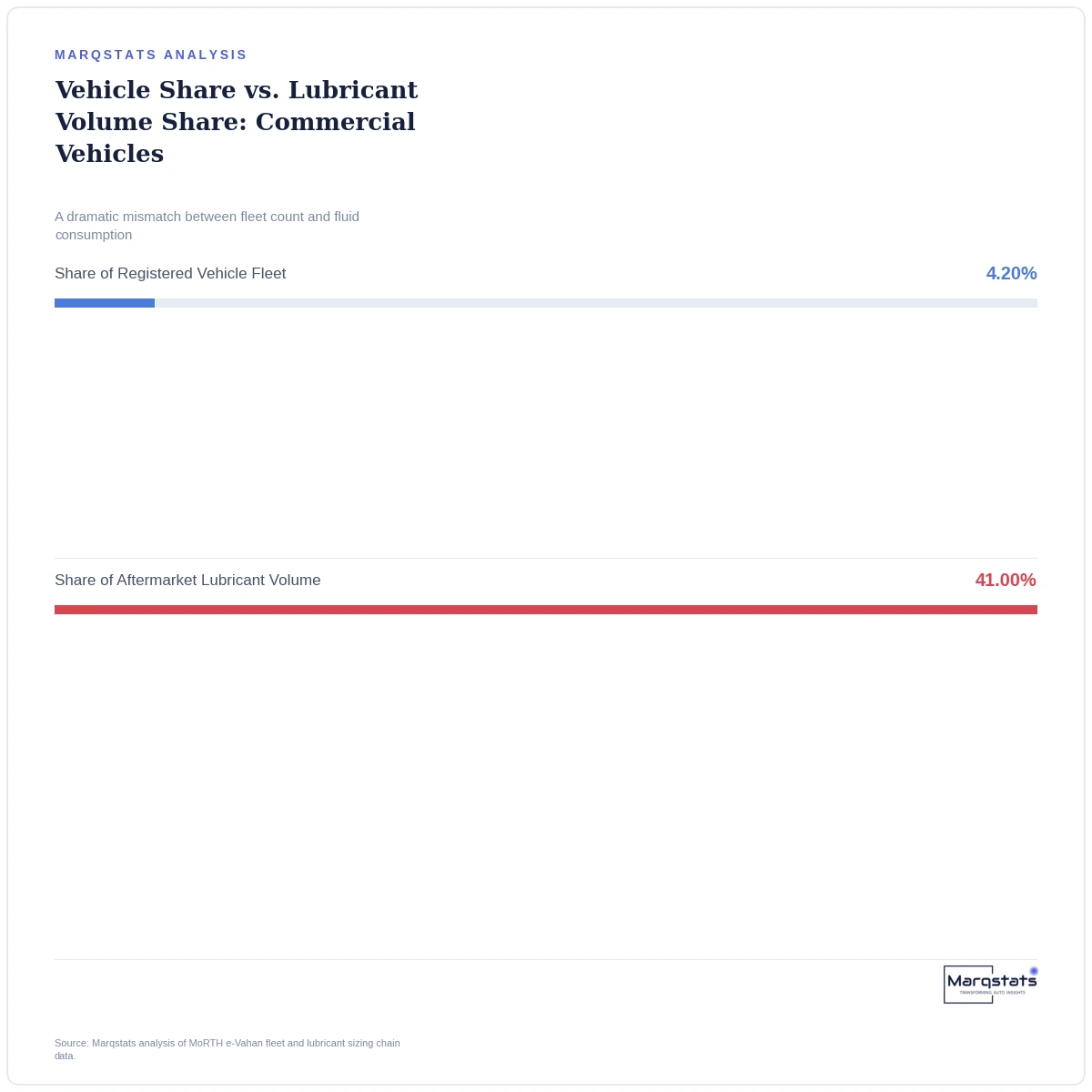
India's trucks are 4% of the fleet. They drink 41% of the oil.
In brief:
- Commercial vehicles comprise just 4.20% of India's 389.77 million-unit registered fleet.
- That same segment absorbs 41.00% of total automotive lubricant aftermarket volume.
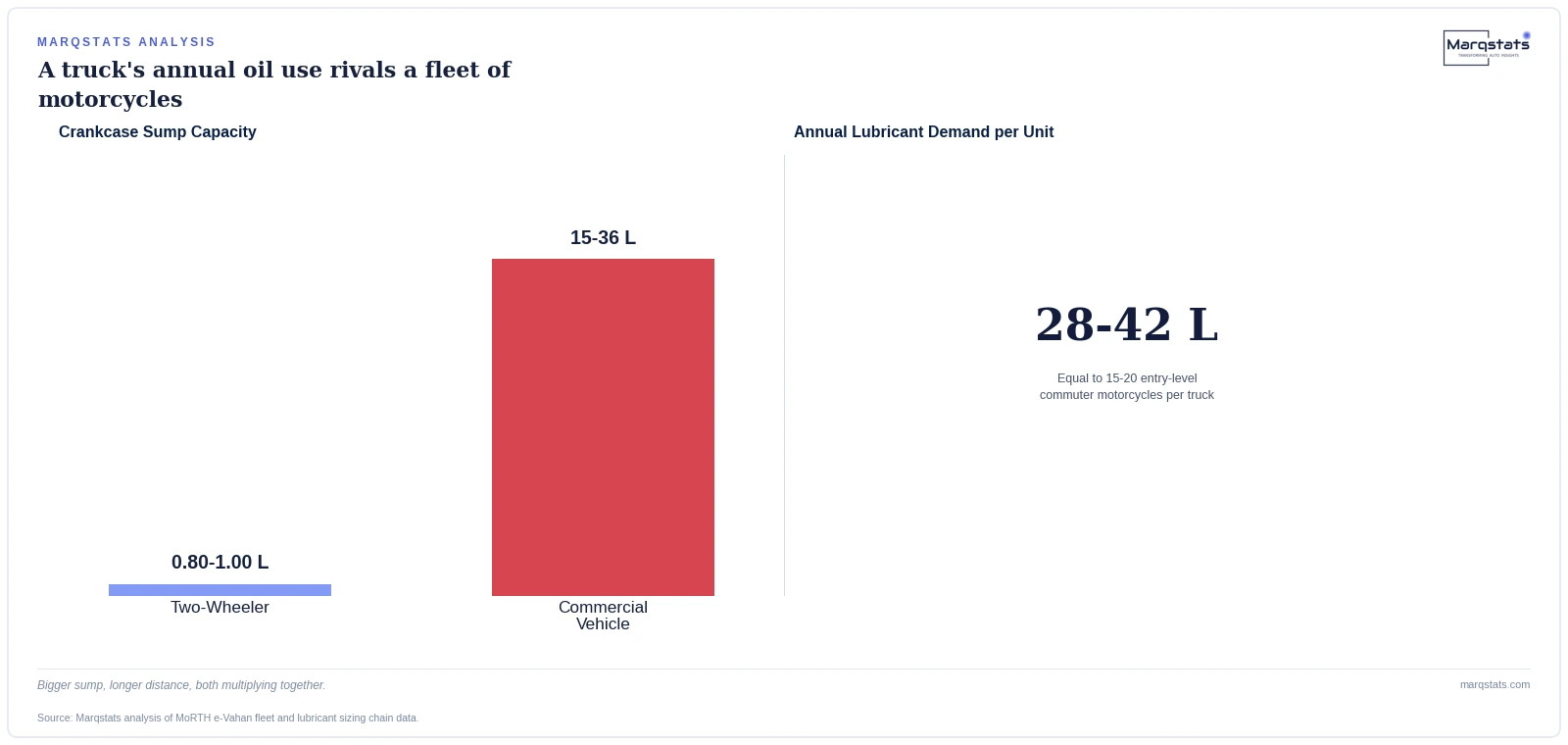
- A single multi-axle freight truck consumes 28 to 42 liters annually, equal to 15 to 20 commuter motorcycles.
If you sized India's lubricants market by counting vehicles, you'd get the picture badly wrong. Two-wheelers vastly outnumber trucks on Indian roads. But when it comes to how much oil actually gets sold, trucks dominate by a wide margin.
The numbers that explain the gap
India's registered vehicle fleet, tracked through the Ministry of Road Transport and Highways e-Vahan portal, reached 389.77 million units. Medium and heavy commercial vehicles plus light commercial vehicles together make up just 16.37 million of that total, 4.20%. Yet this small slice consumes 41.00% of all automotive aftermarket lubricant volume. Two multiplying factors explain the gap: how much oil each vehicle holds, and how hard each vehicle works.
A single truck's annual oil consumption can rival fifteen to twenty motorcycles combined.
— Marqstats Analyst Team
Why one truck holds as much oil as dozens of two-wheelers
A typical Indian two-wheeler carries a crankcase sump capacity of just 0.80 to 1.00 liters. A medium or heavy commercial vehicle, by contrast, carries 15.00 to 36.00 liters, an order of magnitude more oil per vehicle. Annual travel compounds this further: two-wheelers cover 6,000 to 8,000 kilometers a year, while commercial trucks log 60,000 to 90,000 kilometers on inter-state freight corridors, ten times the distance.
Why India's freight backbone runs almost entirely on diesel
This concentration of demand reflects India's underlying freight economy directly. Road transport moves the overwhelming majority of India's domestic freight tonnage, and national highway expansion, progressing at roughly 33.8 kilometers constructed per day, has increased average commercial vehicle utilization further, raising annual vehicle-kilometers traveled even as mechanical engine efficiencies improve. Electrification has barely touched this segment: medium and heavy trucks remain under 0.2% electrified as of fiscal year 2025-26, compared to 55% to 60% penetration for electric three-wheelers. Long-haul diesel freight is, and will remain through 2030, the primary volume driver in this market.
Why BS-VI Phase II is making this segment more valuable, not just voluminous
Regulatory change is reinforcing this segment's importance in dollar terms specifically. BS-VI Phase II Real Driving Emissions standards, in force since 1 April 2023 for commercial vehicles, require API CK-4 and CJ-4 Low-SAPS formulations to protect diesel particulate filters and selective catalytic reduction systems from sulfated ash fouling. These premium diesel oils command meaningfully higher prices than the legacy monograde products they replace, meaning this already-dominant volume segment is becoming a higher-value one simultaneously.
The counter-argument: won't the Vehicle Scrappage Policy and freight electrification eventually erode this dominance?
A fair question is whether India's Voluntary Vehicle-Fleet Modernization Program, phasing out commercial vehicles older than 15 years, combined with eventual electric truck adoption, might meaningfully shrink this segment's outsized lubricant demand over time. This is a genuine structural pressure worth taking seriously, and it's precisely the trigger condition behind this market's own Accelerated Transition scenario, which models scrappage removing roughly 15 million older, high-oil-consuming vehicles. Even under that more aggressive case, though, total market value still grows, reaching Rs 68,500 crore by 2030 at a 7.85% CAGR, since newer trucks entering the fleet under BS-VI Phase II still require premium diesel formulations, and heavy-duty electrification faces steeper technical barriers, battery weight against payload capacity, charging infrastructure across India's vast freight corridors, than lighter vehicle classes.
What this means for blenders and fleet operators
- Lubricant blenders should prioritize commercial diesel formulation capacity and BS-VI Phase II Low-SAPS compliance specifically, given the disproportionate volume and rising value this segment represents.
- Fleet operators and logistics companies should budget for premium API CK-4/CJ-4 formulations as a structural cost of BS-VI Phase II compliance, not a discretionary upgrade.
- Investors evaluating this market should weight commercial vehicle segment trends, freight growth, scrappage enforcement and BS-VI adoption, more heavily than aggregate passenger vehicle statistics alone would suggest.
How two-wheelers compensate for smaller volume with population scale
It's worth being fair to the two-wheeler segment, since its 225 million active units still generate the second-largest volume share in the market at 28.50%. While no individual motorcycle consumes remotely as much oil as a single truck, the population scale is genuinely enormous, and each service event carries a meaningfully higher retail margin than commercial bulk fluid sales. Branded 900-milliliter and one-liter retail containers, sold through India's extensive independent bazaar trade network, generate the kind of packaging premium that bulk-delivered commercial diesel oil simply cannot match on a per-liter basis.
This is precisely why India's aftermarket exhibits its own distinctive value-volume split within the volume story itself: commercial vehicles anchor absolute volume through sheer per-unit consumption, while two-wheelers anchor a meaningfully high-margin retail revenue stream through sheer population scale and packaged product premiums. Both segments matter, but for genuinely different reasons.
Why agricultural tractors add a third, seasonal volume layer
There's a third vehicle category worth understanding alongside commercial trucks and two-wheelers: agricultural tractors and farm implements, which generate 14.80% of aftermarket volume despite comprising a comparatively modest 8.80 million active units. Tractor engines carry substantial sump capacities of 8.00 to 15.00 liters and operate on an hours-based duty cycle rather than a distance-based one, typically 600 to 900 operating hours annually with drain intervals of 250 to 400 hours. This creates a genuinely seasonal demand pattern concentrated around India's post-monsoon Kharif and Rabi harvest cycles, particularly across the Indo-Gangetic basin in the North zone, adding a distinctive agricultural rhythm to what is otherwise a fairly steady, freight-driven volume base.
Why the drain interval gap matters as much as the sump size gap
The sump capacity comparison only tells half the story. Drain intervals compound the gap further: a commercial truck's aftermarket drain interval runs 30,000 to 60,000 kilometers, while a two-wheeler's runs just 3,000 to 5,000 kilometers. On pure distance, that might suggest two-wheelers change oil more often relative to their travel. But because trucks cover so much more absolute distance annually, 60,000 to 90,000 kilometers against a two-wheeler's 6,000 to 8,000, the truck still completes multiple full drain cycles a year, each one moving 15 to 36 liters of fluid through the market rather than under a liter and a half.
This is the specific mechanical arithmetic underlying the market's own per-unit demand table: a commercial vehicle generates 28.00 to 42.00 liters of annual lubricant demand per unit, compared to just 1.80 to 2.50 liters for a two-wheeler, a roughly fifteen-to-one ratio per vehicle that, multiplied against the fleet's actual population split, produces the 41.00% versus 28.50% volume outcome this market demonstrates.
The full market picture
Marqstats' complete Indian automotive lubricants aftermarket analysis, including the full three-scenario forecast through 2030, is available in the linked report below.
Related reportIndia Automotive Lubricants Aftermarket Size, Share & Forecast 2026 – 2030