German lubricant volume is falling. Market value is climbing anyway.
In brief:
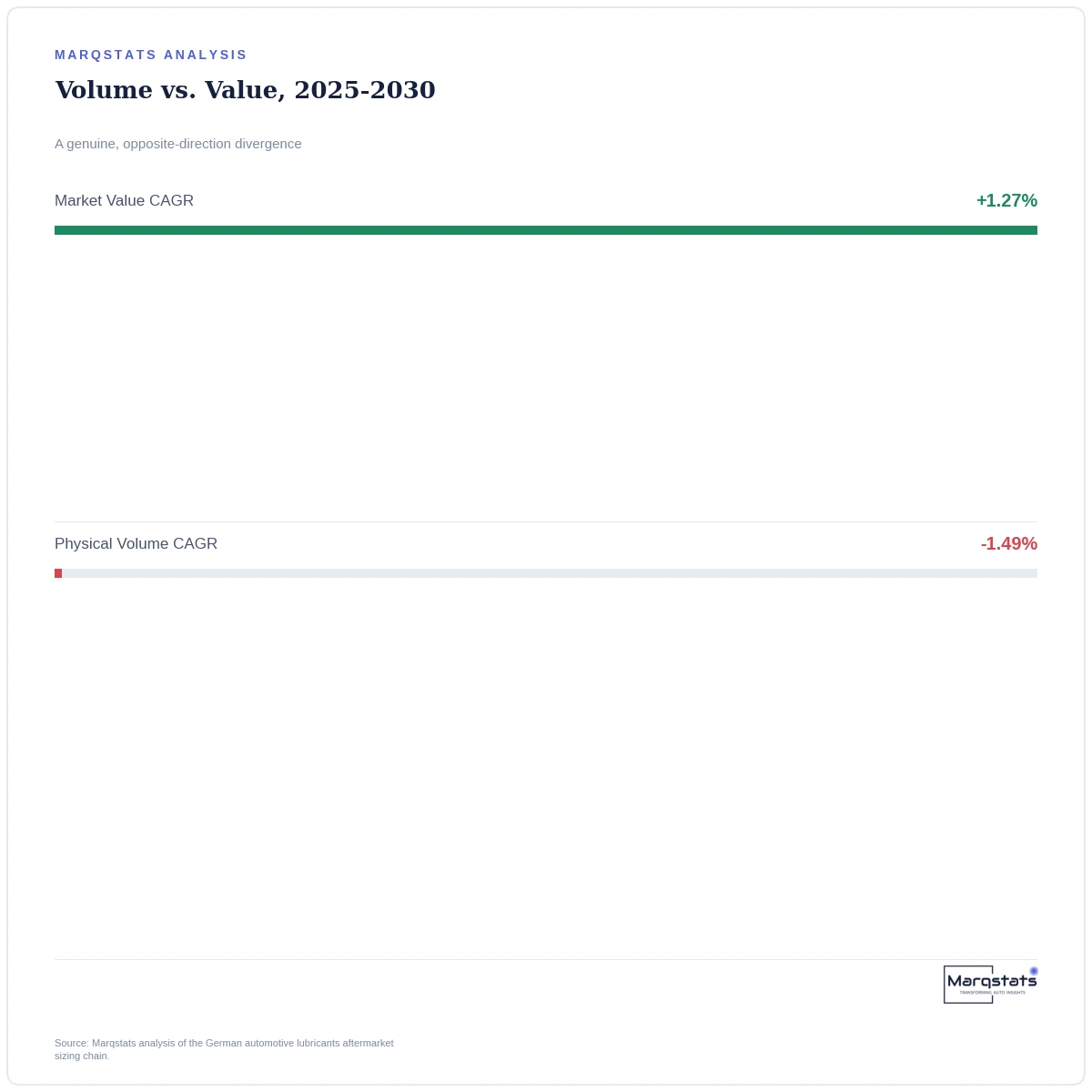
- German automotive lubricant volume contracts from 348,500 to a projected 323,300 metric tonnes by 2030, a -1.49% CAGR.
- Market value grows from €2,450.00 million to €2,610.00 million over the same period, a +1.27% CAGR.
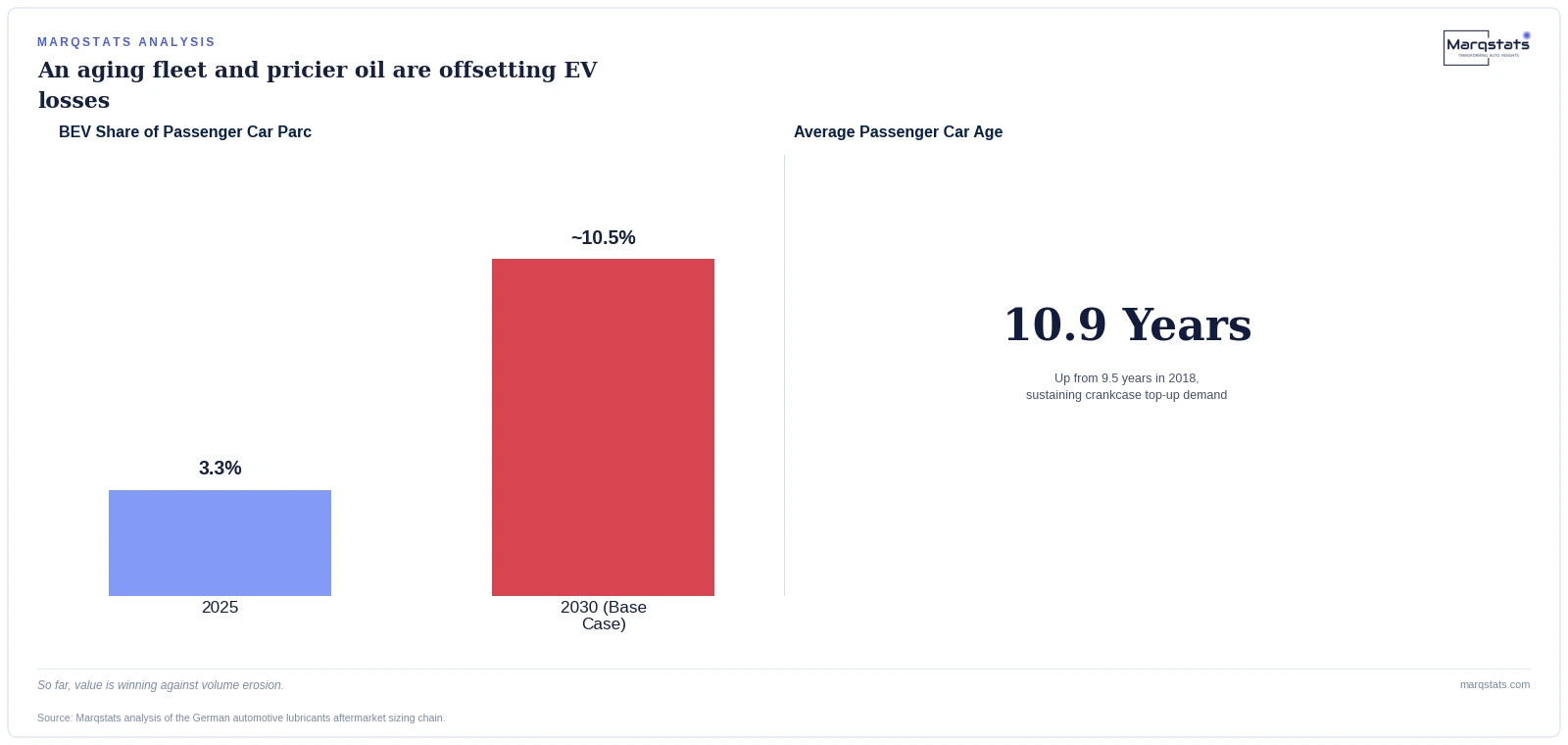
- Battery electric vehicles expand from 3.3% to approximately 10.5% of the passenger car parc by 2030.
Two forces are pulling in opposite directions inside Germany's automotive lubricants aftermarket, and the outcome depends on which one moves faster. So far, value is winning, even as volume genuinely shrinks. Right now, value is winning by a real, measurable margin.
Why volume is falling
The mechanism here is straightforward and mechanical: battery electric vehicles don't need crankcase oil. As BEVs expand from 3.3% of Germany's passenger car parc at the start of 2025 toward a projected 10.5% by 2030, roughly 5.2 million vehicles, each one that replaces an internal combustion car removes that vehicle's entire future crankcase oil demand from the addressable market. Extended OEM oil drain intervals compound this effect on the remaining combustion fleet, further reducing per-vehicle consumption even among vehicles that haven't electrified. That's a permanent, one-way loss for the aftermarket, not a temporary dip.
Every electric vehicle added to the fleet is one fewer future customer for crankcase oil, permanently.
— Marqstats Analyst Team
Why the aging fleet is fighting back against that decline
Working against that erosion is a genuinely powerful counterforce: Germany's internal combustion fleet is getting older, not younger. The average passenger car age climbed to 10.9 years by year-end 2025, up from 9.5 years in 2018, an unbroken multi-year trend. Older engines exhibit higher mechanical clearances and greater top-up oil consumption between scheduled services, a mechanical reality that partially offsets the volume BEVs are removing from the market. With 88.3% of German passenger cars registered to private owners who tend to keep vehicles running well past the manufacturer warranty window, this aging effect isn't a marginal factor, it's a structural feature of how Germans actually own and use cars.
Why value is growing even though volume isn't
The value side of the equation is driven by a genuinely separate mechanism: regulatory-mandated premiumization. ACEA C7-23, part of the mandatory ACEA 2023 Light-Duty Sequences that became the exclusive marketing basis on 1 August 2025, requires ultra-low viscosity SAE 0W-16 formulations for modern engines. These formulations command meaningfully higher wholesale prices per liter than the conventional mineral and semi-synthetic products they replace. As the market mix shifts, fully synthetic formulations are projected to expand from 44.05% to 50.63% of volume by 2030, each liter sold, on average, generates more revenue than it did a few years earlier, even as the total number of liters sold declines.
Why this specific combination is genuinely rare
It's worth being clear about why this pattern is noteworthy rather than simply expected. In many markets facing genuine electrification-driven volume decline, value tends to decline in tandem, since there's no comparable premiumization force strong enough to offset shrinking unit sales. Germany's combination of an unusually old, well-documented vehicle parc and a stringent, actively enforced technical specification regime creates conditions where premiumization can genuinely outpace volume erosion, at least under the market's Base Case trajectory.
The counter-argument: could this value cushion eventually run out as electrification accelerates further?
A fair question is whether this value growth is a durable, multi-year feature of the German market, or simply a temporary cushion that will eventually be overwhelmed if BEV adoption accelerates beyond the Base Case's gradual pace. This is precisely the logic tested by the market's own Downside Scenario, which models exactly this acceleration, BEV penetration reaching 16.0% by 2030 alongside federal fleet renewal incentives prematurely retiring older vehicles, and even under that considerably more aggressive scenario, market value only turns modestly negative, at a -0.25% CAGR, a genuinely small contraction relative to the volume decline of -3.12% that scenario projects. Even accelerated electrification doesn't fully erase the value cushion premiumization provides; it simply narrows it.
What this means for blenders and investors
- Lubricant blenders should track dollar-per-liter realization as the primary growth metric for the German market, given how structurally decoupled volume and value have become.
- Investors evaluating this market should weight exposure toward fully synthetic and re-refined formulation capacity specifically, since forecast value growth concentrates almost entirely there.
- Market participants should model the Downside Scenario explicitly when planning long-term capacity, since even accelerated electrification narrows rather than eliminates the value cushion fleet aging and premiumization provide.
How commercial freight adds a third, separate stabilizing force
There's a third dynamic reinforcing this value story, sitting alongside passenger car aging and formulation premiumization: commercial freight resilience. Heavy-duty engine oil consumption is declining by less than 1.0% annually along major transit corridors, a genuinely small contraction compared to the passenger car segment, because technical hurdles facing electric commercial prime movers, battery weight, range and charging infrastructure across long-haul freight corridors, remain considerably steeper than for passenger vehicles. Germany's export-oriented economy depends heavily on road freight along corridors like the A1, A2 and A7, and that freight volume shows no sign of meaningfully declining even as passenger vehicle electrification accelerates.
This matters because heavy-duty motor oil, unlike passenger car motor oil, is actually projected to gain share of the total aftermarket, expanding from 28.52% in 2025 to 29.32% by 2030. A segment that's both volumetrically resilient and gaining relative share functions as a genuine structural ballast for the overall market, distinct from and additive to the aging-fleet and premiumization effects already discussed.
Why this pattern should inform how blenders allocate capital
For a lubricant blender deciding where to direct capital and formulation research within the German market specifically, this three-part value story, aging-driven passenger car top-up demand, regulatory-driven synthetic premiumization, and freight-driven heavy-duty resilience, suggests a genuinely different allocation than a naive read of aggregate market contraction would imply. Rather than treating the German market as simply shrinking and deprioritizing investment accordingly, the more accurate read is that specific segments within the market, fully synthetic passenger car formulations, ACEA F01-24-compliant heavy-duty products, and re-refined circular base oils, are each independently well-positioned for continued growth even as the aggregate volume figure declines.
This is precisely the strategic logic LIQUI MOLY appears to be following in practice: sustaining 8.0% revenue growth in 2025 despite the broader market's volumetric contraction, by capturing disproportionate share of exactly the premiumized, higher-value segments this analysis identifies as the market's genuine growth engines.
The full market picture
Marqstats' complete German automotive lubricants aftermarket analysis, including the full three-scenario forecast through 2030, is available in the linked report below.
Related reportGermany Automotive Lubricants Aftermarket Size, Share & Forecast 2026 – 2030