A Statistic That Looks Straightforward Until You Check Where the Cars Actually Go
Germany's new-car registration data looks like a clean, simple metric: count the registrations by region, and you know where the market is. KBA's own data shows that assumption breaks down almost immediately once you look at who is doing the registering.
The Share That Changes the Picture
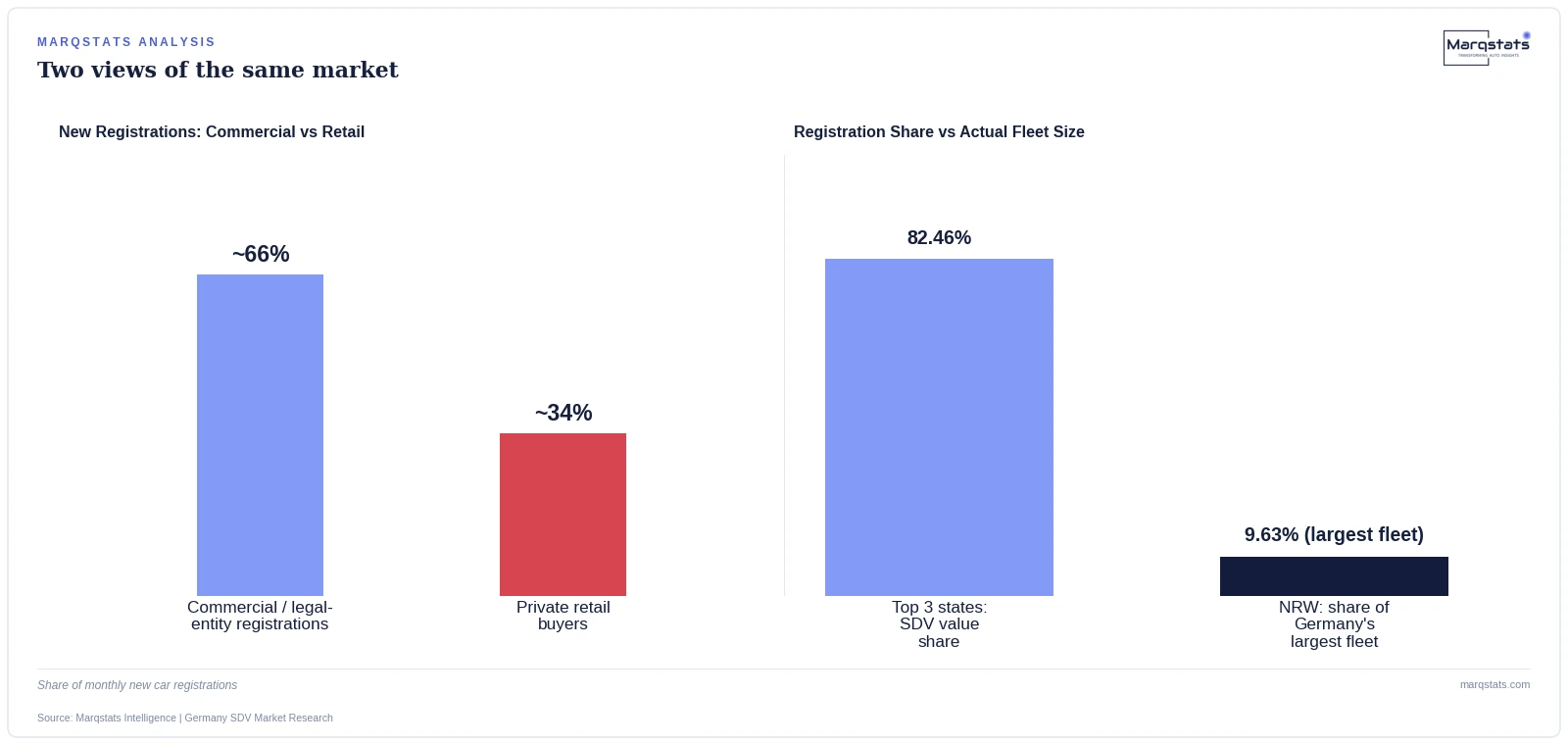
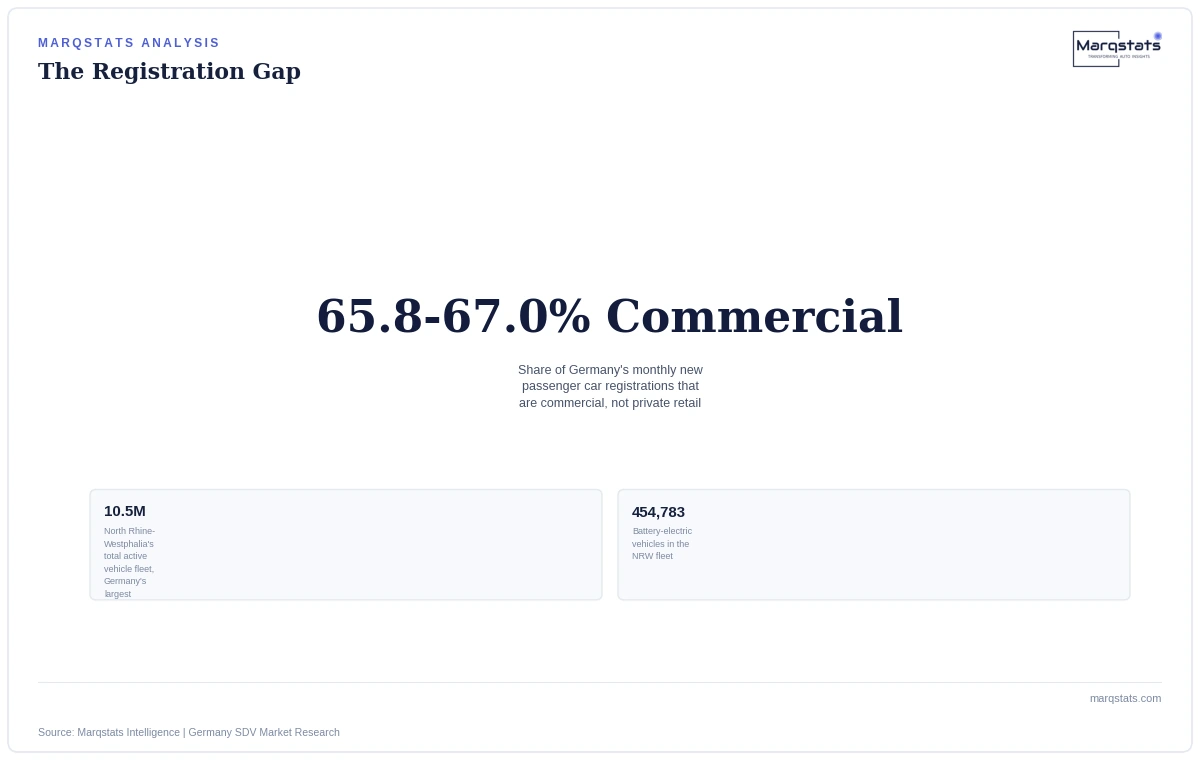
Between 65.8% and 67.0% of all monthly new passenger car registrations in Germany represent commercial and legal-entity registrations (gewerbliche Zulassungen). Private retail purchasers account for only about one-third of the market. And commercial fleet operators, leasing companies and manufacturer test fleets don't register vehicles where they're driven; they register them centrally, in corporate districts like Wolfsburg, Munich, and the Stuttgart and Böblingen districts, for administrative and tax efficiency, regardless of where the vehicle physically operates afterward.
The Region This Distortion Hides
The practical consequence: Baden-Württemberg, Bavaria and Lower Saxony look like the overwhelming centre of Germany's automotive world in registration statistics, and for production, R&D and corporate headquarters, they genuinely are. But North Rhine-Westphalia, which maintains a standard proportion of retail buyers rather than corporate fleets, quietly holds Germany's largest active vehicle fleet: 10.5 million total passenger cars, including 454,783 battery-electric vehicles. That makes NRW the country's densest environment for actual over-the-air update delivery, connected mobility usage, and third-party telematics activity under the EU Data Act, activity that barely registers in a production-and-registration view of the market.
What This Means for Anyone Reading German Market Data
The takeaway is simple but easy to miss: registration data measures where a vehicle enters the fleet administratively, not where it lives operationally. For a telematics provider, a connected-services vendor, or anyone planning regional go-to-market coverage in Germany, weighting investment by registration share alone would systematically overallocate toward Wolfsburg, Munich and Stuttgart and underallocate toward exactly the kind of retail-heavy, high-density region, like North Rhine-Westphalia, where connected vehicles actually spend most of their operational lives.