
A Salary Gap Real Enough to Build a Campus Around
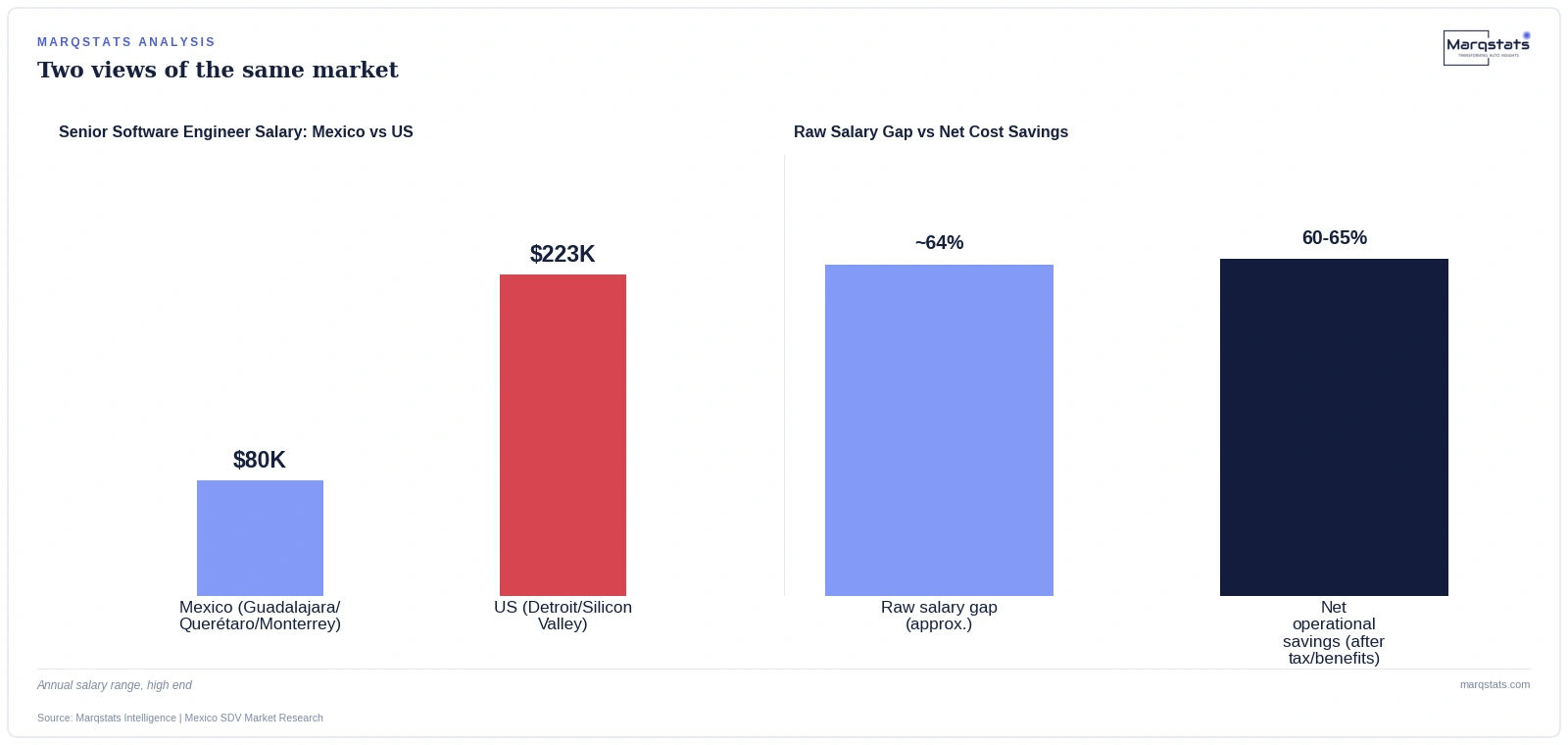
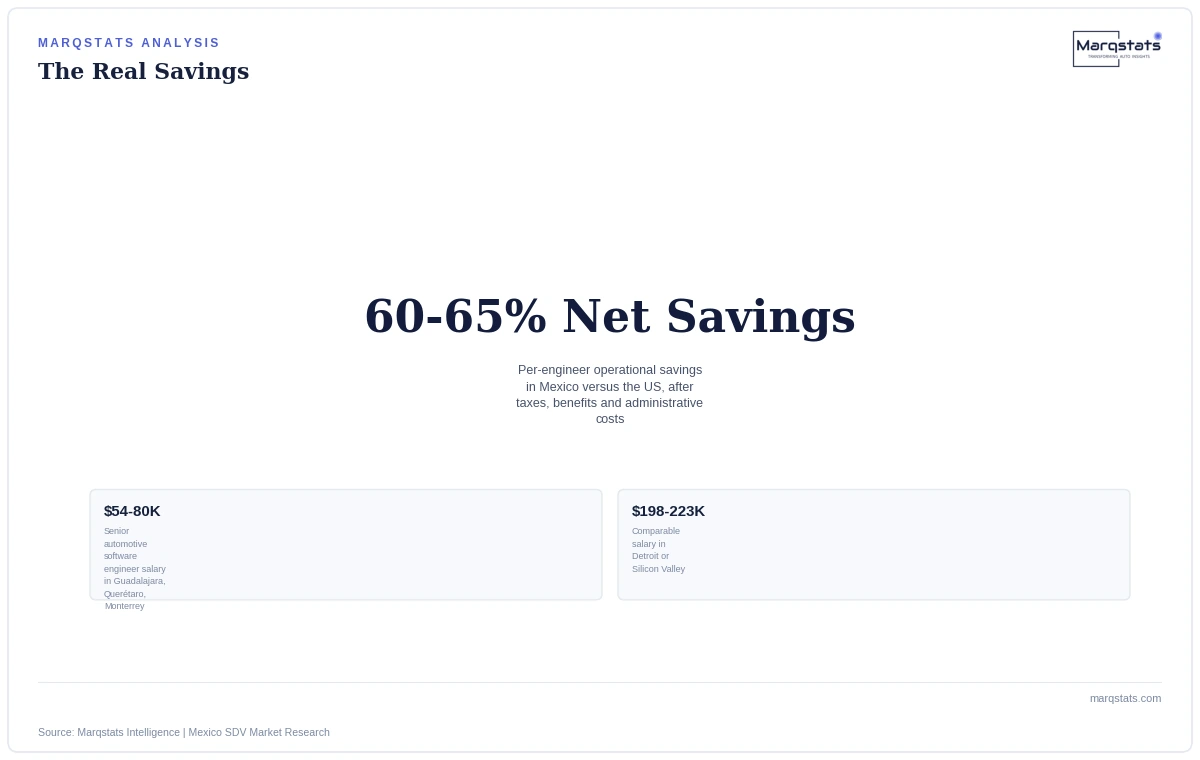
Senior automotive embedded software engineers in Guadalajara, Querétaro and Monterrey earn between USD 54,000 and USD 80,000 a year. Their counterparts in Detroit or Silicon Valley earn USD 198,000 to USD 223,000 for comparable work. That gap alone would justify serious investment, and it has: Ford's Global Technology and Business Center in Naucalpan de Juárez is built for up to 9,000 employees and already houses over 4,000, one of only three primary Ford technology centres anywhere in the world.
The Part of the Calculation That Doesn't Show Up in the Salary Line
The raw salary comparison, USD 54-80K versus USD 198-223K, already looks like roughly a two-and-a-half to four-fold difference. But once taxes, mandatory benefits and administrative overhead are factored in on both sides of the comparison, North American manufacturers realize 60% to 65% net operational savings per engineer, a wider gap than the headline salary numbers alone suggest. Layer on Central and Eastern time zone overlap, which supports real-time daily collaboration with US engineering teams rather than the overnight handoffs a lower-cost location in a distant time zone would require, and the economic case gets stronger still.
Why This Isn't Just About Cost
If this were purely a cost play, Mexican engineering centres would look like offshore support desks: junior staff executing specifications written elsewhere. That is not what the facilities on the ground actually do. Bosch operates a dedicated Bosch Global Software Technologies centre in Guadalajara focused on AUTOSAR Adaptive middleware and ISO 26262 functional safety engineering, genuine systems-level work. Querétaro has built an automotive R&D cluster with over 350 Tier-1 and Tier-2 suppliers developing steer-by-wire algorithms and automated transmission control software from scratch. Aptiv's Ciudad Juárez Technical Center runs more than 800 engineers on vehicle network packaging and active safety systems, core architecture decisions, not downstream testing.
What This Means for Where the Next Facility Gets Built
The practical takeaway: the companies getting the most value from Mexican engineering investment are the ones treating these centres as genuine R&D assets with real ownership over specific technical domains, not interchangeable staffing pools competing purely on hourly rate. For any OEM or Tier 1 supplier still weighing where to place the next embedded-software team, the Mexico calculation is stronger than the salary comparison alone suggests, and the deciding factor increasingly isn't cost at all: it's which facility gets handed genuine architectural ownership rather than just execution work.