ENEOS just absorbed ExxonMobil's old Japan lubricants business into direct corporate control
For nearly a decade, EMG Lubricants Godo Kaisha operated as a distinct subsidiary within Japan's largest energy company, carrying forward the legacy of ExxonMobil's Mobil-branded lubricants business in the country. As of 1 January 2026, that separate corporate identity is gone.
What actually happened
ENEOS Corporation formally decided to absorb EMG Lubricants Godo Kaisha, its wholly owned subsidiary handling lubricants business, effective 1 January 2026. This is a statutory absorption-type merger, EMG Lubricants ceases to exist as a separate legal entity, and its operations, assets and contracts transfer directly into ENEOS Corporation. The company has stated the move is intended to further streamline the lubricants business and strengthen competitiveness, with plans to gradually transfer some lubricant product manufacturing and logistics functions from the Yokohama plant to the former EMG Tsurumi lubricants plant by around March 2028.
A separate brand identity that survived multiple corporate reorganizations just quietly disappeared into direct corporate control.
— Marqstats Analyst Team
Why this particular subsidiary existed at all
EMG Lubricants traces back to ExxonMobil's Japanese downstream operations. When ExxonMobil exited its stake in what eventually became part of the ENEOS group years earlier, the lubricants marketing arm for Mobil-branded products was carved out as a distinct entity specifically to manage brand continuity and business development for those products, a structure that made sense during a period of active brand transition but that became less necessary as ENEOS Corporation itself matured as the unified successor entity to that earlier consolidation.
Why the timing and structure matter commercially
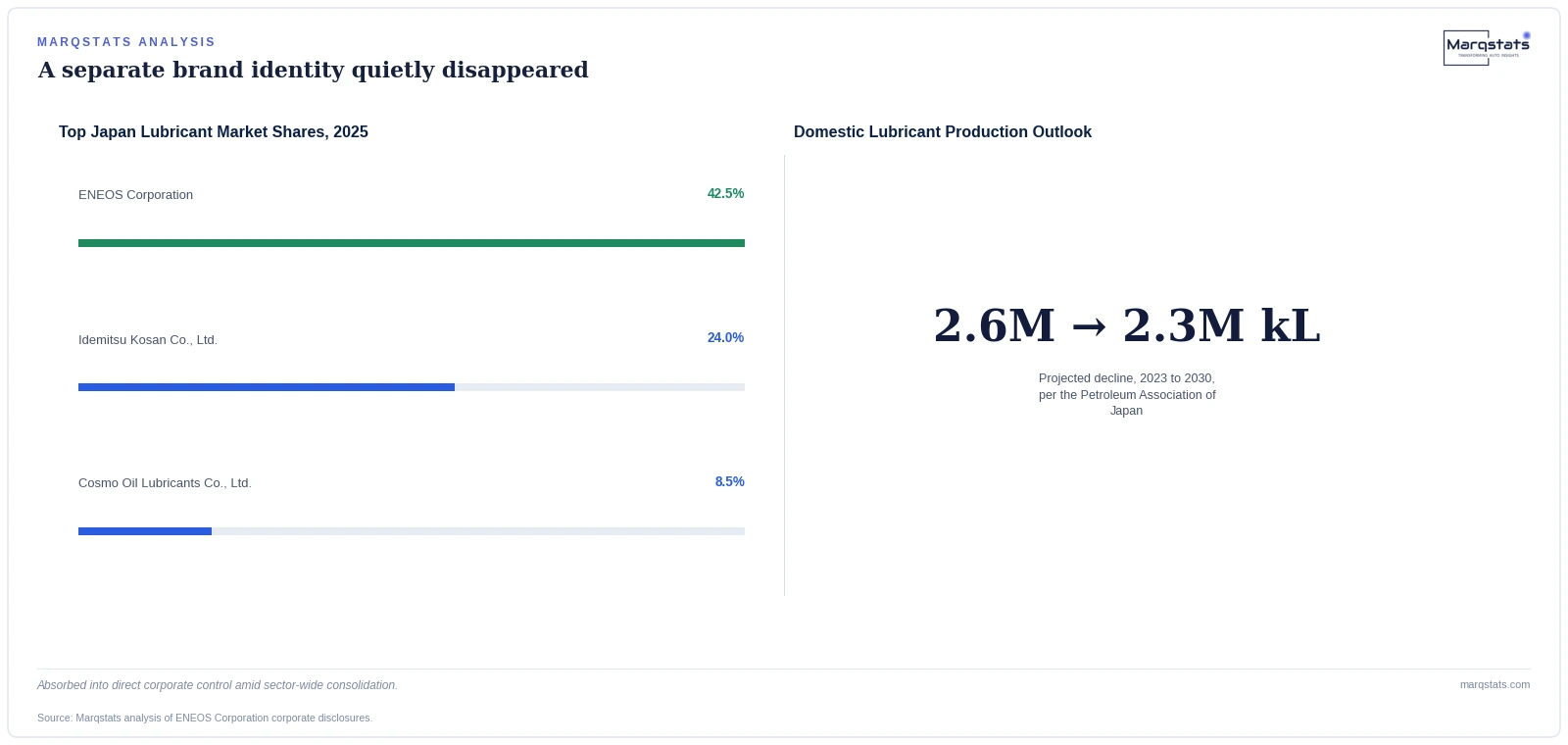
A full legal absorption is a meaningfully different move than a simple rebranding or management reshuffle. It eliminates the administrative overhead of running EMG Lubricants as a separate legal entity, consolidated financial reporting, separate governance structures, intercompany transaction accounting, and it lets ENEOS present a single, unified balance sheet for its entire domestic lubricants operation. For a company already holding an estimated 42.50% share of Japan's automotive lubricants aftermarket, that kind of structural simplification is about operational efficiency and competitive positioning at scale, not correcting any particular weakness in the underlying business.
Why this fits a broader pattern of Japanese refining consolidation
This merger doesn't happen in isolation, it reflects a broader structural pressure across Japan's entire petroleum refining sector. The Petroleum Association of Japan projects domestic fuel consumption contracting by 2% to 2.5% annually, which is expected to lower total domestic lubricant refining output from 2.6 million kiloliters in 2023 to 2.3 million kiloliters by 2030. Against that backdrop of shrinking domestic refining capacity, consolidating operational structures, and securing external base oil supply where domestic production is retiring, exemplified by Idemitsu Kosan's comprehensive global base oil supply agreement with Saudi Aramco in February 2026, becomes a genuinely necessary strategic response rather than an optional efficiency move.
The counter-argument: does this level of market concentration risk reducing competition and consumer choice in Japan's aftermarket?
A fair concern is whether ENEOS consolidating an already-dominant 42.50% share into an even more unified corporate structure, on top of Idemitsu and Cosmo Oil's own scale, risks reducing genuine competitive pressure and consumer choice within Japan's lubricants aftermarket over time. This is a reasonable structural concern in any concentrated market. What complicates a purely negative reading, though, is that this specific merger doesn't actually increase ENEOS's market share, it restructures how an already-existing, already-counted business unit is legally organized, and genuine competitive alternatives, Idemitsu at 24.00% share, Cosmo Oil at 8.50%, foreign specialty marketers like BP Castrol, and independent blenders like WAKO'S, remain active and distinct participants in the market rather than being absorbed into this particular transaction.
What this means for competitors and suppliers
- Competing refiners and blenders should monitor ENEOS's consolidated operational efficiency gains as a competitive benchmark, given the scale advantage a unified corporate structure provides.
- Suppliers and distributors with existing EMG Lubricants contracts should confirm continuity terms directly with ENEOS Corporation following the formal legal absorption.
- Investors evaluating Japan's lubricants sector should track further base oil supply agreements, following Idemitsu's Aramco pact, as leading indicators of how refiners are managing domestic capacity contraction.
What the Tsurumi plant transfer signals about where ENEOS is investing
The physical manufacturing transfer detail is worth examining closely, since it says something concrete about ENEOS's longer-term production strategy. Rather than simply keeping both the Yokohama and the former EMG Tsurumi plants running in parallel indefinitely, ENEOS plans to gradually shift lubricant product manufacturing and logistics functions from Yokohama to Tsurumi by around March 2028, positioning the former EMG facility as the primary Eastern Japan lubricants manufacturing hub. That's a genuine consolidation of physical production infrastructure, not just a corporate paperwork exercise, and it suggests ENEOS sees efficiency gains in a single, unified production site over maintaining two separate parallel operations inherited from a decade of corporate history.
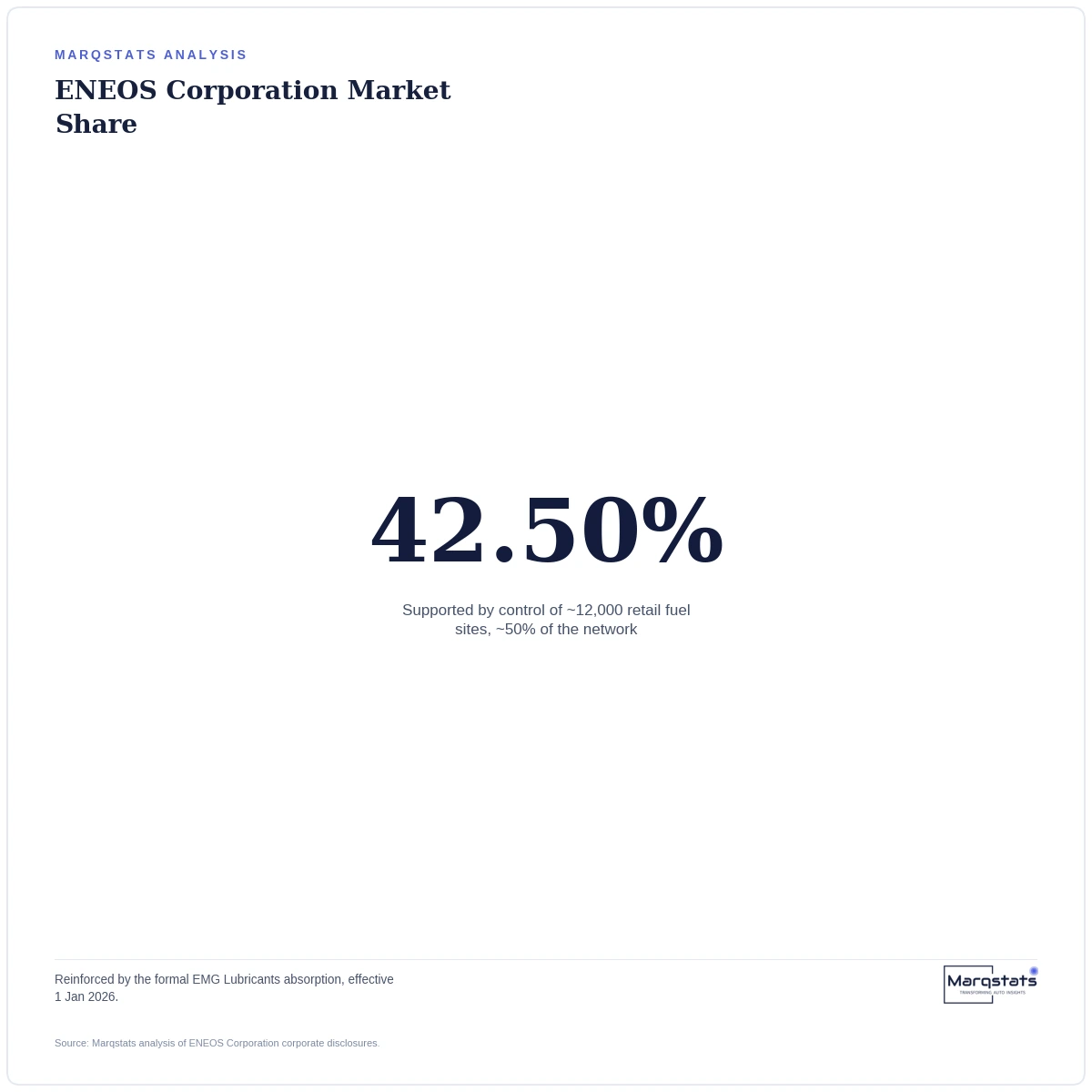
This kind of physical consolidation typically takes years to execute properly, coordinating equipment relocation, workforce transitions and supply chain continuity without disrupting deliveries to the roughly 12,000 retail fuel sites and extensive dealer network ENEOS lubricant products flow through. The multi-year timeline to 2028 reflects that operational reality rather than any lack of commitment to the consolidation itself.
Why Mobil-branded products specifically matter to this transition
It's worth being explicit about what's actually at stake commercially in this merger: continued access to the Mobil brand specifically, a globally recognized lubricant brand with genuine consumer trust built over decades, now flowing through ENEOS's direct corporate structure rather than a semi-independent subsidiary. Mobil-branded products have historically served as a meaningful distribution channel asset in Japan, and Japanese drivers commonly get oil changes during a fuel stop, making retail lubricant distribution genuinely inseparable from ENEOS's broader fuel retail network. Bringing Mobil-branded distribution fully inside ENEOS's direct management, rather than through a semi-independent subsidiary, gives the company tighter control over how that brand gets positioned and marketed across its dominant retail footprint going forward.
The full market picture
Marqstats' complete Japanese automotive lubricants aftermarket analysis, including the full competitive landscape, is available in the linked report below.
Related reportJapan Automotive Lubricants Aftermarket Size, Share & Forecast 2026 – 2030