A Household Adoption Number That Reads Like a Rounding Error for ICE
It's worth pausing on this figure specifically, since it describes something closer to a completed transition than an ongoing one.
In brief: private household car purchases in Denmark have moved to near-total electrification. Internal combustion engine purchases among retail consumers have fallen to residual levels -- not a declining share, a residual one.
The Two Numbers Doing the Work
This kind of speed doesn't happen from consumer preference alone. It traces to a specific, deliberate fiscal architecture.
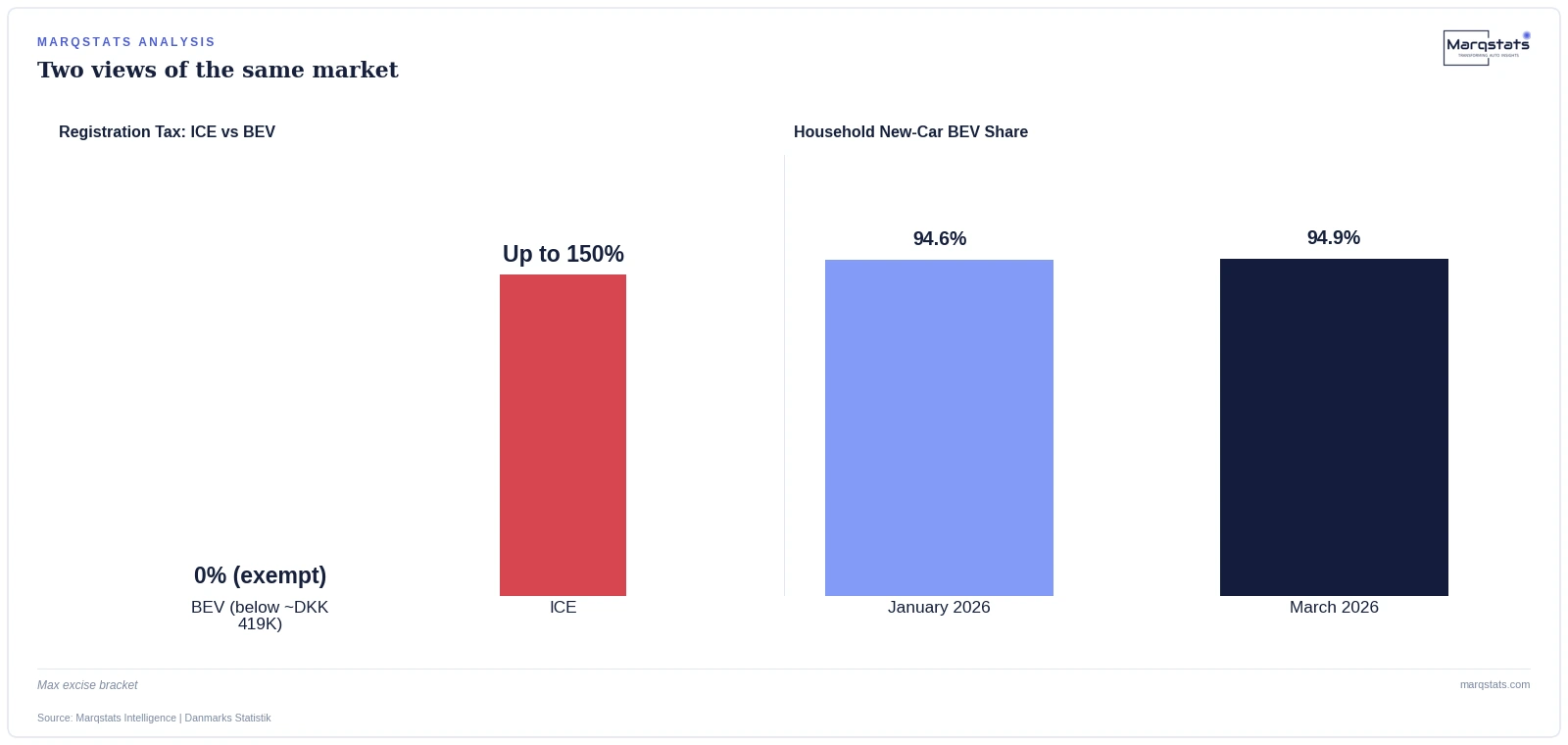
Petrol cars taxed up to 150%. EVs under roughly DKK 419,000, exempt.
— Marqstats Analyst Team
Denmark's national registration tax system (registreringsafgift) applies progressive excise brackets reaching up to 150% of vehicle value to conventional fossil-fuel vehicles, while zero-emission vehicles priced below roughly DKK 419,000 remain tax-exempt. Through the National Budget Agreement (Finansloven), planned tariff increases on EVs were postponed to at least 2027, preserving that exemption rather than letting it phase out on the original schedule.
A Named Comparison: Why the Electricity Tax Cut Matters Just as Much
The purchase-price incentive is only half of what changed -- the ongoing cost of ownership shifted just as sharply.
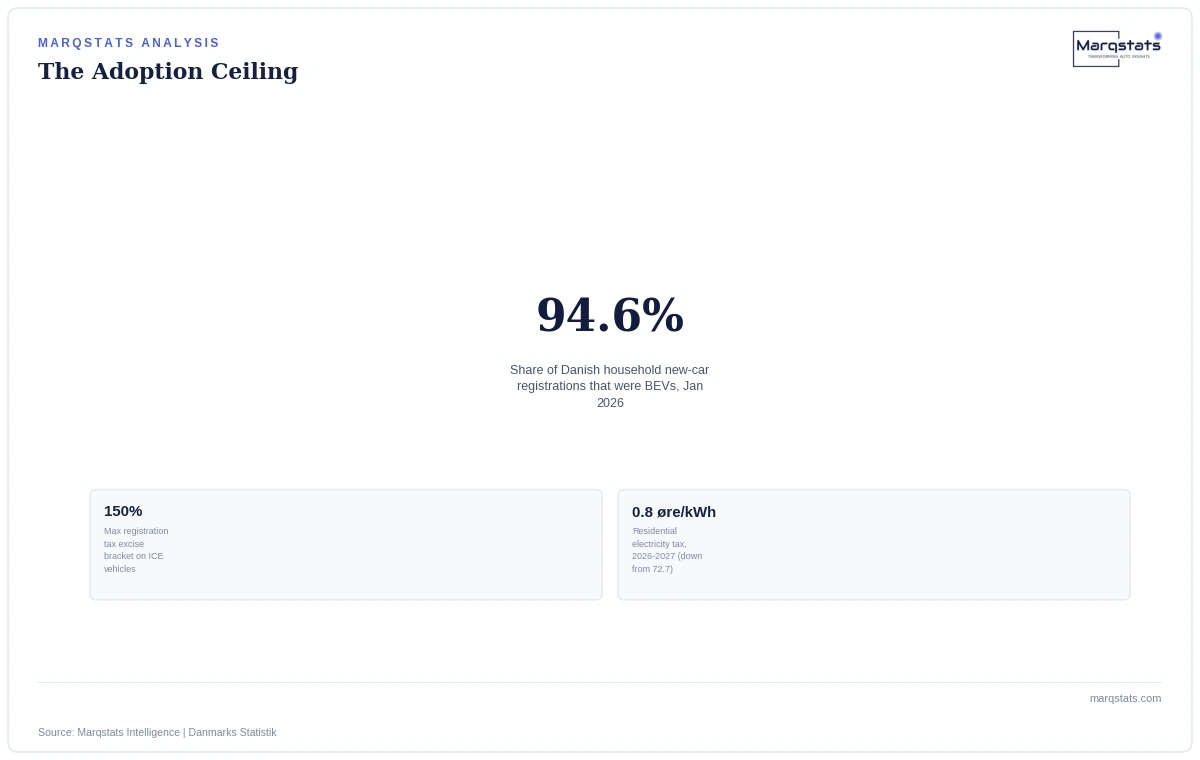
Statutory residential electricity taxation (elafgift) was lowered from 72.7 øre/kWh to just 0.8 øre/kWh for 2026 and 2027 -- not a modest adjustment, but a reduction of roughly 99%. That change substantially widens the operating cost advantage of residential charging over petrol or diesel fuel, compounding the upfront purchase-tax exemption with an ongoing running-cost advantage.
Why This Matters More for the Aftermarket Than the Showroom
The purchase-side story gets most of the attention. The consequence that actually matters for this specific market is what happens next.
A near-total shift to BEVs in new registrations means the aftermarket faces an unusually concentrated, fast-aging fleet rather than a gradual multi-decade transition. Workshops planning capacity, technician training, and parts inventory around a slow multi-decade ICE-to-EV shift are planning for a transition that, in Denmark specifically, has already mostly happened.
Why This Pace Should Continue, Not Plateau
Nothing about the current fiscal structure points toward petrol regaining ground, at least through the period the policy commitment currently covers.
With the tax exemption preserved through at least 2027 and the electricity tax cut running the same duration, there is no current fiscal signal pointing toward a reversal or even a plateau in the household BEV share -- if anything, the trajectory from 94.6% to 94.9% across just two months of 2026 suggests further tightening toward a near-complete ceiling.
What This Means for Anyone Planning Around This Market
The practical takeaway: workshops, dealers and parts distributors operating in Denmark should plan around an already-largely-completed electrification transition specifically, not a gradual multi-year shift still underway, since the fiscal structure driving this pace shows no near-term sign of easing.