
A Fleet Share That Doesn't Match the Revenue Share at All
That gap is worth sitting with, since it runs directly against the assumption that fleet size and service revenue should track roughly together.
Municipal transit buses make up a genuinely small slice of Colombia's electrified vehicle fleet. Counting purely by units on the road, they'd be easy to overlook. The revenue numbers tell an entirely different story.
The Numbers Behind the Gap
These figures trace directly to the underlying research's own reconciled sizing chain, not a rough estimate.
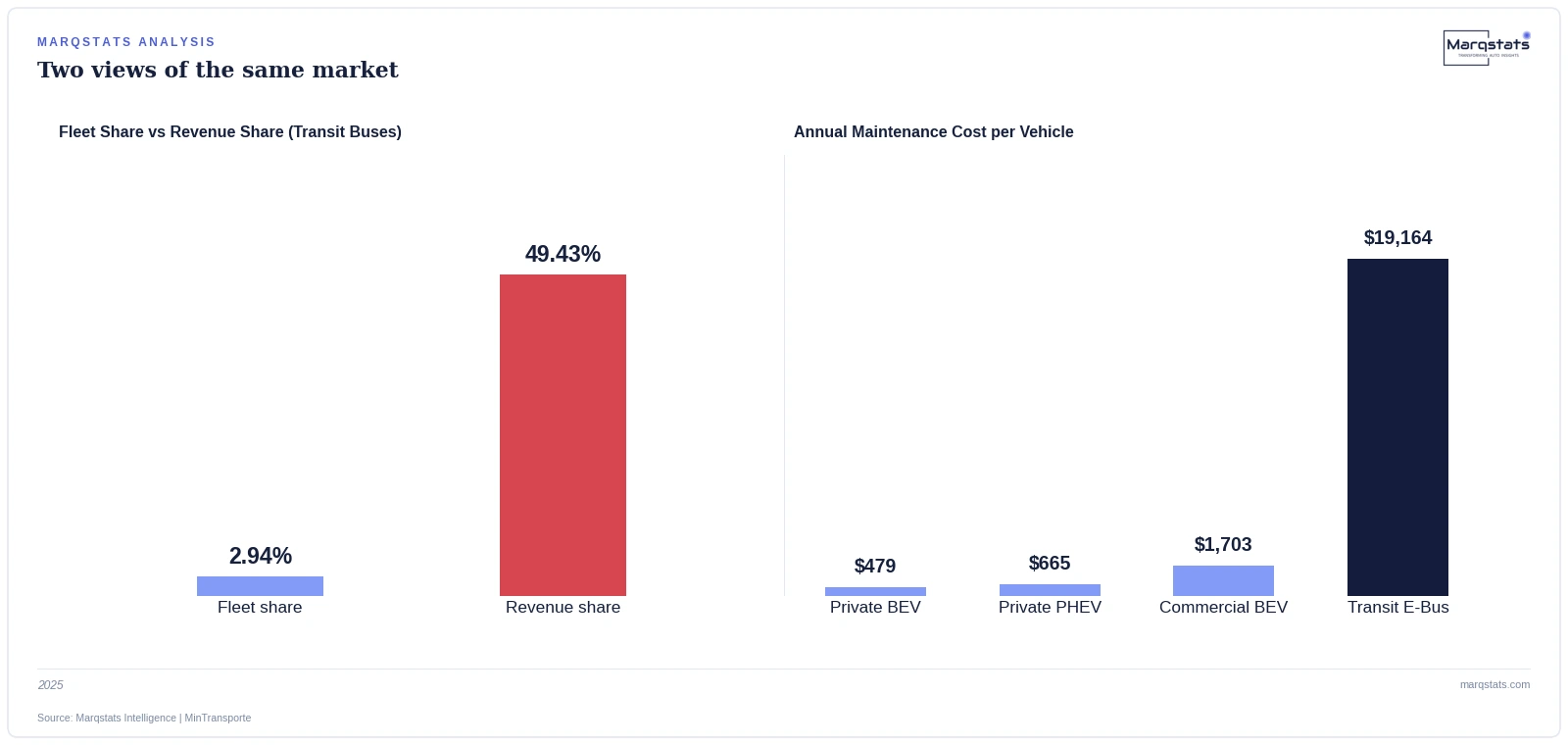
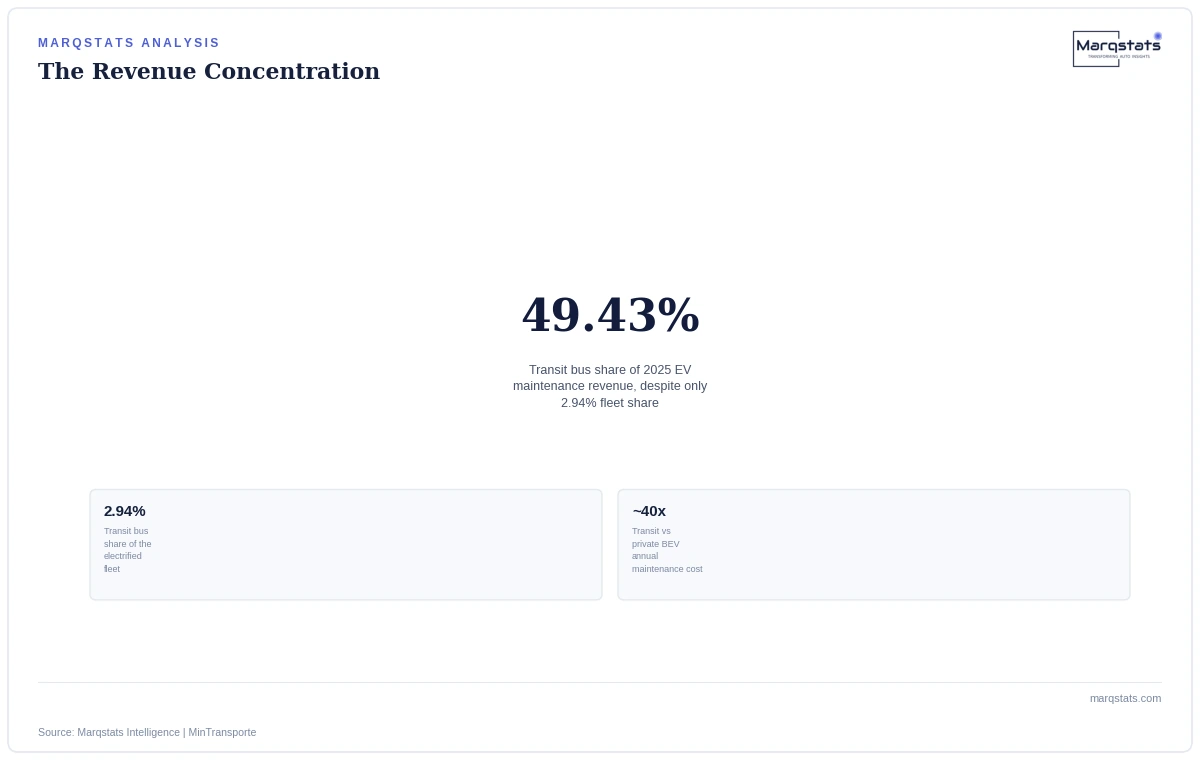
Transit buses represent just 2.94% of Colombia's active electrified vehicle parc. They generate 49.43% of total aftermarket maintenance expenditure -- nearly half the entire national market's revenue.
Why One Bus Costs Roughly Forty Private Cars' Worth of Maintenance
That comparison is worth stating plainly, since the scale of the gap is easy to understate in the abstract.
A private passenger BEV in Colombia averages 10,000 to 12,000 kilometers a year and COP 1,800,000 in annual maintenance. A transit bus runs 60,000 to 80,000 kilometers annually under full passenger loads, serviced under a contractually enforced preventative maintenance regime in a dedicated depot. That bus costs roughly COP 72,000,000 a year to maintain -- close to forty times a single private car.
A Named Comparison: Why This Isn't Just "Commercial Vehicles Cost More"
Every market has some version of commercial vehicles costing more to maintain than private ones. Colombia's gap is unusually extreme specifically because of the combination at play: intense daily mileage, full passenger loads, and a contractual maintenance framework that leaves no room for deferred servicing the way a private owner might delay a routine check. TransMilenio's own operational data backs this up directly -- its more than 1,500 BYD electric buses show a documented 21% maintenance cost reduction versus CNG buses and an 83% reduction versus older diesel units, proof that even at this intensity, electrification is paying off financially for the operator.
How Durable This Concentration Is Likely to Be
Nothing about the underlying drivers points toward this pattern softening soon. Transit fleet growth is projected to continue on contractual, predictable timelines through 2030, and the enforced preventative maintenance regime governing depot operations is a structural feature of transit concession agreements, not a temporary condition.
What This Means for Anyone Assessing This Market
The practical takeaway: anyone sizing Colombia's EV aftermarket opportunity by counting private-passenger dealership coverage is missing where nearly half the actual revenue sits. Depot-based transit servicing capability, battery module remanufacturing, and fleet contract relationships matter disproportionately more here than in markets with a more evenly distributed revenue base.