Half of China's new cars are electric. Ninety-two percent of the cars already on the road still aren't.
In brief:
- New energy vehicles captured 49.38% of China's new vehicle registrations in 2025.
- 91.74% of the operating 366.00 million-unit civilian automobile parc still requires crankcase lubricants.
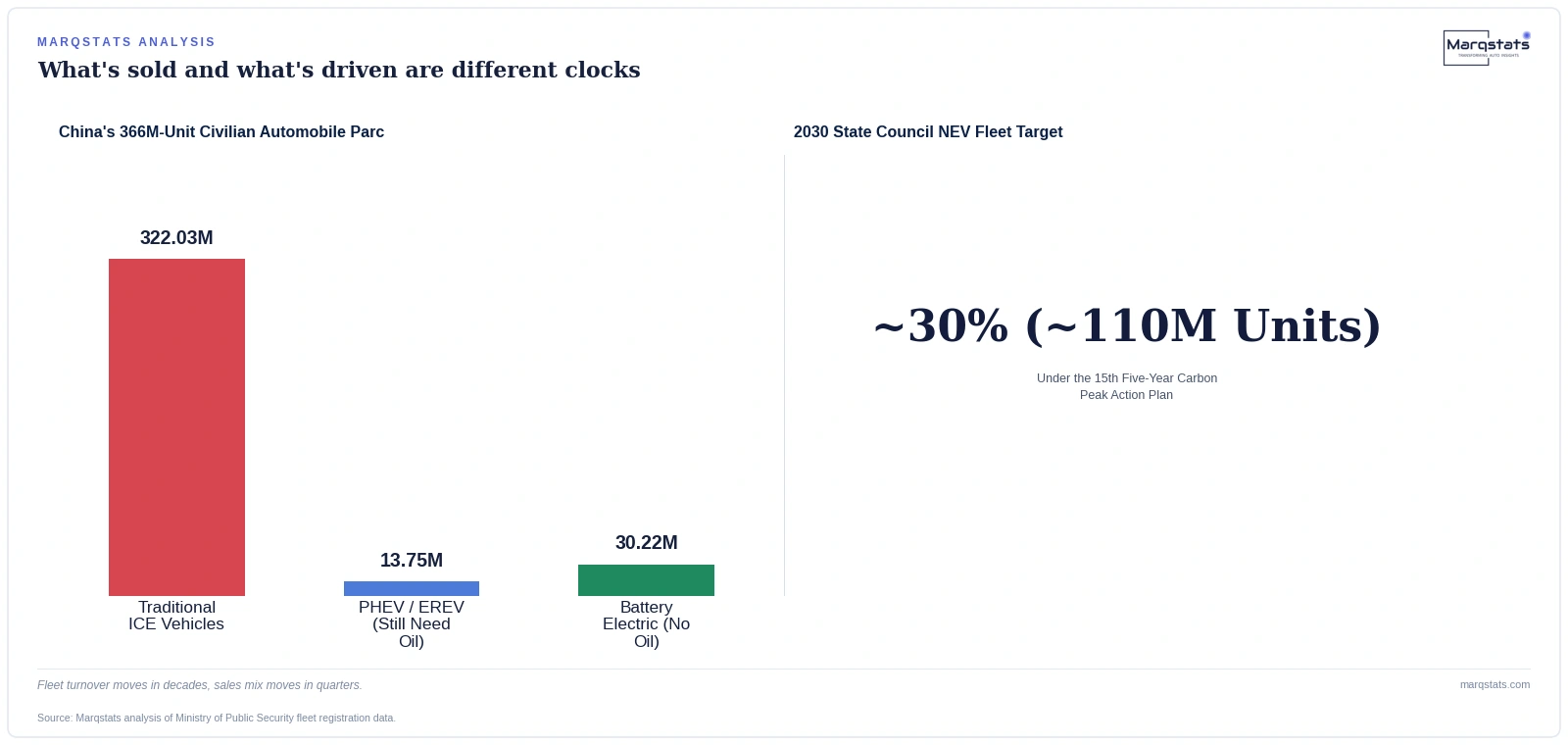
- Traditional internal combustion vehicles alone represent 322.03 million units, 87.99% of the total fleet.
Two statistics about China's automotive market, read separately, tell contradictory stories. One says the internal combustion engine is being rapidly replaced. The other says it isn't going anywhere for a long time. Both are true, and understanding why requires distinguishing between what's being sold and what's actually on the road. Reconciling them takes about two minutes of arithmetic, and it changes the whole forecast.
What the sales number actually measures
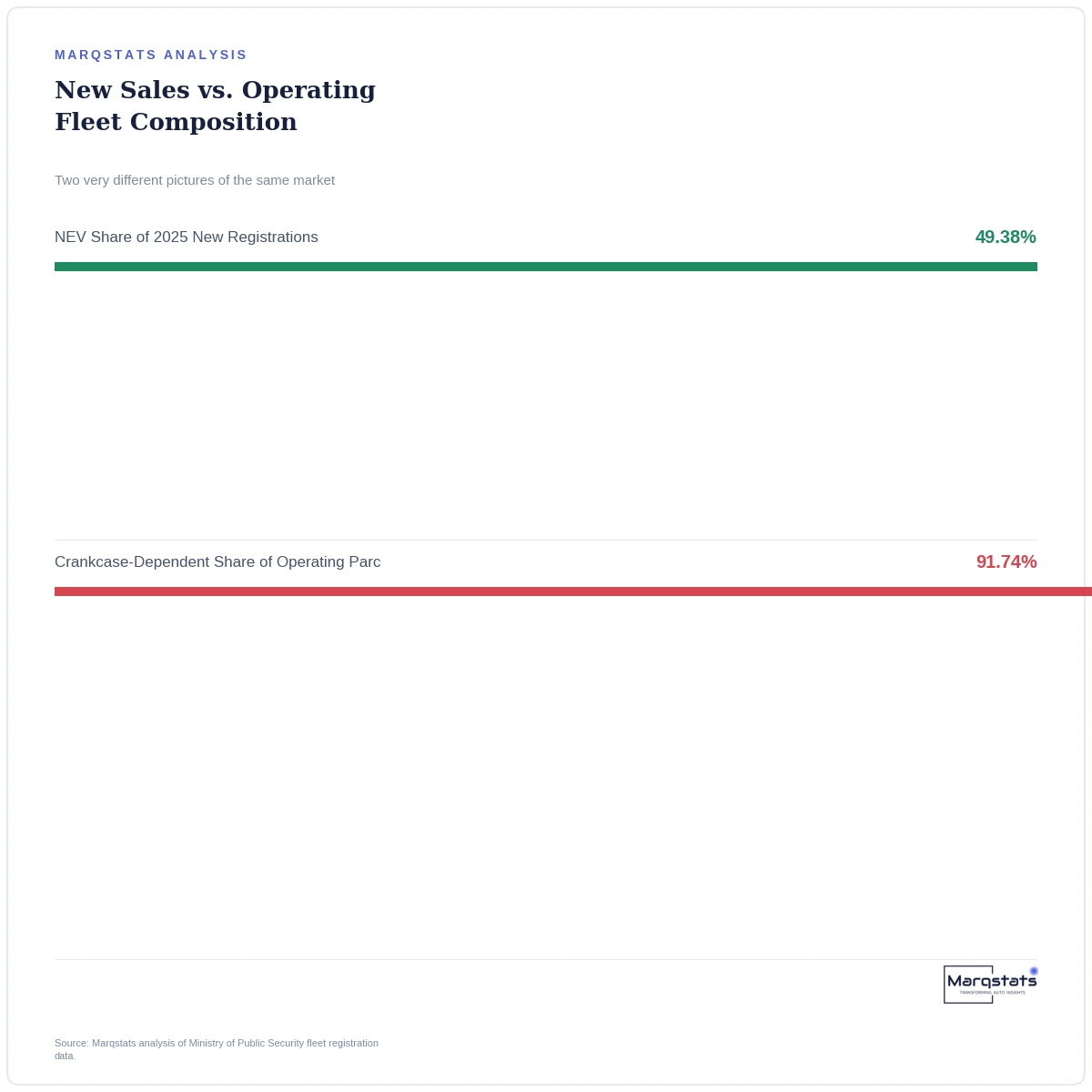
New energy vehicles captured 49.38% of China's new vehicle registrations in 2025, representing 12.93 million units. That's a genuinely remarkable figure, and it's the number most headlines about China's automotive market lead with. It measures one thing precisely: what buyers chose when they walked into a dealership or configured an order this year.
What the parc number actually measures, and why it moves so much slower
China's civilian automobile parc, the total stock of vehicles actually registered and operating on the road, stood at 366.00 million units at year-end 2025. Of that total, 322.03 million units (87.99%) are traditional internal combustion vehicles, and another 13.75 million units (3.75%) are plug-in hybrids and extended-range electric vehicles that still carry a combustion engine requiring crankcase servicing. Add those together, and 91.74% of China's operating fleet still needs the same fundamental maintenance product it needed a decade ago.
One number tells you what China bought this year. The other tells you what China is actually driving.
— Marqstats Analyst Team
Why the two numbers move at such different speeds
The explanation is straightforward arithmetic, once you think about vehicle lifespan. A new vehicle registration is a single event. A vehicle parc is the accumulated stock of every vehicle purchased over the last 14 to 15 years that hasn't yet been retired. Even if every single new vehicle sold in China from this point forward were fully electric, it would take well over a decade of sustained turnover for the operating parc's composition to catch up to the sales mix, simply because the enormous existing base of combustion vehicles doesn't disappear the moment new energy vehicle sales accelerate.
Why this distinction matters commercially
This isn't an academic distinction - it has direct, practical consequences for anyone trying to size demand in China's automotive aftermarket specifically. A market participant who extrapolates lubricant demand from new energy vehicle sales momentum alone would badly misjudge near-term crankcase lubricant volume, since that volume tracks the 91.74%-combustion-dependent operating parc, not the roughly 49%-electrified sales mix. China's automotive lubricants aftermarket reflects exactly this dynamic: physical volume stays essentially flat through 2030 (a 0.17% compound annual growth rate) precisely because the operating parc dilutes the sales-level electrification story so heavily.
Why this gap will eventually close, just not on the timeline sales headlines suggest
None of this means the transition isn't happening - it clearly is, and the direction is unambiguous. China's State Council 15th Five-Year Carbon Peak Action Plan explicitly targets new energy vehicles reaching approximately 30% of the operational automobile fleet by 2030, roughly 110 million units, a genuinely substantial structural shift from today's smaller NEV parc share. The point is simply that this transition unfolds on a parc-turnover timeline measured in years and decades, not a sales-mix timeline measured in quarters, and treating the faster-moving sales statistic as a proxy for the slower-moving parc statistic systematically overstates how quickly aftermarket lubricant demand will actually contract.
The counter-argument: doesn't accelerating NEV sales momentum eventually compound into a much faster parc shift than a simple linear projection suggests?
A fair objection is that NEV sales share has itself been accelerating rapidly, from a much smaller base just a few years ago to nearly half of new registrations today, and that continued acceleration, combined with potential scrappage incentives removing older combustion vehicles, could compound into a considerably faster parc-level shift than a simple extrapolation from today's 91.74% combustion-dependent figure would suggest. This is a legitimate consideration, and it's precisely the logic behind this market's own Accelerated NEV Transition scenario, which models exactly this kind of compounding effect, expanded municipal scrappage incentives and NEV sales exceeding 75% of new additions by 2028, and still projects the operating combustion-dependent fleet only declining to 260 million units by 2030, a meaningful reduction, but still a majority of the total parc. Even under an aggressive acceleration scenario, the underlying stock-versus-flow dynamic means the operating parc simply cannot electrify as fast as new sales figures alone might imply.
What this means for market participants
- Lubricant blenders and distributors should size near-term demand against Ministry of Public Security operating parc data specifically, not new vehicle registration statistics, to avoid systematically underestimating crankcase lubricant volume.
- Investors evaluating China's automotive aftermarket should recognize that headline NEV sales momentum, while directionally important for long-term planning, is a poor proxy for near-term physical lubricant volume trends.
- Market analysts covering China's automotive sector should routinely distinguish between registration-flow statistics and parc-stock statistics when characterizing the pace of the country's vehicle electrification transition.
The plug-in hybrid wrinkle that makes the gap even wider than it first appears
There's a further nuance worth making explicit, since it's easy to overlook. Plug-in hybrid electric vehicles and extended-range electric vehicles are frequently counted within new energy vehicle statistics, and rightly so, they qualify under China's official NEV classification. But that classification obscures something operationally important: PHEVs and EREVs still carry a full internal combustion engine that requires crankcase oil, transmission fluid and the same scheduled maintenance a conventional vehicle needs. Of the 43.97 million-unit new energy vehicle fleet at year-end 2025, 13.75 million units, 31.26% of the entire NEV parc, fall into this PHEV and EREV category and remain crankcase-lubricant customers despite their new energy vehicle classification.
This matters because a casual reading of NEV statistics might assume that every vehicle counted in that 43.97 million-unit NEV total has exited the lubricant market entirely. Nearly a third of it hasn't, and won't, until those specific hybrid and extended-range vehicles are eventually retired or replaced with pure battery electric models. The addressable lubricant-consuming fleet is therefore larger than a naive reading of China's headline NEV adoption statistics would suggest, even after accounting for the new energy vehicle category specifically.
Why hybrid vehicles actually need more specialized, not less specialized, lubrication
It's also worth noting that this 13.75 million-unit hybrid and extended-range segment doesn't simply need standard combustion-engine oil, it often needs something more specialized than a conventional gasoline vehicle would. Hybrid powertrains subject cold engine components to instantaneous maximum torque loading without a gradual thermal warm-up cycle, since the combustion engine in a hybrid system remains deactivated during electric-only propulsion before engaging abruptly under wide-open throttle. Frequent short-trip usage, common in the urban driving conditions where many hybrid vehicles operate, prevents engine oil from reaching stabilized operating temperatures, accelerating fuel dilution and low-temperature sludge formation in ways a comparable conventional gasoline vehicle driven the same distance typically wouldn't experience to the same degree.
The practical result is that this specific hybrid and extended-range segment of the fleet, despite technically qualifying as a new energy vehicle, actually commands premium-formulation lubricant demand, with specialized ultra-low cold-cranking viscosity products carrying a 25% to 40% wholesale price premium over standard mineral and semi-synthetic alternatives.
The full market picture
Marqstats' complete China automotive lubricants aftermarket analysis, including the full three-scenario forecast through 2030, is available in the linked report below.
Related reportChina Automotive Lubricants Aftermarket Size, Share & Forecast 2026 – 2030