A Growth Number That Looks Better Standing Alone
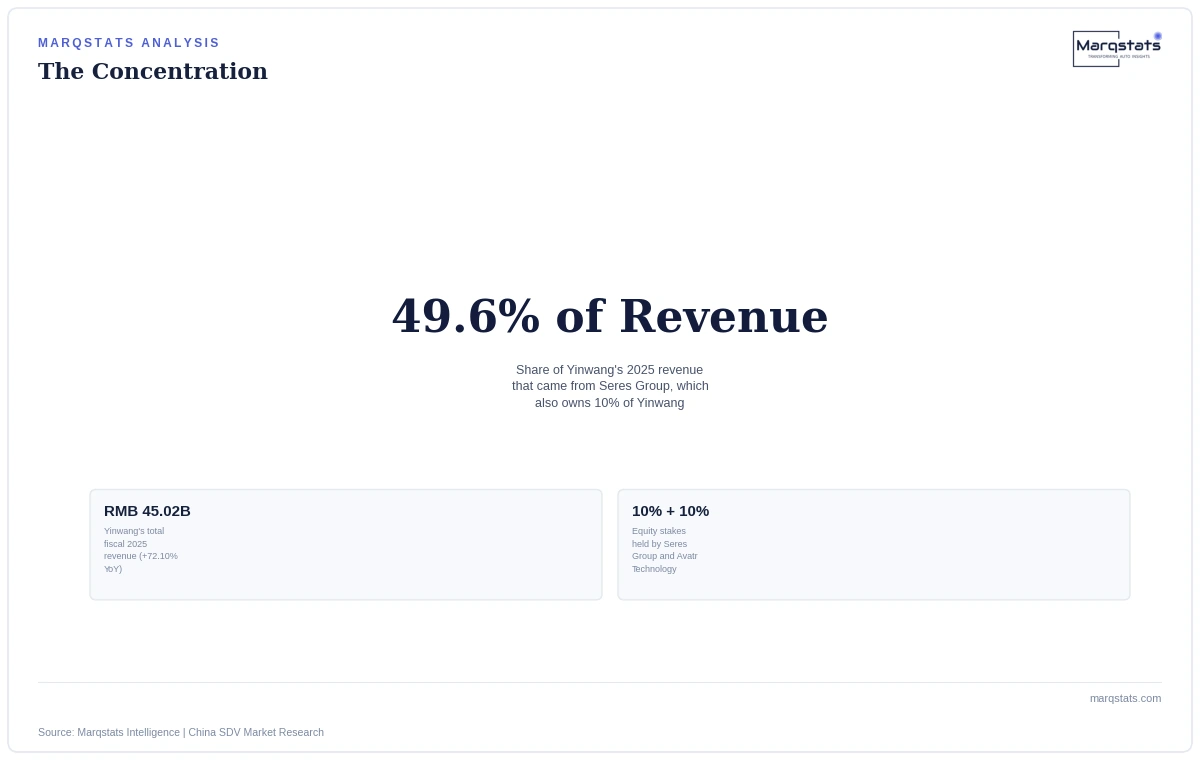
Shenzhen Yinwang Intelligent Technology, the corporatized form of Huawei's Intelligent Automotive Solution business, generated RMB 45.02 billion in fiscal 2025 revenue, up 72.10% year-over-year. Read on its own, that is one of the strongest growth numbers in China's entire software-defined vehicle supply chain. Read alongside who is actually buying that revenue, the number gets more complicated.
The Relationship Behind the Revenue
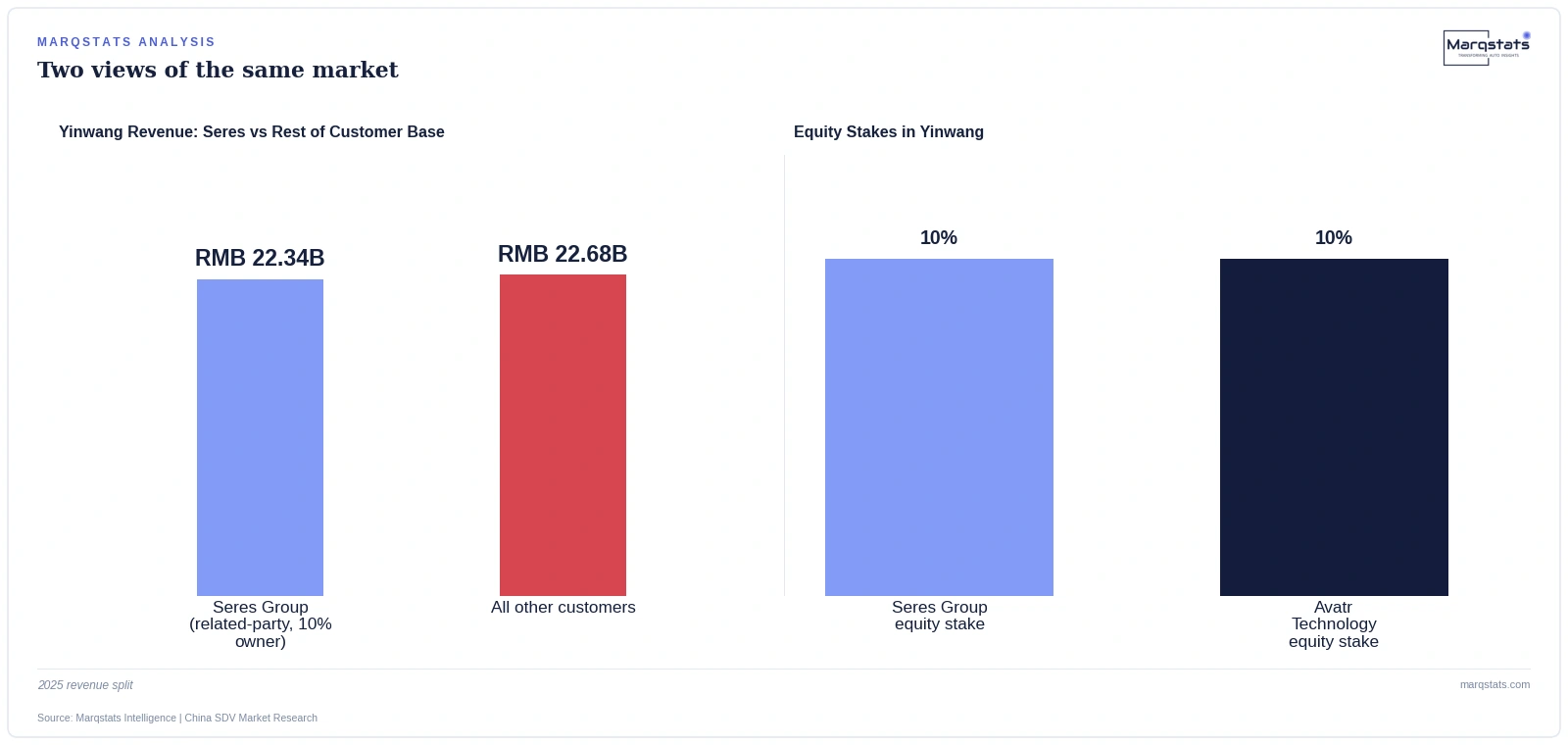
Seres Group holds a 10% equity stake in Yinwang, acquired for RMB 11.5 billion. Avatr Technology holds an equivalent 10% stake. Seres's own corporate filings show RMB 22.34 billion in related-party procurement of automotive components and software from Yinwang in 2025, nearly half of Yinwang's entire annual revenue. That is not a customer relationship in the ordinary arm's-length sense. It is a part-owner buying at a scale large enough to materially shape the growth rate of the company it partly owns.
Why This Isn't Necessarily a Red Flag, But It Is a Real Question
Equity-linked anchor customers are a genuinely common structure in platform-supplier arrangements, and there are real reasons to like it: it aligns Yinwang's and Seres's incentives, gives Seres priority access to Huawei's Qiankun autonomous driving suites and HarmonyOS cockpit platforms, and gives Yinwang a committed, high-volume launch customer while it builds out a broader supply base. But it also means a meaningful share of Yinwang's headline growth rate reflects a related party's own purchasing decisions, not purely independent market demand, which matters enormously for anyone trying to judge how fast Yinwang's business would actually be growing if Seres were a completely unrelated buyer.
What to Watch as the Customer Base Broadens
Yinwang already supplies BAIC, Changan, Chery and JAC alongside Seres and Avatr, and that broadening base is exactly the metric worth tracking closely. As those non-equity customers' share of Yinwang's revenue grows relative to Seres and Avatr's combined roughly 20% equity-linked share, Yinwang's growth numbers become a genuinely cleaner signal of independent market demand for its platform. Until that shift shows up clearly in the disclosure, anyone using Yinwang's 72.10% growth rate as a proxy for how the broader Chinese SDV supplier market is performing should discount it for how much of that number one related party is currently supplying.