China just rewrote its engine oil rulebook for the first time in nearly 20 years
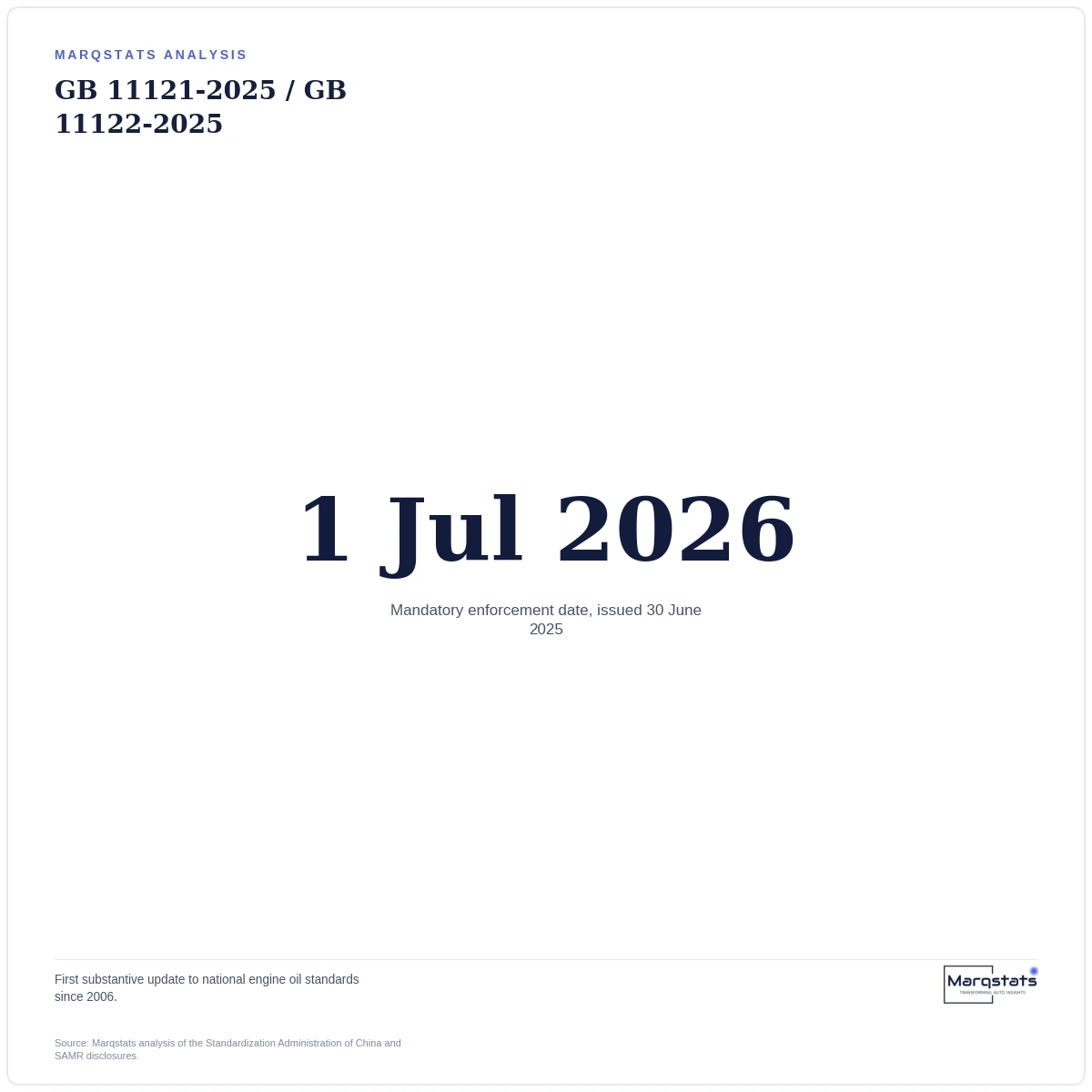
On 30 June 2025, the Standardization Administration of China issued two mandatory national standards that will reshape what's legally allowed inside a bottle of engine oil sold in China. GB 11121-2025 covers gasoline engine oils. GB 11122-2025 covers diesel engine oils. Both replace specifications that had governed the sector, largely unchanged, since 2006.
What actually changed in the technical requirements
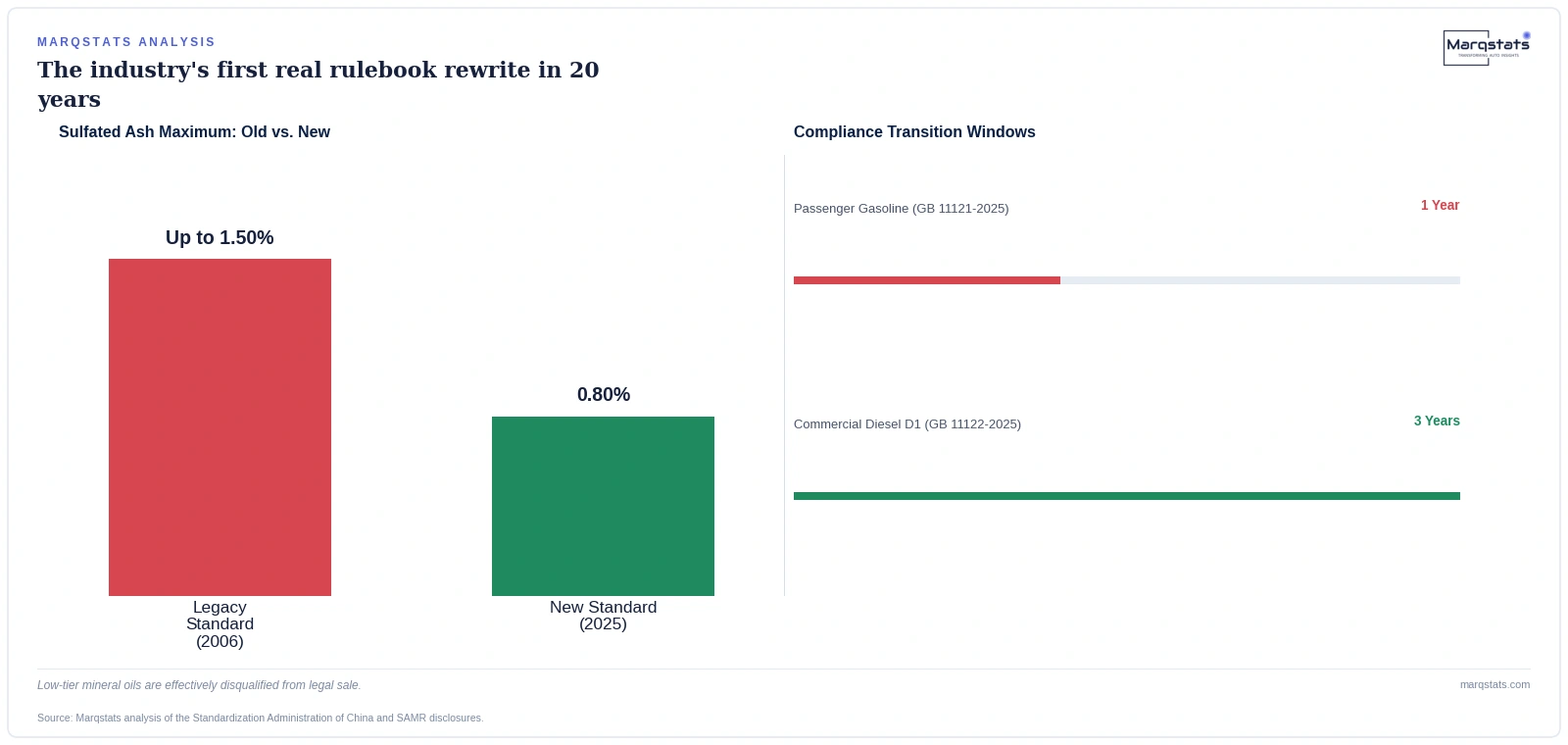
The previous 2006-era standards were built around performance baselines like API SJ, SL and SM, categories that reflected engine technology from two decades ago. The new standards align with API SP, API SQ and ILSAC GF-7, modern international performance benchmarks. Beyond the headline category upgrade, several specific technical parameters tightened meaningfully: sulfated ash content, a measure of the non-combustible metallic residue an oil leaves behind, drops to a strict 0.80% maximum from a previous allowance of up to 1.50%. Phosphorus content, similarly, moves from being effectively uncapped or loosely capped to a firm 0.06 to 0.08 mass percent ceiling. The standards also introduce testing that simply didn't exist before: mandatory Low-Speed Pre-Ignition testing and Sequence X timing chain wear evaluation, both targeting failure modes specific to modern turbocharged, direct-injection engines.
This isn't a minor update. It's the industry's first real rulebook rewrite in two decades.
— Marqstats Analyst Team
Why the sulfated ash limit specifically matters so much
The sulfated ash reduction deserves particular attention because of what's actually driving it. China's nationwide China 6b emissions standards require gasoline particulate filters and diesel particulate filters on new vehicles, wall-flow filters designed to trap fine particulate matter before it exits the exhaust system. Legacy lubricant formulations relying on high concentrations of zinc dialkyldithiophosphate and calcium sulfonate detergents release ash-forming metallic compounds into the exhaust stream. Those non-combustible ash deposits accumulate inside the particulate filter's micro-channels over time, creating persistent exhaust backpressure, raising fuel consumption, and eventually causing filter failure. The new 0.80% sulfated ash ceiling exists specifically to protect these emissions control systems from the kind of premature failure legacy oil chemistry would otherwise cause.
What this means for the products currently on store shelves
The practical commercial consequence is direct: this regulatory framework effectively disqualifies low-tier API SJ and SL mineral oils from legal commercial distribution in China. Formulators can't simply keep selling their existing mineral oil product lines past the 1 July 2026 enforcement date, they have to reformulate using magnesium-based cleansers, ashless friction modifiers and organic anti-wear agents to hit the new sulfated ash and phosphorus targets, which in practice pushes the entire market toward Group II, Group III and Group IV synthetic base stocks and away from cheaper legacy mineral chemistry.
Why commercial diesel gets a longer transition period
It's worth noting that the two standards aren't treated identically. GB 11122-2025, governing diesel engine oils, establishes a domestic China D1 category specifically to protect heavy-duty selective catalytic reduction and diesel particulate filter systems, but grants commercial diesel vehicles a three-year transition window to comply, rather than the single-year runway passenger gasoline vehicles get. That distinction likely reflects the genuine operational difficulty of abruptly reformulating supply chains for commercial freight and logistics fleets, which can't easily absorb sudden product discontinuations the way individual consumers replacing a bottle of oil at a quick-lube shop can.
The counter-argument: is a one-year compliance runway for passenger vehicles actually enough time for the industry to fully reformulate?
A fair concern is whether the roughly twelve months between the standards' June 2025 issuance and their July 2026 enforcement date gives formulators genuinely sufficient time to reformulate, test and requalify product lines at the scale China's automotive lubricants market operates at, or whether this compressed timeline risks supply disruptions or rushed, under-validated reformulations. This is a legitimate operational concern for an industry this large. What mitigates it somewhat is that much of the underlying base stock and additive technology required, Group III and higher synthetic base oils, magnesium-based detergent packages, was already commercially available and in use internationally under comparable standards like API SP and ILSAC GF-6 before China's specific mandate took effect, meaning formulators are adapting proven chemistry to a new regulatory framework rather than inventing entirely new formulations from scratch within the compliance window.
What this means for formulators and fleet operators
- Lubricant formulators still marketing legacy API SJ or SL product lines in China should complete reformulation to Group II, Group III or Group IV base stocks well ahead of the 1 July 2026 passenger vehicle enforcement deadline.
- Commercial fleet operators and diesel lubricant suppliers should use the three-year GB 11122-2025 transition window to plan an orderly migration to China D1-compliant formulations rather than delaying compliance planning.
- Businesses sourcing lubricants for the Chinese market should verify supplier compliance roadmaps against both standards' specific technical thresholds, sulfated ash, phosphorus content and the new performance testing regime, rather than assuming generic reformulation is sufficient.
How state-owned refiners are already responding
It's worth looking at how China's largest domestic lubricant producers are positioning ahead of the deadline, since their response illustrates the scale of reformulation already underway. PetroChina Lubricant Company's 2026 renewal of its Kunlun lubricant portfolio introduces the Tianrun gasoline series, formulated specifically to meet API SQ standards, alongside a Tianwei diesel series engineered to the new China D1 specification. This kind of coordinated, named product-line renewal from a major state-owned refiner, timed well ahead of the July 2026 enforcement date, signals that domestic industry leaders are treating this as a genuine technical upgrade cycle rather than a compliance formality to address at the last possible moment.
Multinational formulators operating in China face the same compliance requirement, and several have moved to secure supply relationships that anticipate the shift. ExxonMobil's January 2026 memorandum of understanding with BYD to co-develop hybrid-specific lubricants and supply manufacturing plants directly reflects a similar dynamic: aligning product development with both the new regulatory baseline and the specific technical demands of China's rapidly growing hybrid vehicle segment simultaneously.
What this means for the broader shift toward synthetic formulations already underway
The GB 11121-2025 and GB 11122-2025 standards don't operate in isolation, they reinforce a formulation chemistry shift that was already gaining momentum for independent commercial reasons. Full synthetic formulations, built on Group III, Group III+ and polyalphaolefin base stocks, are projected to expand from 42.30% to 59.20% of total aftermarket volume by 2030, while mineral base formulations contract sharply from 23.59% to just 14.70% over the same period. The new mandatory standards function as a hard regulatory floor beneath a transition the market's own economics, extended drain intervals, fuel efficiency demands, and premium pricing power, were already pushing toward, which likely explains why the industry's response has looked more like accelerated technical investment than reluctant last-minute compliance scrambling.
The full market picture
Marqstats' complete China automotive lubricants aftermarket analysis, including the full regulatory framework and formulation chemistry breakdown, is available in the linked report below.
Related reportChina Automotive Lubricants Aftermarket Size, Share & Forecast 2026 – 2030