A Mandate That Missed and a Market That Moved
Canada's electric-vehicle sales fell sharply in 2025, and the vehicles that took their place reshape what goes into the engine sump.
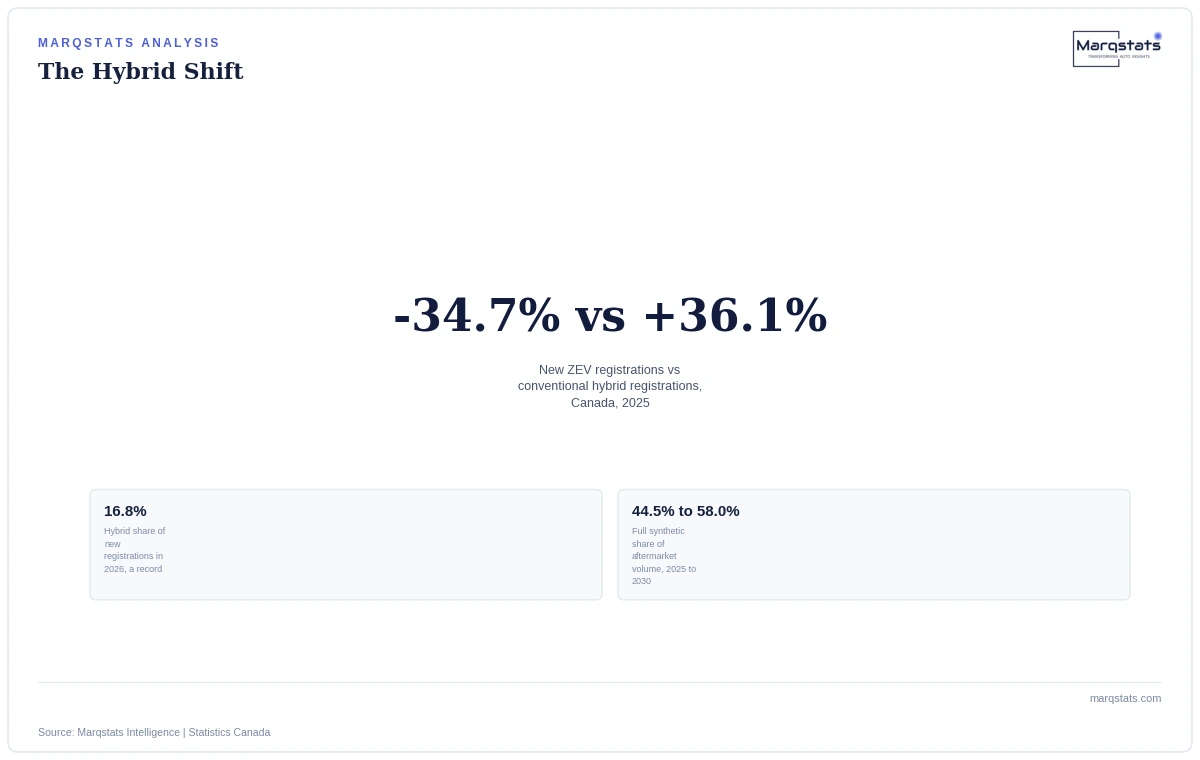
New zero-emission vehicle registrations, battery electric plus plug-in hybrid, fell 34.7% in 2025 to 9.5% of new vehicles, from 14.6% a year earlier. Battery electric registrations fell 43.1%. Quebec restructured its Roulez vert subsidies and British Columbia suspended its Go Electric rebates. The federal Electric Vehicle Availability Standard calls for 20% zero-emission sales in 2026 and 60% in 2030.
What Buyers Chose Instead
The gap went to a vehicle that needs no plug and no subsidy.
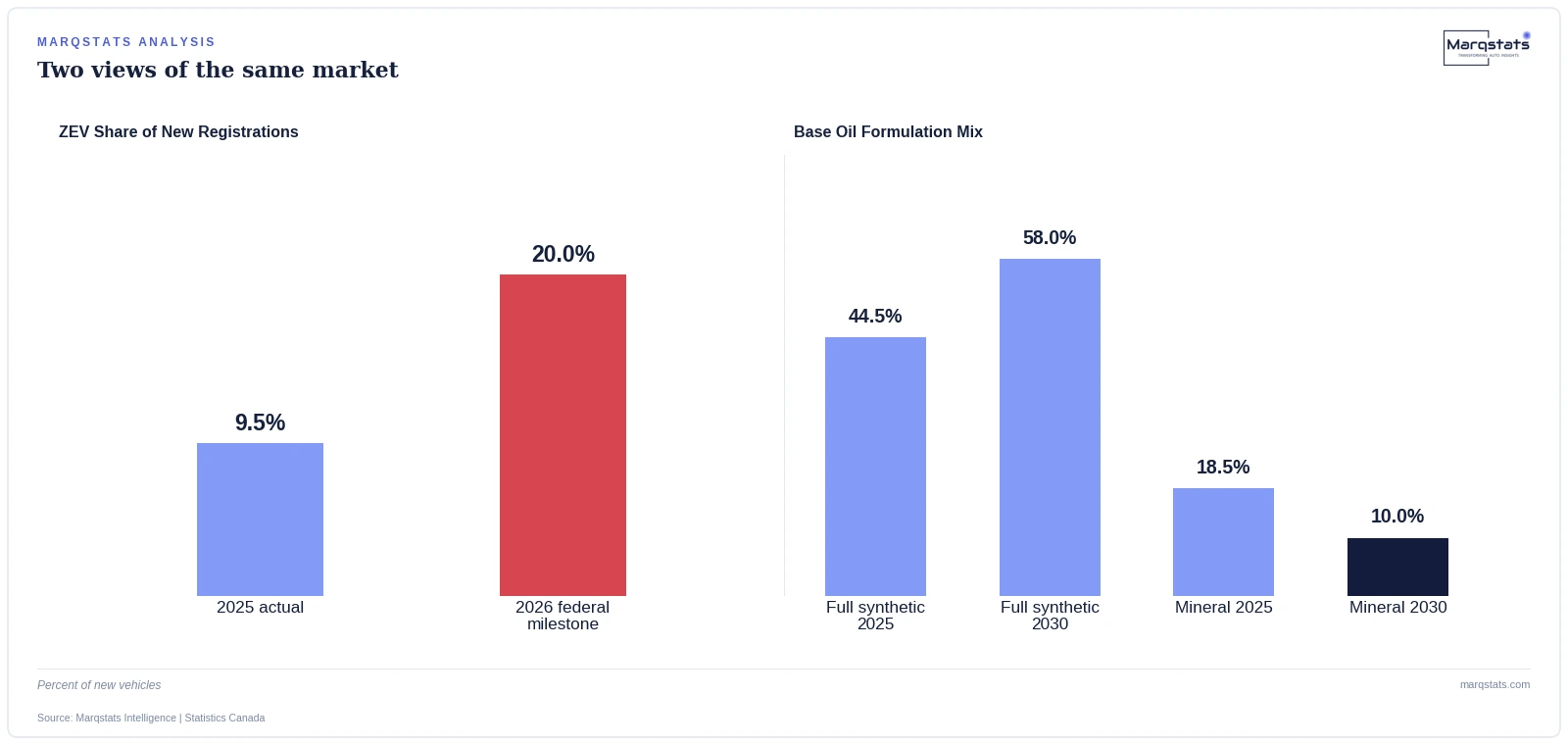
Conventional hybrids grew 36.1% in 2025 to 224,192 units, 12.0% of new registrations against 8.8% in 2024. In 2026 they reached a record 16.8% of new vehicles, 91,868 units. Federal purchase support returned in February 2026 and ZEV registrations rebounded 15.8% in the first quarter to a 10.8% share, but the combustion engine remains at the centre of the fleet.
Why a Hybrid Is Hard on Oil
A hybrid does not remove the engine. It changes how the engine is used.
In suburban driving and on sub-zero winter commutes, a hybrid's engine cycles on and off and often fails to reach oil temperatures high enough to boil off contaminants. Unburnt fuel and condensation stay in the crankcase, which thins the oil, encourages low-temperature sludge and adds wear to bearings and timing chains. Canadian winters make this worse.
A Named Comparison: What Hybrid Makers Specify
Manufacturers respond with thinner, more robust oils.
Hybrid engines call for full-synthetic, ultra-low-viscosity grades, SAE 0W-16, 0W-12 and 0W-8, with tuned dispersants, oxidation inhibitors and zinc boundary-wear additives. In the light-duty slate, SAE 0W-16 is projected to rise from 7.5% to 15.0% by 2030 and 0W-20 from 38.5% to 43.0%. Full synthetics rise from 44.5% to 58.0% of aftermarket volume while conventional mineral oil falls from 18.5% to 10.0%.
What This Means for Oil Demand
Hybrid growth does not shrink the oil market. It shifts it up the price ladder.
Wholesale value grows 4.50% a year to 2030 while volume grows 1.77%, and the blended price rises from CAD 6.85 to CAD 7.82 per litre. In a Downside Scenario where ZEV sales reach 45% by 2030, volume is nearly flat at 0.13% a year; in an Upside Scenario where owners keep vehicles longer, it grows 2.95%. The hybrid wave sits between them.
What This Means for Service Providers
The practical takeaway: quick-lube chains and independent garages should stock 0W-16 and 0W-20 in dedicated dispensing lines, train staff to explain why hybrid engines need OEM-approved synthetic oil, and bundle tire, brake and transmission services to offset drain intervals of 12,000 to 16,000 km.