Two Numbers That Don't Belong on the Same Scale
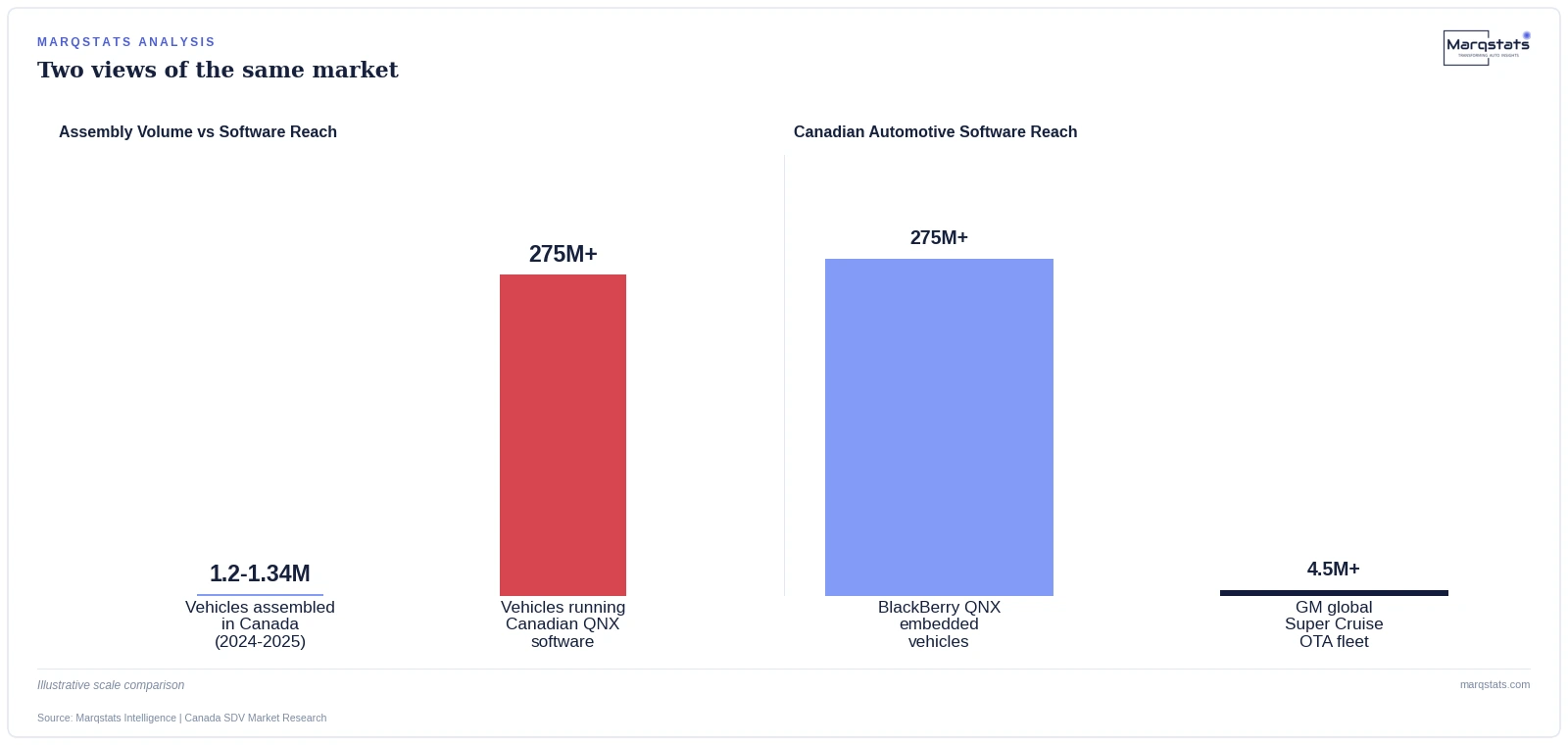
Canadian facilities assembled between 1.20 and 1.34 million physical light vehicles in 2024 and 2025, across Ontario plants operated by General Motors, Ford, Stellantis, Honda and Toyota. That's a respectable, if unremarkable, manufacturing footprint by North American standards. It is also nowhere close to the actual scale of Canada's automotive industry, once you stop counting factory output and start counting software.
The Number That Actually Measures Canada's Footprint
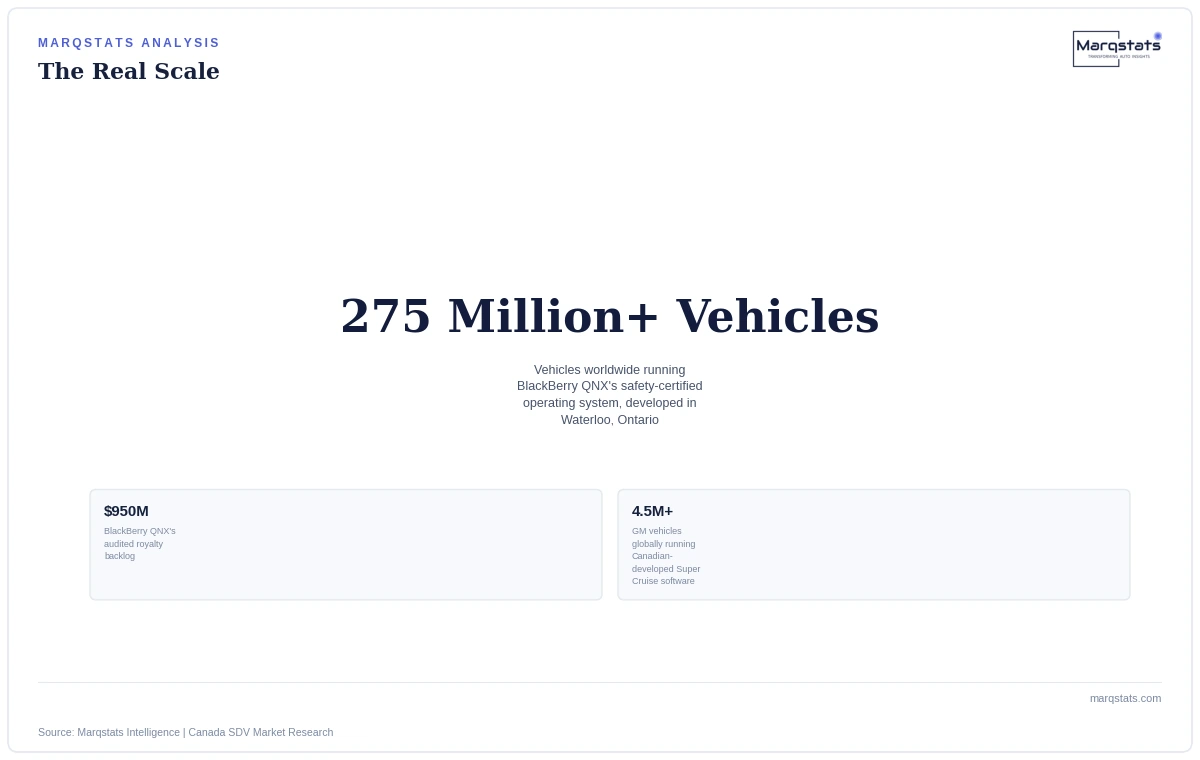
BlackBerry QNX's safety-certified real-time operating system, developed and headquartered in Waterloo, is embedded in more than 275 million vehicles globally, backed by an audited USD 950 million royalty backlog. General Motors' Canadian Technical Centre, spread across Markham and Oshawa, employs over 1,100 engineers who develop the motion-control and route-following software behind GM's Super Cruise hands-free driving system, a platform supporting more than 4.5 million GM vehicles worldwide that receive over-the-air updates, more than three times Canada's entire annual vehicle production. Oakville-based Geotab processes telematics data from over 5 million active commercial vehicle subscriptions globally.
Why This Isn't the Same Story as Manufacturing Offshoring
This is a fundamentally different kind of economic activity than a country building parts for someone else's factory. Manufacturing volume and software reach have become almost entirely decoupled: a vehicle built in Michigan, Germany or South Korea can run software written by engineers in Markham or Waterloo, and Canada captures that value through royalties, licensing and engineering services regardless of where final assembly happens. September 2026 made the mechanism concrete: Coretura, the commercial-vehicle joint venture between Daimler Truck and Volvo Group, selected BlackBerry QNX's Alloy Kore platform as its foundational software layer, adding more than USD 100 million to QNX's royalty backlog in the single largest contract in the division's history, a deal with no Canadian assembly line attached to it at all.
What This Means for How You Should Read Canada's Auto Industry
The practical takeaway: measuring Canada's automotive sector by vehicles assembled dramatically understates its actual economic footprint. The country has built a genuine intellectual-property export business in safety-certified operating systems, driver-assistance algorithms and fleet telematics software, one that scales with global vehicle production everywhere, not just domestic output. For policymakers and investors, that means Canada's automotive competitiveness should be evaluated on engineering talent retention and royalty-backlog growth at least as much as on assembly-line employment figures.