A Billion Dollars, Paused
This is a genuinely large sum to put on hold, and the decision wasn't made lightly — it reflects a company weighing multiple simultaneous production commitments across different markets and prioritizing accordingly under real capital constraints.
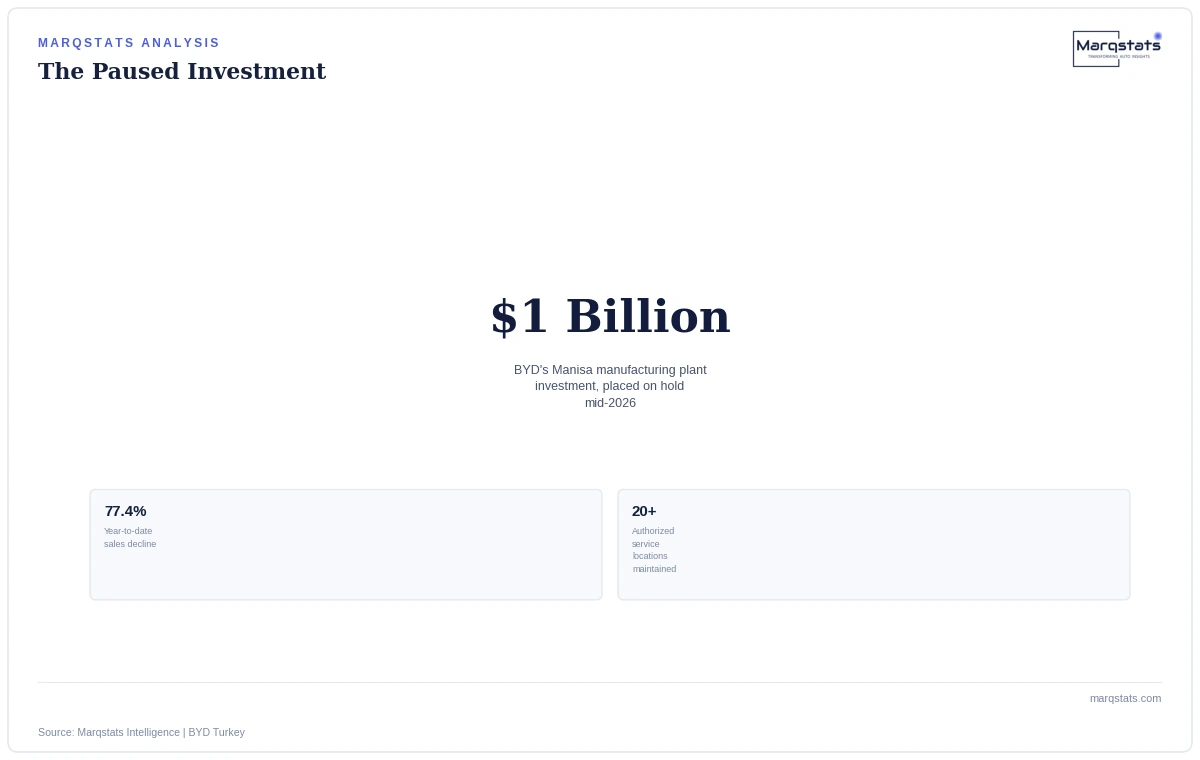
In July 2024, BYD signed an agreement to build a $1 billion manufacturing plant in Manisa, Turkey. By mid-2026, the company placed that investment on hold, prioritizing its facility in Szeged, Hungary instead.
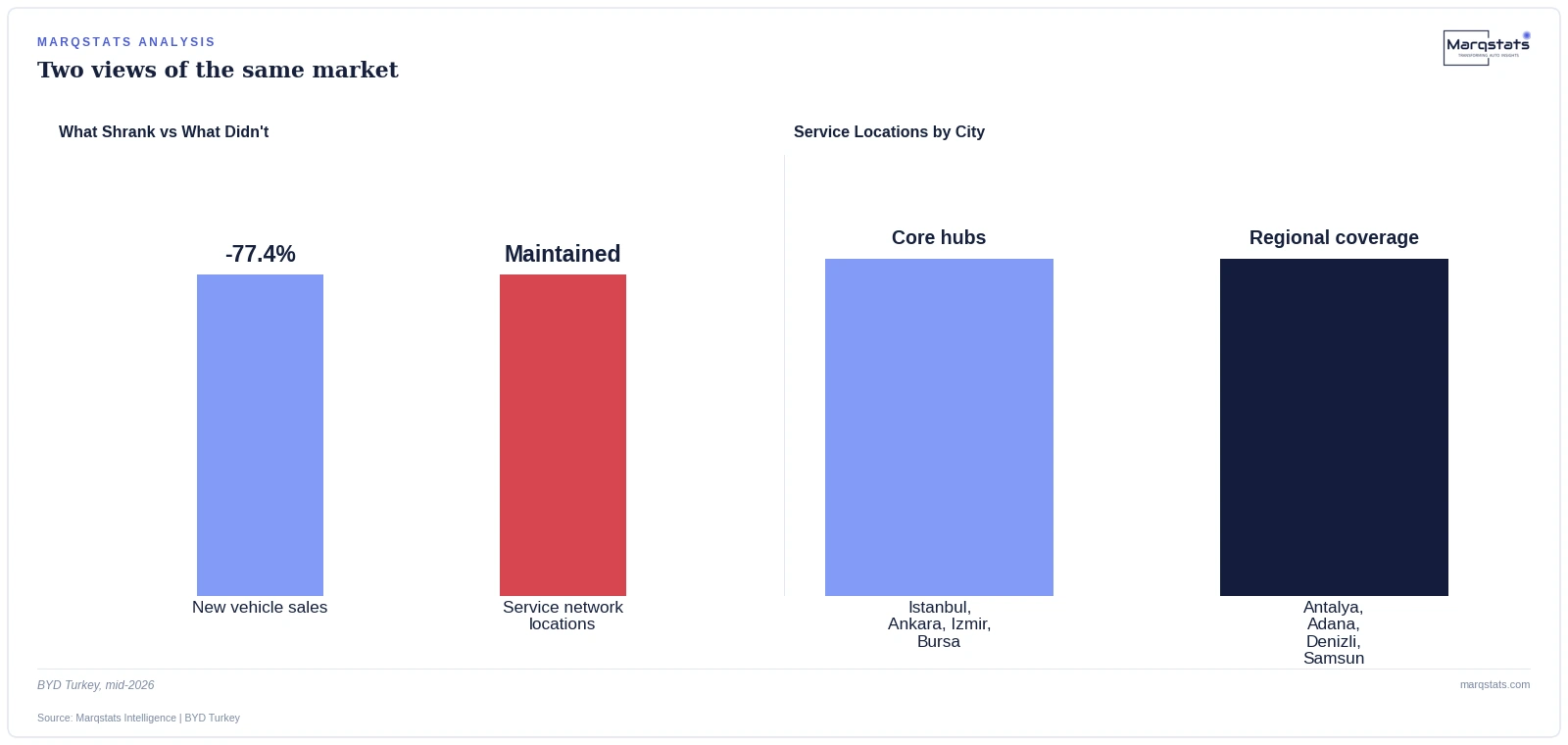
In the same stretch of time, BYD's Turkish sales fell 77.4% year-to-date, driven largely by import tariffs on non-EU vehicles. By almost any conventional measure, this looks like a company retreating from a market.
What Actually Happened Instead
BYD kept over 20 authorized service locations open across Istanbul, Ankara, Izmir, Bursa, Antalya, Adana, Denizli and Samsun. The dealer network didn't shrink to match the sales decline. It stayed roughly intact — and deliberately shifted its operational focus.
The Pivot, Specifically
Rather than treating the service network purely as a sales-support function, BYD's Turkish dealers redirected toward servicing the existing fleet of vehicles already imported and registered. That's a genuinely different business model than the one built around moving new units — one that depends on the accumulated parc rather than ongoing sales momentum.
Why This Made Business Sense
Every BYD vehicle already sold in Turkey still needs scheduled servicing, tire replacement and eventual out-of-warranty repair, regardless of whether BYD sells another unit this quarter. With manufacturing paused and new sales down sharply, that existing fleet became, in effect, the most reliable revenue base the Turkish dealer network had left — recurring, predictable, and completely independent of new-sales momentum.
A Named Comparison: This Mirrors a Broader Market Pattern
BYD's own situation is a company-specific illustration of the exact dynamic playing out across Turkey's broader EV maintenance market: new-vehicle sales cyclicality and aftermarket service revenue are genuinely different economic flows, and a company (or market) experiencing sales pressure isn't automatically experiencing aftermarket pressure at the same time or to the same degree.
The Financial Logic Underneath This Decision
A paused factory and a maintained service network aren't actually contradictory decisions — they're both consistent with a single underlying calculation: manufacturing capacity is a large, lumpy capital commitment best deferred during uncertain trade conditions, while service infrastructure is a comparatively smaller, already-sunk cost that keeps generating revenue from vehicles that exist regardless of what happens to new production.
What This Means for Other OEMs Facing Similar Pressure
The practical lesson for any automaker navigating a sales slowdown in a market where it's already built meaningful fleet presence: the existing service network isn't a sunk cost to shrink defensively. It's a revenue base that can be deliberately reoriented toward the installed fleet, buying time and cash flow while sales-side pressures work themselves out.