
A Forecast With Exactly Two Outcomes
In brief: most market forecasts hedge across a range of plausible outcomes shaped by many variables. Brazil's own scenario framework for EV maintenance is more specific than that — it comes down to a single race against a single dated deadline.
The Race in Question
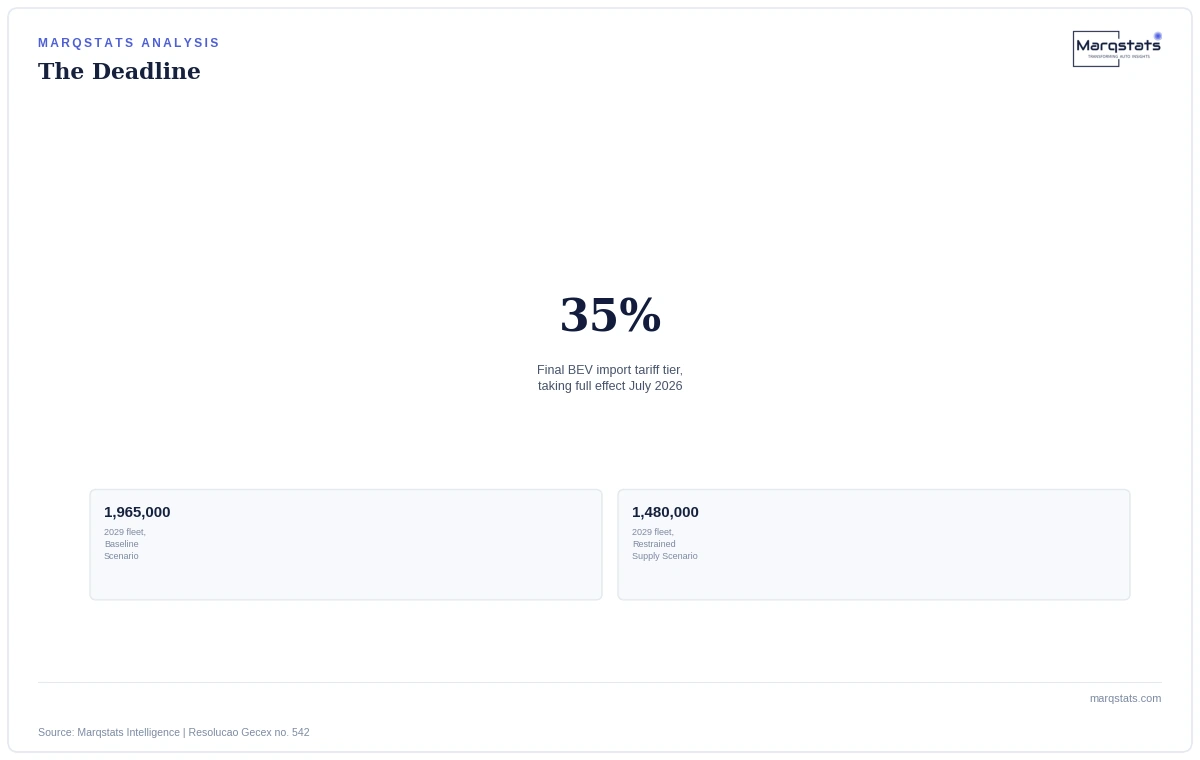
Brazil's import tariffs on electric vehicles have been phasing upward since January 2024, reaching a final 35% tier for BEVs by July 2026 under Resolucao Gecex no. 542. Whether that final tariff bites depends entirely on one thing: whether BYD's Camacari plant and GWM's Iracemapolis plant reach their planned production volumes before that date arrives.
What Happens If Domestic Assembly Wins the Race
This market doesn't have a range of outcomes. It has two, and a stopwatch.
— Marqstats Analyst Team
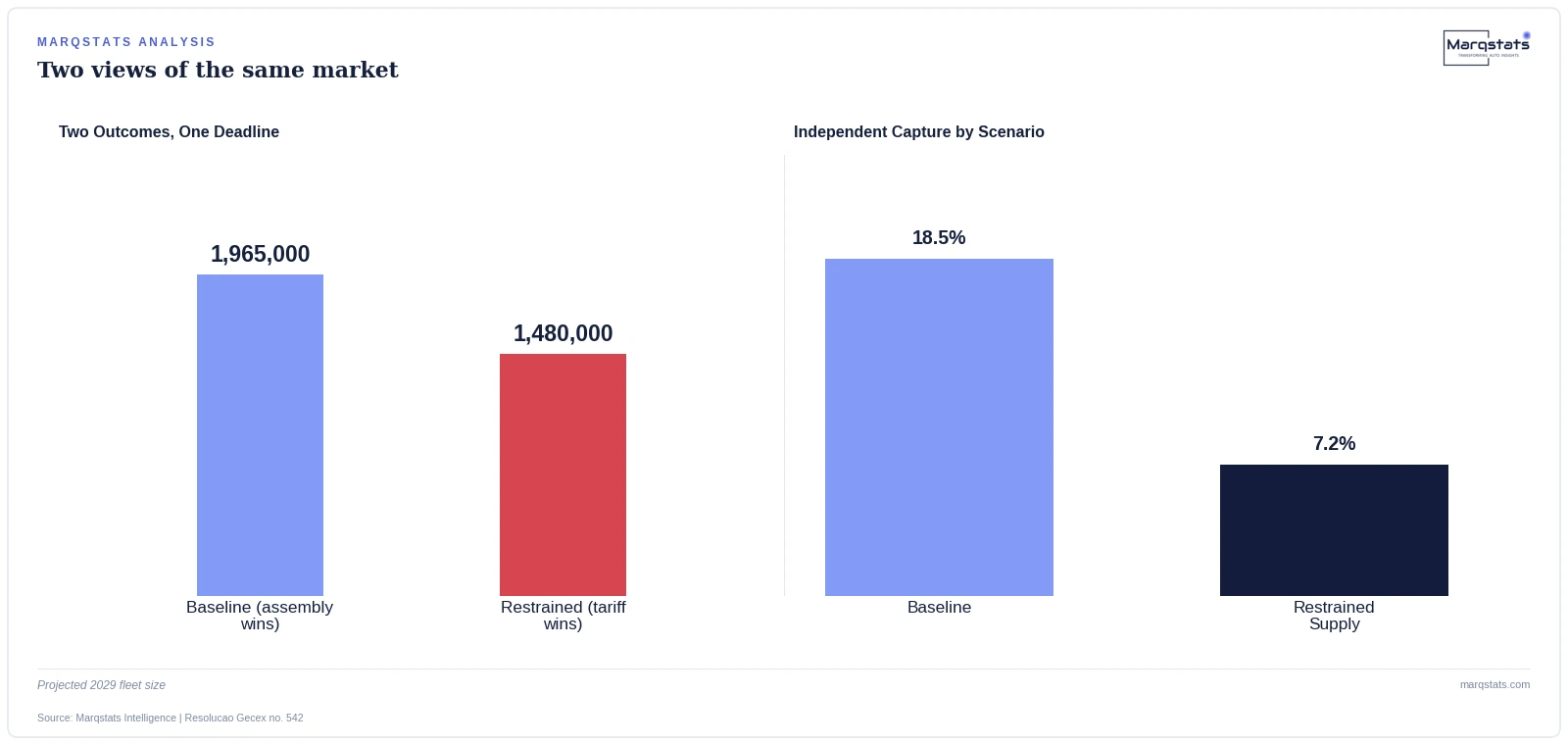
If local production capacity gets there first, tariff exposure gets absorbed domestically, vehicle prices stay competitive, and the underlying research's own Baseline Scenario plays out: the circulating fleet reaches 1,965,000 units by 2029, and independent workshops, supported by continuing vocational certification, capture 18.5% of out-of-warranty service volume.
What Happens If the Deadline Wins Instead
If the tariff deadline arrives before local capacity is ready, the Restrained Supply Scenario takes over: import costs raise retail prices, sales growth slows, and the fleet reaches only 1,480,000 units by 2029. Proprietary software encryption and slower workshop certification further limit independent participation to just 7.2%, while franchised dealerships retain over 85% of service revenue and component backlogs for imported platforms lengthen repair times.
A Named Comparison: Why This Differs From Typical Regulatory Uncertainty
Most regulatory uncertainty in market forecasting is genuinely uncertain — will a bill pass, will an agency enforce a rule. Brazil's tariff schedule is different: the schedule itself is fixed and already published. The only open variable is a production timeline that OEMs themselves control and report on, which makes this one of the more genuinely trackable binary splits in this entire coverage set.
Why the Gap Between the Two Outcomes Is So Large
A roughly 485,000-unit gap in projected 2029 fleet size between the two scenarios isn't a rounding difference -- it represents nearly a quarter of the entire Baseline fleet projection, meaning the tariff-timing race genuinely determines whether this market ends the decade meaningfully smaller or meaningfully larger than its own central case suggests.
What This Means for Anyone Tracking This Market
The practical rule: anyone forecasting or planning around Brazil's EV maintenance market should treat BYD and GWM's own production ramp-up disclosures as the single most informative leading indicator available, well ahead of any broader macroeconomic or demand-side signal.