Brazil's own refineries can't make the oil Brazil's own cars actually need
In brief:
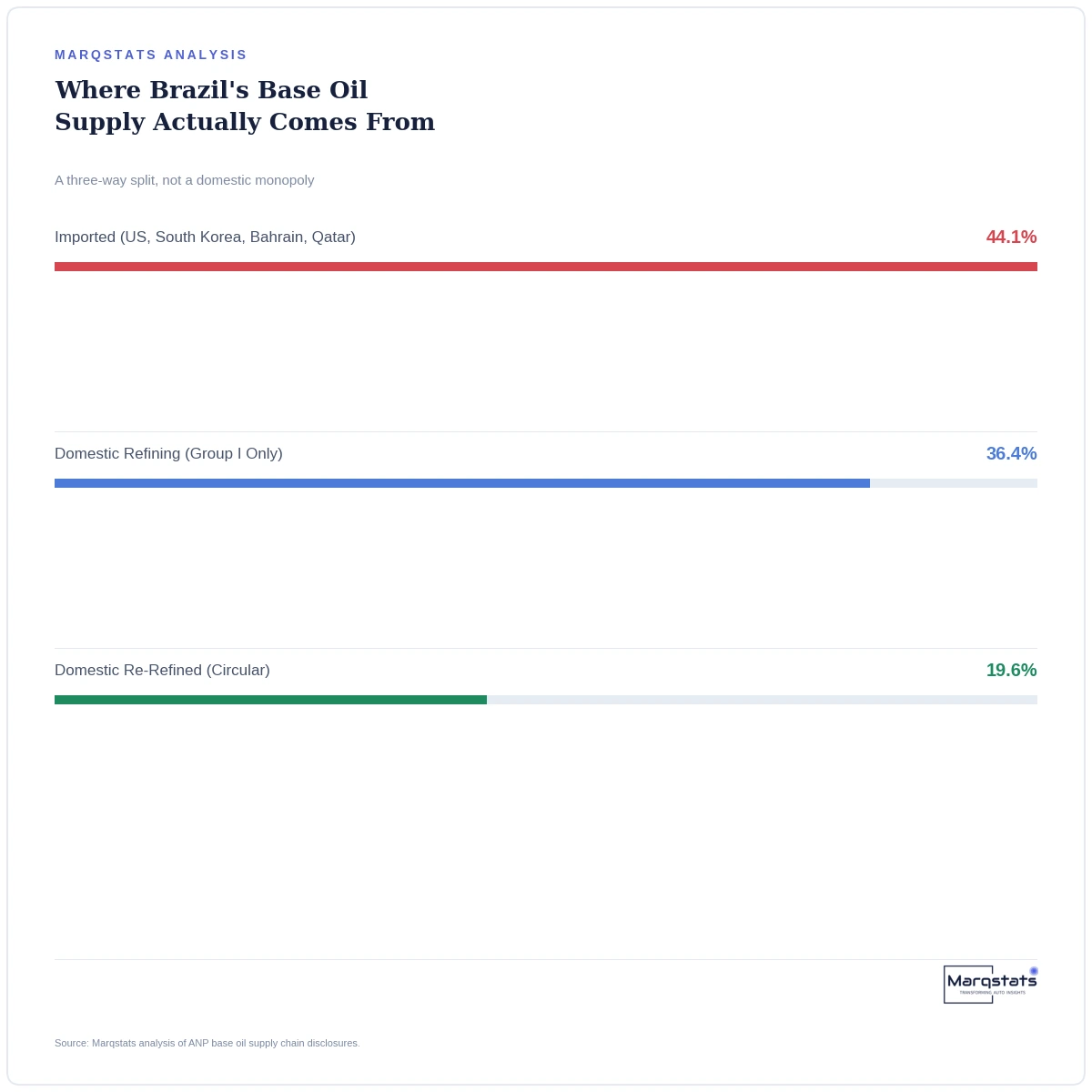
- Brazilian domestic refineries satisfy only 36.4% of national base oil demand.
- Blenders import 44.1% of base stocks (751,469 cubic meters), primarily from the US, South Korea, Bahrain and Qatar.
- A domestic re-refining circular economy supplies the remaining 19.6%, offsetting import exposure.
It's a genuine paradox: Brazil has meaningful domestic petroleum refining capacity, yet nearly half the base oil its own lubricant blenders need still has to come from overseas. The reason isn't a lack of refining, it's a mismatch between what Brazilian refineries produce and what modern engines actually require. Understanding the specific technical gap explains the whole story.
What Brazilian refineries actually produce
Brazilian domestic petroleum refineries, led by Petrobras' Duque de Caxias Refinery, produce API Group I paraffinic base stocks almost exclusively. Group I is the oldest, least chemically refined base oil category, made through solvent extraction rather than hydroprocessing. It's genuinely fine for legacy engine architectures and basic mineral oil formulations, but it carries elevated sulfur content, lower viscosity index, and higher evaporative loss than modern engine specifications tolerate.
Brazil can refine oil. It just can't refine the specific oil modern engines actually require.
— Marqstats Analyst Team
Why Group I doesn't meet modern requirements
Modern automotive lubricant specifications, API SP, ILSAC GF-6, and Low-SAPS API CK-4 in particular, require base stocks with considerably better thermal stability, lower volatility and cleaner combustion chemistry than Group I can provide. This isn't a minor technical nuance. Proconve L7, L8 and P8, Brazil's own emissions standards, effectively mandate these higher-tier formulations for any vehicle sold to comply with modern emissions rules, particularly diesel trucks running Diesel Particulate Filters that Group I-based oils would foul with ash deposits over time.
Where the imports actually come from
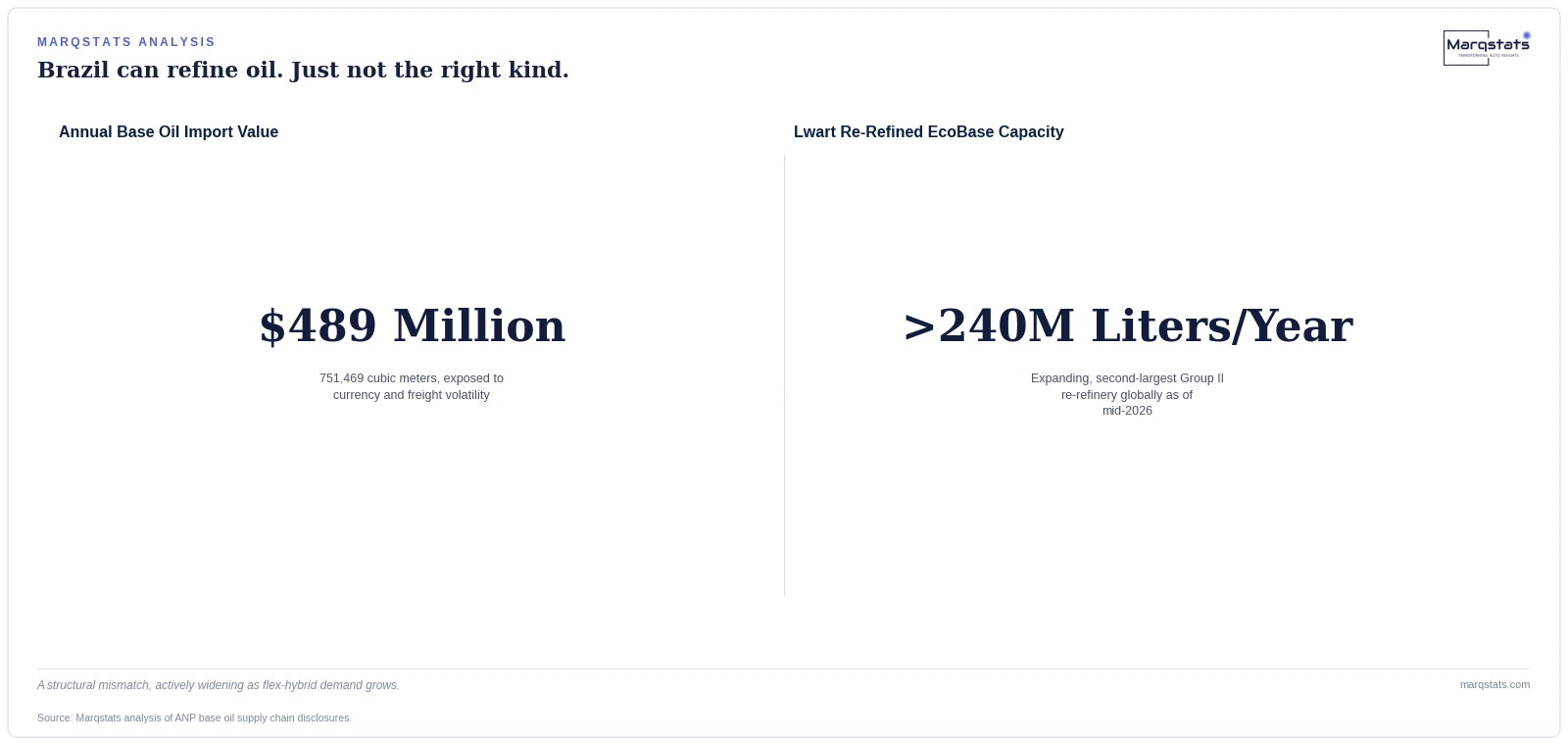
With domestic Group II and Group III capacity essentially absent, blenders turn to established international suppliers: the United States, South Korea, Bahrain and Qatar together account for the bulk of Brazil's 751,469 cubic meters of annual base oil imports, valued at approximately USD 489 million. These are established Group II and Group III production centers with hydrocracking infrastructure Brazil's domestic refining base largely lacks. That's a genuinely long supply chain for something as fundamental as engine oil.
Why this creates genuine commercial exposure
Relying on imports for 44.1% of a critical input creates real, structural business risk that goes beyond simple cost. Every one of those imported base oil shipments is exposed to foreign exchange fluctuations, since Brazil's currency, the real, can move meaningfully against the US dollar over a purchasing cycle, and to maritime shipping rate volatility, since these are bulk liquid cargo shipments crossing international waters from multiple continents. A blender pricing a batch of finished lubricant months in advance of actually receiving the imported base stock carries genuine currency and freight risk baked into that pricing decision.
Why the re-refining sector matters as more than a sustainability story
This is precisely why Brazil's domestic re-refining sector matters commercially, not just environmentally. Under statutory reverse logistics mandates, Lwart Soluções Ambientais alone processes over 225 million liters of collected used lubricating oil annually into Group II re-refined base stock, supplying 19.6% of total domestic base oil consumption. That's domestically sourced, currency-hedged supply, insulated from the same import volatility affecting virgin base stocks, precisely because the feedstock, Brazil's own used motor oil, never leaves the country.
The counter-argument: is 19.6% domestic re-refined supply really enough to meaningfully offset a 44.1% import dependency?
A fair objection is that re-refined base oil supplying under a fifth of national demand is a modest offset against an import dependency covering nearly half the market, and that celebrating this circular supply chain as a meaningful hedge might overstate its actual impact on Brazil's genuine exposure to import volatility. This is a reasonable proportionality concern. What it doesn't fully account for, though, is the trajectory: Lwart's own capacity expansion, completing performance validation in mid-2026 and pushing output past 240 million liters annually, represents real, ongoing growth in domestic supply specifically targeting this gap, meaning the 19.6% figure is a current snapshot of a genuinely expanding capability, not a static ceiling the market has already reached.
What this means for refiners and blenders
- Domestic refiners should evaluate hydroprocessing capacity investment specifically targeting Group II and Group III production, given the structural, statutorily reinforced demand gap this analysis quantifies.
- Lubricant blenders should evaluate expanding offtake agreements with domestic re-refiners specifically to hedge against currency and freight volatility affecting imported virgin base stocks.
- Investors evaluating this market should treat re-refining capacity expansion announcements as a leading indicator of reduced long-term import exposure, given the trajectory Lwart's own expansion demonstrates.
Why Brazil's flex-hybrid strategy makes this gap even more consequential
This base oil mismatch lands at a particularly consequential moment for Brazil specifically, given the country's distinctive automotive electrification pathway. Rather than pursuing pure battery-electric vehicles the way China and much of Western Europe have, major manufacturers including Stellantis, Toyota, Volkswagen and General Motors are directing local capital toward flex-hybrid vehicles engineered to run on any ratio of hydrous ethanol and gasoline. These powertrains require advanced low-viscosity SAE 0W-16 and 0W-20 synthetic formulations specifically to resist water emulsification and acidic corrosion from ethanol's water content, formulations that sit at the very top of the chemical sophistication ladder Group I base stocks simply cannot climb.
In other words, Brazil's specific automotive technology roadmap is pushing demand even further toward exactly the higher-tier base stocks the country is least equipped to produce domestically. The base oil gap isn't a static problem the market can grow around, it's actively widening as flex-hybrid adoption accelerates and synthetic formulation penetration climbs from 42.05% to 51.50% of passenger car motor oil volume by 2030.
What this means in practice for a blender sourcing base stock
It's worth being concrete about what this structural gap actually looks like for a lubricant blender making sourcing decisions today. A blender formulating a modern full synthetic passenger car oil essentially has three realistic options: import virgin Group III base stock from established Asian or Middle Eastern producers, source domestic re-refined Group II material from Lwart or comparable processors, or attempt a blended approach combining both. Each option carries a different risk profile, virgin imports expose the blender to currency and freight volatility but offer consistent, well-characterized chemistry, while domestic re-refined stock offers currency stability but has historically carried a slight quality-consistency premium that blenders have had to formulate around.
As Lwart's expanded capacity comes fully online, that quality-consistency gap has been narrowing, making domestic re-refined base stock an increasingly viable primary sourcing option rather than merely a supplementary hedge, a genuine structural shift in how Brazilian blenders can realistically manage this base oil mismatch going forward.
The full market picture
Marqstats' complete Brazilian automotive lubricants aftermarket analysis, including the full base oil supply chain breakdown, is available in the linked report below.
Related reportBrazil Automotive Lubricants Aftermarket Size, Share & Forecast 2026 – 2030