Brazil skipped the electric car race. Its engine oil is paying the price for that choice.
Most major automotive markets are racing toward pure battery-electric vehicles. Brazil is taking a genuinely different path, one rooted in a resource most other countries don't have at scale: sugarcane-derived ethanol. That choice has real, specific consequences for what has to go inside the engine.
Why Brazil chose a different electrification path
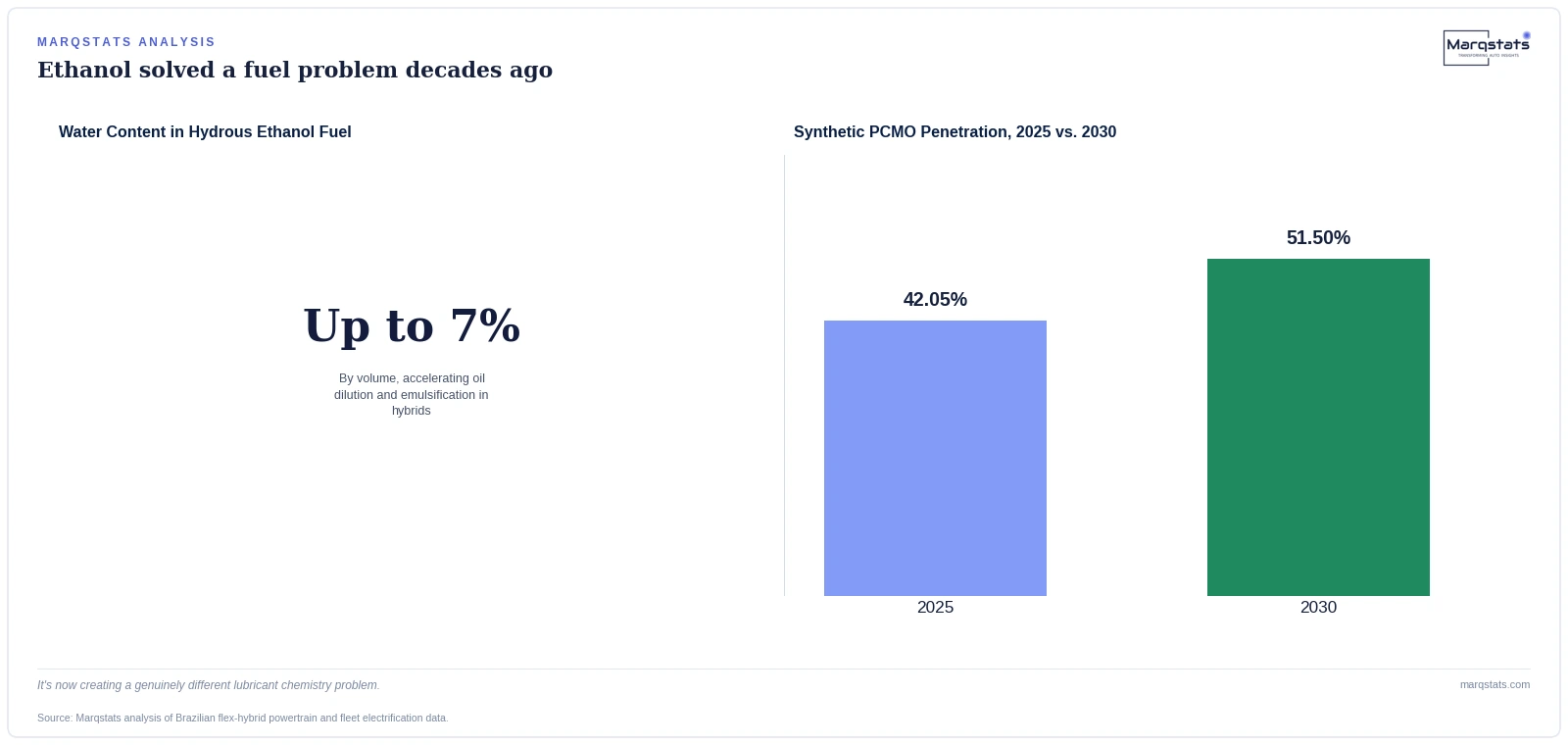
Brazil produces and consumes hydrous ethanol at a scale few other countries can match, built on decades of sugarcane agricultural infrastructure and flex-fuel vehicle adoption. Rather than abandoning that infrastructure advantage to chase pure battery-electric vehicles, major manufacturers including Stellantis, Toyota, Volkswagen and General Motors are directing local capital expenditure toward flex-hybrid vehicles, powertrains combining an electric motor with an internal combustion engine engineered to run on any ratio of hydrous ethanol and gasoline. It's a pragmatic bet on existing national strengths rather than a wholesale technology replacement.
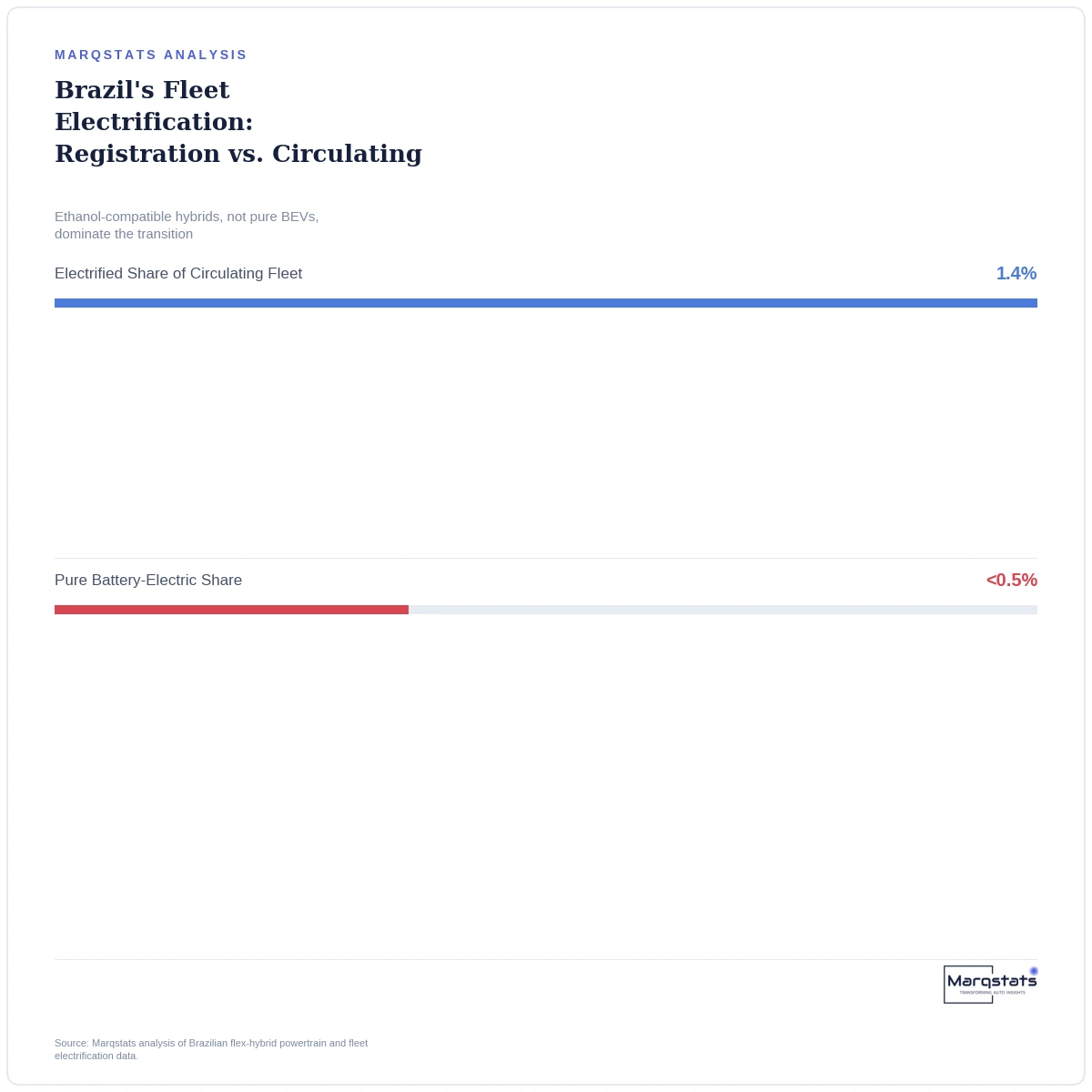
Ethanol solved Brazil's fuel problem decades ago. It's now creating a genuinely different lubricant problem.
— Marqstats Analyst Team
What ethanol actually does to engine oil
Hydrous ethanol contains up to 7% water by volume, a meaningfully higher water content than gasoline. During combustion, some of that unburned fuel and water vapor inevitably blows past the piston rings into the crankcase, a process called blow-by. In a conventional combustion engine running consistently at operating temperature, that moisture typically evaporates off harmlessly. But flex-hybrid vehicles introduce a complication: frequent engine stop-start transitions during electric-assisted urban driving prevent the crankcase oil from maintaining stable operating temperatures, inhibiting that thermal evaporation process and allowing water and unburned ethanol to accumulate.
The consequence is genuine chemical stress on the oil: dilution that thins the protective hydrodynamic film between moving engine parts, and water emulsification that can accelerate acidic corrosion of internal components. This isn't a hypothetical concern, it's a documented failure mode specific to the combination of ethanol fuel chemistry and hybrid stop-start operation.
What formulators are doing about it
The response has been a genuine shift toward more sophisticated lubricant chemistry. Advanced low-viscosity SAE 0W-16 and 0W-20 synthetic formulations are increasingly required specifically to resist this water emulsification and acidic corrosion, rather than the simpler mineral or semi-synthetic oils that sufficed for conventional, continuously-running combustion engines. That's a direct technical response to Brazil's specific fuel chemistry, not a generic global premiumization trend imported wholesale from other markets.
Why this matters for how the lubricants market actually grows
This dynamic explains something that might otherwise look counterintuitive: Brazil's automotive lubricants aftermarket is projected to grow in value at 3.67% annually through 2030, faster than its 3.05% physical volume growth, even as the country pursues meaningful vehicle electrification. In markets pursuing pure battery-electric transitions, electrification typically reduces total lubricant demand, since battery-electric vehicles don't need crankcase oil at all. In Brazil, the flex-hybrid pathway keeps combustion engines, and therefore lubricant demand, firmly in the picture, while simultaneously pushing that demand toward higher-value, more chemically sophisticated formulations. Electrification here is elevating lubricant value density rather than eroding it.
The counter-argument: is Brazil's flex-hybrid strategy actually a durable long-term path, or a transitional detour before pure electrification eventually arrives anyway?
A fair question is whether Brazil's flex-hybrid emphasis represents a genuinely durable, decades-long technology strategy, or simply a transitional bridge that will eventually give way to pure battery-electric vehicles once charging infrastructure and battery costs improve, in which case the current lubricant premiumization trend might be a temporary phenomenon rather than a structural market feature. This is a reasonable long-horizon consideration. What supports treating the flex-hybrid strategy as genuinely durable rather than merely transitional, though, is that it's built on a resource advantage, domestic sugarcane ethanol production, that pure battery-electric vehicles simply can't leverage at all, giving Brazil an economic and infrastructure rationale for this pathway that's considerably more durable than a market simply lagging behind global electrification trends by a few years.
What this means for formulators and manufacturers
- Lubricant formulators serving the Brazilian market should prioritize water-emulsification-resistant, low-viscosity synthetic chemistry specifically engineered for hybrid stop-start operating conditions under ethanol fuel exposure.
- Automotive manufacturers planning flex-hybrid platforms for Brazil should coordinate closely with lubricant suppliers on formulation requirements specific to the local ethanol fuel chemistry, rather than assuming global hybrid lubricant specifications transfer directly.
- Investors evaluating Brazil's automotive lubricants market should recognize that vehicle electrification here elevates rather than erodes lubricant value, a genuine divergence from pure battery-electric market dynamics elsewhere.
Why the base oil supply chain makes this formulation shift harder than it sounds
This formulation shift toward advanced low-viscosity synthetics doesn't happen in a vacuum, it lands directly on top of a separate, genuine structural constraint in Brazil's base oil supply chain. Brazilian domestic refineries, concentrated almost entirely in Group I paraffinic chemistry, cannot produce the Group II, Group III and synthetic Polyalphaolefin base stocks these advanced formulations actually require. That means the very chemistry Brazil's flex-hybrid strategy is pushing toward is chemistry the country's own refining base is least equipped to supply domestically, compounding two separate structural challenges, ethanol-driven formulation complexity and base oil import dependency, into a single sourcing problem for blenders.
Domestic re-refined Group II base stock, supplied by processors like Lwart Soluções Ambientais, offers a partial answer, but formulating a genuinely advanced 0W-16 or 0W-20 synthetic typically still requires some proportion of imported Group III or Group IV material to hit the full performance specification, meaning Brazil's flex-hybrid lubricant strategy remains genuinely dependent on the same import channels the broader market already relies on.
What this looks like for a specific vehicle owner
It's worth grounding this in what it actually means for someone bringing a flex-hybrid vehicle in for routine service. A workshop technician servicing one of these vehicles can no longer simply reach for a generic 5W-30 mineral oil the way they might have for a conventional flex-fuel vehicle a decade ago. The correct formulation needs to specifically address the combination of ethanol water content and hybrid stop-start thermal cycling this vehicle experiences, meaning technical documentation and OEM-specific approval have become genuinely more important at the point of service than they were for the simpler flex-fuel-only vehicles that dominated Brazil's roads previously.
This has real implications for the independent garage channel specifically, since these workshops handle 43.5% of Brazil's aftermarket volume and make brand and formulation decisions largely on mechanic judgment rather than manufacturer-mandated protocols. As flex-hybrid vehicles become a larger share of the vehicles these workshops service, the technical sophistication required of a typical independent mechanic rises correspondingly.
The full market picture
Marqstats' complete Brazilian automotive lubricants aftermarket analysis, including the full formulation chemistry breakdown, is available in the linked report below.
Related reportBrazil Automotive Lubricants Aftermarket Size, Share & Forecast 2026 – 2030