A Vehicle Emissions Law That Reaches the Sump
The New Vehicle Efficiency Standard is usually discussed as a rule about tailpipes and fleet targets. It also changes what a workshop pours into an engine.
The New Vehicle Efficiency Standard Act 2024 took effect on 1 January 2025. It sets carbon dioxide intensity limits across each supplier's fleet of new light vehicles. To meet them without paying penalties, manufacturers are shipping downsized, turbocharged, direct-injection engines and more hybrids. Those engines are specified with very thin oils.
What the Standard Is Doing to Oil Grades
Thin oil cuts friction, and less friction saves fuel. That is the whole logic.
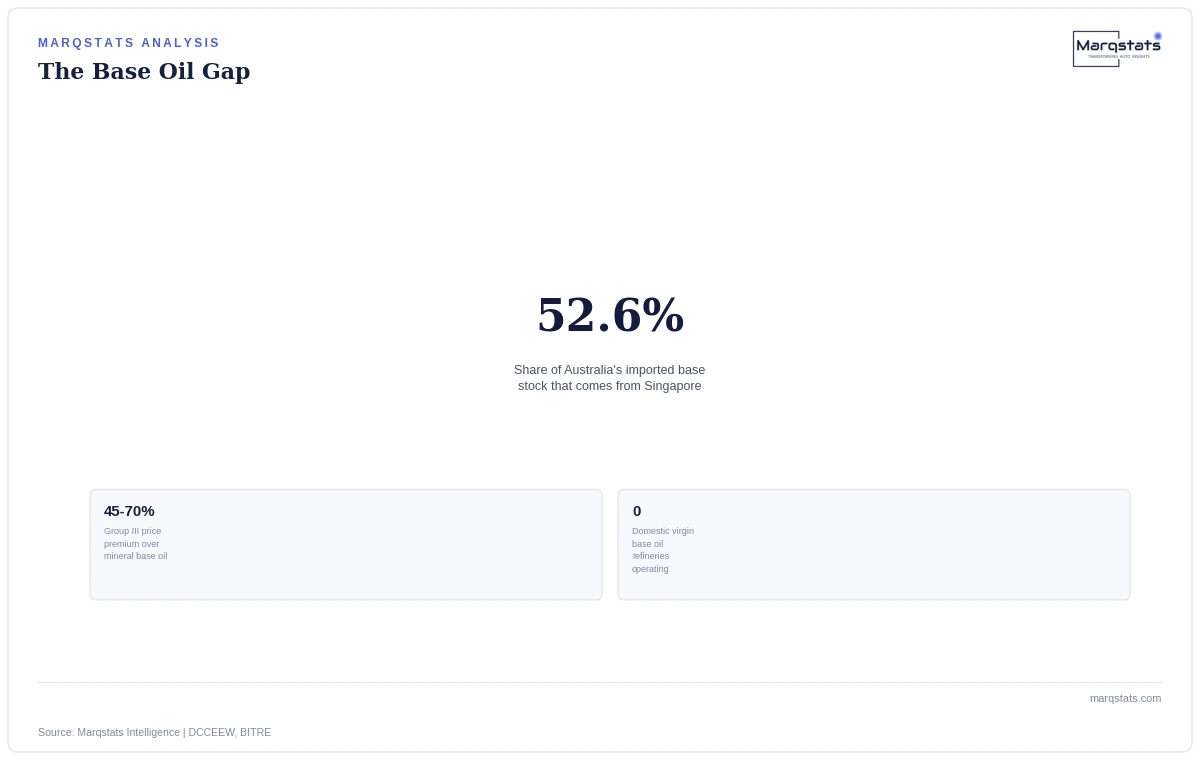
Manufacturers are moving servicing to SAE 0W-16 and 0W-20 viscosities that meet API SP, ILSAC GF-6 and ACEA C5, C6 and C7 specifications. Making them takes polyalphaolefin or severely hydroprocessed Group III and III+ base stock, plus friction modifiers that guard against low-speed pre-ignition. Group III costs 45% to 70% more than Group II mineral oil at wholesale.
Why Value Grows Three Times Faster Than Volume
The result is a market that sells roughly the same amount of oil at a higher price.
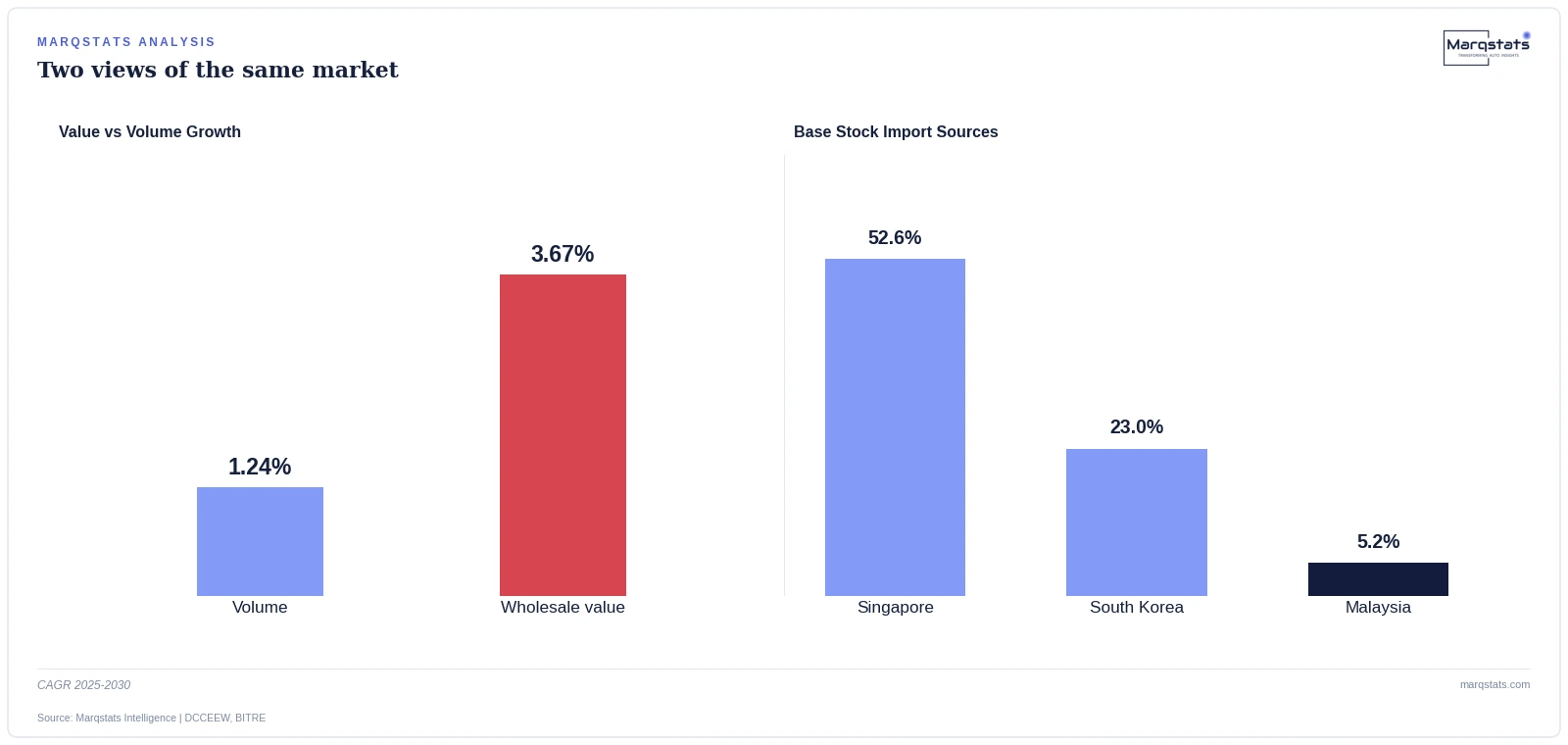
The research puts physical demand growth at 1.24% a year, from 299.40 megalitres in 2025 to 318.50 by 2030. Wholesale value grows at 3.67% a year, from USD 1,402.17 million to USD 1,679.37 million. The blended wholesale price rises from AUD 7.15 to AUD 8.05 per litre. Modern powertrains are also serviced every 15,000 km or 12 months, where pre-2015 models needed 7,500 km or 6 months, so each vehicle buys oil less often but pays more per litre when it does.
The Catch: Australia Refines None of the Base Oil
Every premium grade depends on a raw material the country does not produce.
Lubricant refining units at Kurnell in New South Wales and Geelong in Victoria have been decommissioned. Blenders import Group I, II and III virgin base stock by sea. Singapore supplies 52.6% of it, South Korea 23.0% and Malaysia 5.2%. Domestic re-refining collects more than 320 megalitres of used oil a year, but OEM approval rules keep re-refined oil out of premium passenger car synthetics. The grades that regulation favours are exactly the ones Australia has to buy in.
A Named Comparison: Why This Matters for Local Blenders
Domestic brands and import brands face the same shipping costs but different approval hurdles.
Local blenders such as Penrite, Fuchs, Gulf Western and Nulon must secure Group III supply from Singapore and South Korea and pay for OEM candidate testing before their synthetics carry factory approvals. Imported finished brands arrive already approved. The Australian Lubricant Association's July 2025 determination on non-compliant ACEA C3 5W-30 claims showed how closely approvals are now policed.
Why This Pressure Is Likely to Last
The shift is written into the fleet, and the fleet turns slowly.
Full synthetics are projected to reach 65% of passenger car engine oil demand by 2030 in the Base Case. Battery electric vehicles reach 22.0% of new light vehicle sales by then, yet only 7.5% of vehicles on the road, so more than 90% of the parc still needs engine oil. A fixed 14.2 cents per litre stewardship levy adds a floor under every price.
What This Means for Workshops and Buyers
The practical takeaway: independent workshops should stock for several thin grades at once, and buyers should expect to pay more per litre even as they buy oil less often. The single 205-litre drum of semi-synthetic 10W-40 no longer serves a modern fleet.