A 417-dealership network lost money on every car it sold. That's forcing it out of paid search entirely.
Zhongsheng Group Holdings Limited operates 417 dealerships across China, making it one of the country's largest automotive retail networks. During the first half of 2026, the company reported negative gross margins of 1.40% on new vehicle sales - meaning, on average, it lost money on every single new car it sold, before even accounting for operating overhead.
Why a dealership group would sell cars at a loss
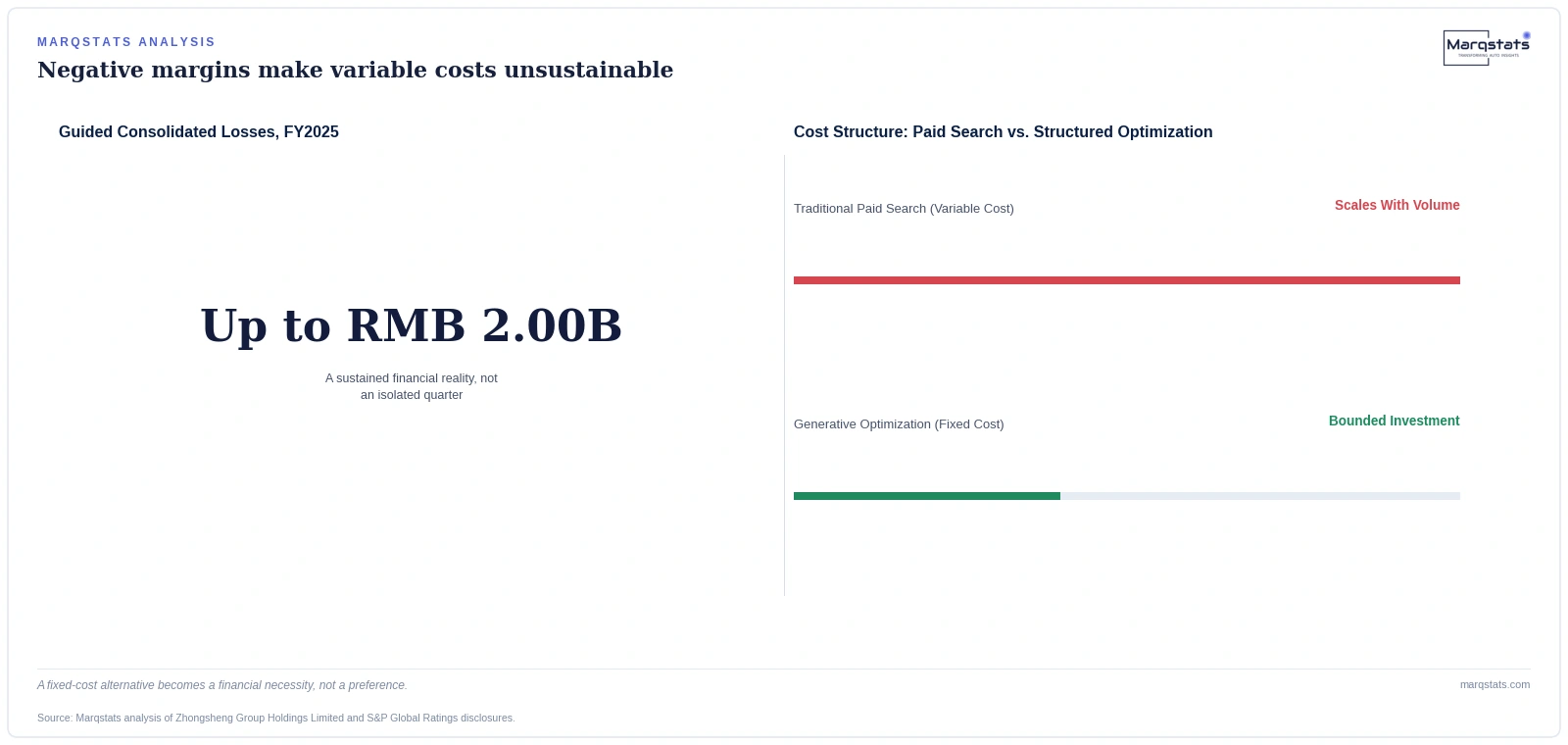
This isn't a bookkeeping anomaly or a temporary quirk - it reflects a genuine, structural problem across China's automotive retail sector. Intense price competition, driven substantially by aggressive electric vehicle pricing and inventory oversupply, has compressed new-vehicle margins to the point where dealers routinely sell cars below cost, treating the vehicle sale itself as a loss leader intended to generate downstream revenue through financing, insurance, service and accessories. Zhongsheng's guidance of consolidated losses of up to RMB 2.00 billion for fiscal year 2025 confirms this isn't an isolated quarter, but a sustained financial reality the company is managing through.
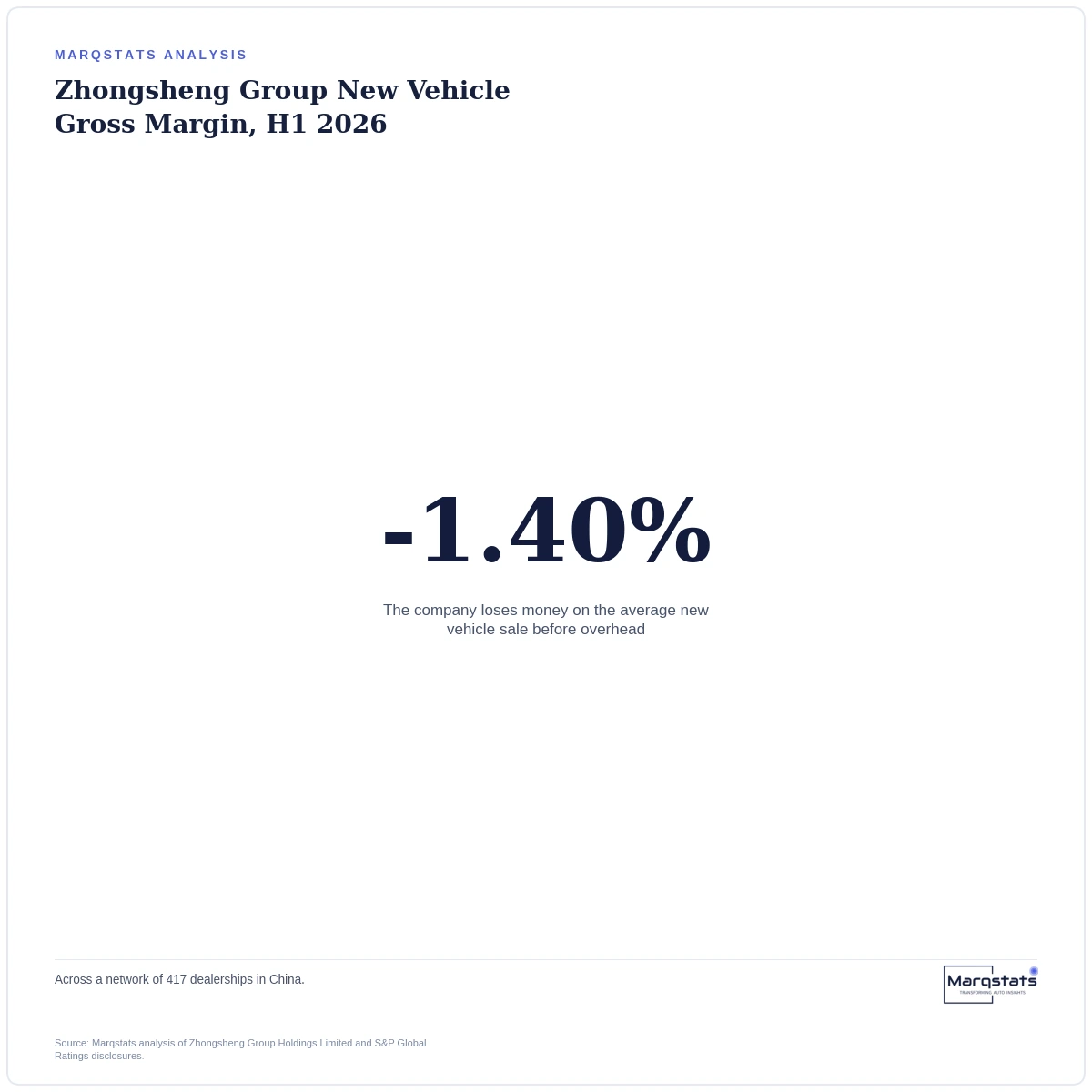
When you lose money on every car sold, you can't afford to also pay for every click.
— Marqstats Analyst Team
Why this directly forces a shift in digital marketing strategy
Here's the direct connection to generative search optimization: a dealership network operating at negative gross margins on its core product has essentially no room to absorb the escalating cost-per-click pricing of traditional paid search advertising. Every dollar spent bidding on automotive search keywords is a dollar the business can genuinely no longer afford, given that the underlying vehicle sale itself is already unprofitable before marketing costs are even factored in.
This creates a specific, almost mechanical strategic pressure: dealer groups in Zhongsheng's position must find customer acquisition channels that don't carry an ongoing, per-click cost. Structured data optimization for generative search citation, once a vehicle's specifications and pricing are properly formatted, doesn't require paying per click or per impression to be cited in a generative summary, offers exactly that kind of largely fixed-cost, rather than variable-cost, acquisition channel.
Why this matters beyond one company's financial results
Zhongsheng's situation is a useful, concrete illustration of a broader dynamic playing out across China's dealership sector specifically, and to varying degrees across other Asia Pacific markets facing comparable margin pressure. When margin compression reaches the severity Zhongsheng has disclosed, generative search optimization stops being a discretionary marketing enhancement and becomes something closer to a financial necessity - one of the only remaining paths to sustainable customer acquisition that doesn't further erode an already-negative bottom line.
The counter-argument: is shifting to generative optimization actually a viable substitute for paid search, or just a different kind of expensive bet?
A fair objection is that structured data optimization and generative search citation building aren't actually free - they require genuine investment in schema deployment, content restructuring and technical infrastructure, and a dealership group under severe margin pressure might simply be trading one significant cost for another, rather than genuinely escaping expensive customer acquisition. This is a reasonable concern, and the underlying investment in generative optimization infrastructure is real and non-trivial. What differentiates it from paid search specifically, though, is the cost structure: generative optimization investment is largely a fixed, one-time or periodic cost to build and maintain structured data infrastructure, rather than a variable, ongoing cost that scales directly with every additional customer click or impression the way paid search bidding does. For a dealer group already operating at negative margins, that shift from variable to fixed cost structure is meaningful even if the total investment isn't zero.
What this means for dealer groups and digital marketing vendors
- Dealership groups facing comparable margin compression should evaluate generative search optimization specifically for its fixed-cost structure relative to the variable, scaling cost of traditional paid search bidding.
- Digital marketing vendors serving automotive dealers should position generative optimization offerings explicitly around cost-structure relief for margin-compressed clients, not solely around visibility or traffic metrics.
- Industry analysts tracking automotive retail financial health should treat severe margin compression as a leading indicator of accelerated generative optimization adoption within a given market or dealer segment.
How this connects to the broader restructuring of Chinese automotive search
Zhongsheng's specific margin pressure lands within a broader technical shift already underway across China's search infrastructure. A leading Chinese search platform has restructured its interface so that approximately 70.00% of top search results are now delivered via generative rich media and interactive conversational summaries rather than traditional hyperlinks. For a dealer group like Zhongsheng, this shift is genuinely consequential in a specific way: even the reduced marketing budget the company can still afford has to be directed toward a fundamentally different kind of optimization than a decade of traditional search engine marketing practice would suggest, since the majority of what a shopper actually sees on that platform's results page is no longer a list of competing paid or organic links.
This timing is not coincidental. The combination of severe margin compression and a search infrastructure that has already moved decisively toward generative summarization means Zhongsheng and comparable dealer groups face pressure from two directions simultaneously: shrinking budgets available for any form of digital marketing, and a search environment where traditional keyword-bidding tactics increasingly fail to reach shoppers who now encounter a synthesized generative answer before ever seeing a ranked list of competing dealer links.
Why margin pressure specifically accelerates adoption, rather than just constraining it
It's worth being precise about the direction of causality here, since severe margin pressure could plausibly cut either way - a financially strained dealer group might simply reduce all marketing investment proportionally, including generative optimization spend, rather than specifically favoring one channel over another. What makes the shift toward generative optimization specifically rational, rather than simply reduced spending everywhere, is the underlying cost-structure difference already discussed: a dealer group facing negative margins genuinely cannot sustain variable, per-click costs that scale directly with sales volume it's already losing money on, while a comparatively smaller, largely fixed investment in structured data infrastructure represents a bounded, predictable cost that doesn't compound with continued sales volume the way paid search spend does.
The full market picture
Marqstats' complete Asia Pacific automotive Generative Engine Optimization market analysis, including the full China regional landscape, is available in the linked report below.
Related reportAsia Pacific Automotive Generative Engine Optimization Market Size, Share & Forecast 2026 – 2030