A wrecked EV's scrap value might be $1,500. It'll probably sell for $8,000 anyway.
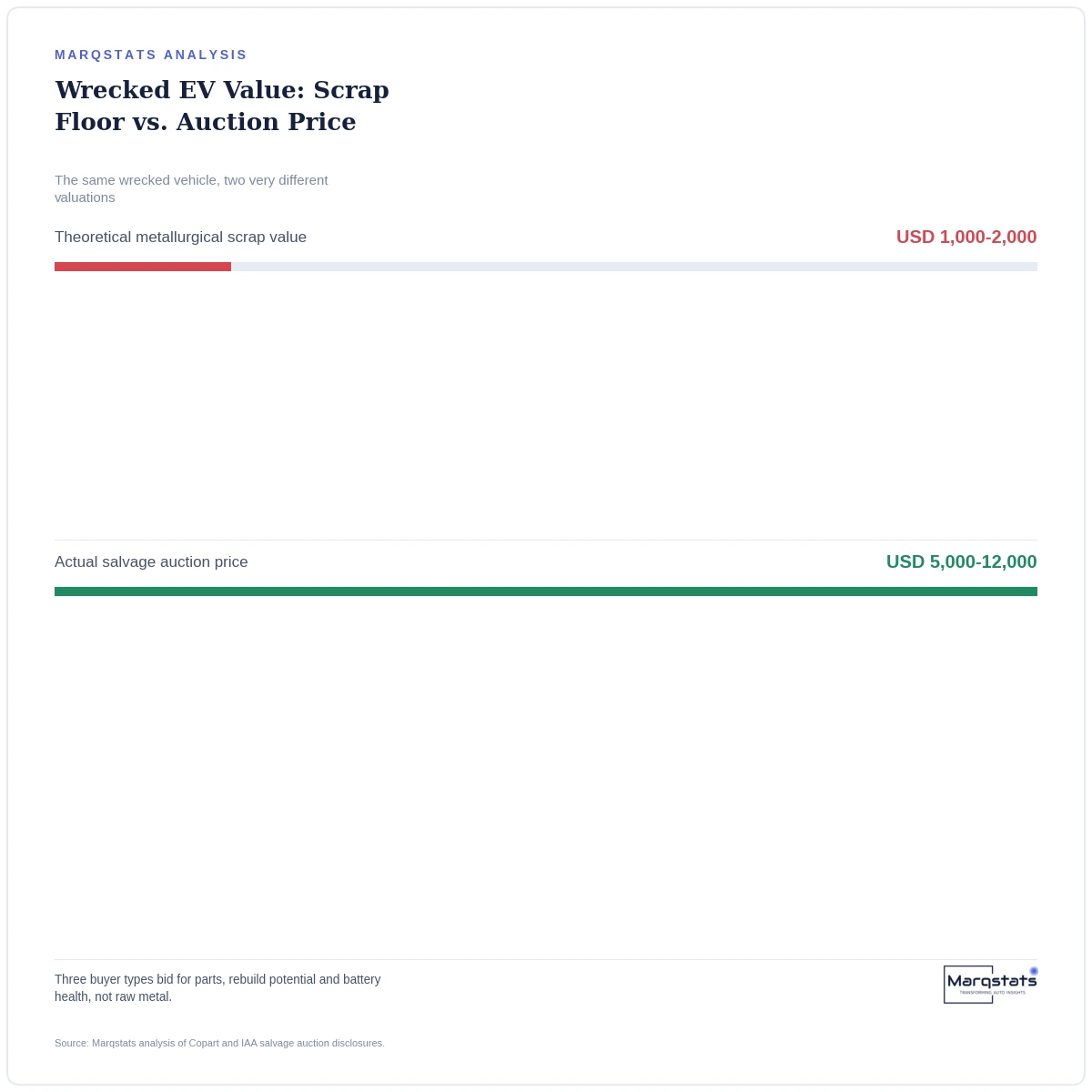
Picture a mid-size electric SUV, T-boned badly enough that the insurer declares it a total loss. Melt it down for its raw materials - nickel, cobalt, lithium, copper - and you'd get maybe $1,000 to $2,000. Put that exact same wrecked car up for auction, and it'll routinely sell for $5,000 to $12,000. Someone is paying several times the scrap value for a car that, by the insurance company's own determination, isn't worth fixing.
Three different buyers, three different reasons
The gap isn't a mystery once you know who's actually bidding. Three distinct buyer types show up at salvage auctions, and none of them are thinking about the car as a pile of raw metal.
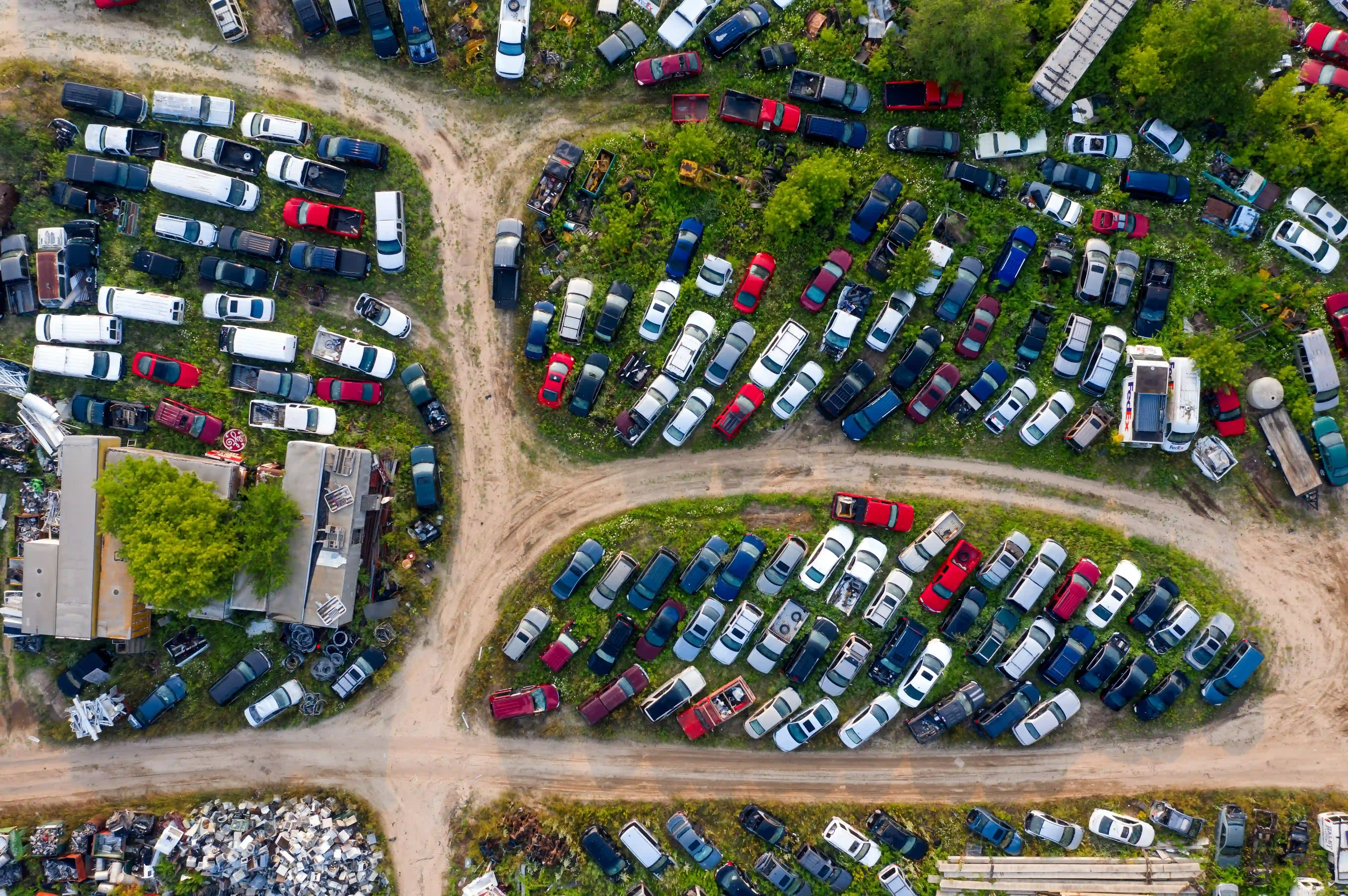
Dismantlers want the parts that survived the crash. A headlamp assembly, a steering rack, an inverter, an undamaged body panel - these are expensive and slow to source new from the manufacturer, so a dismantler harvesting them from a wreck can resell at a real margin. LKQ Corporation, one of the largest players in this space, went further in 2021 and bought a company called Green Bean Battery specifically to build in-house capability for remanufacturing battery modules, not just body parts.
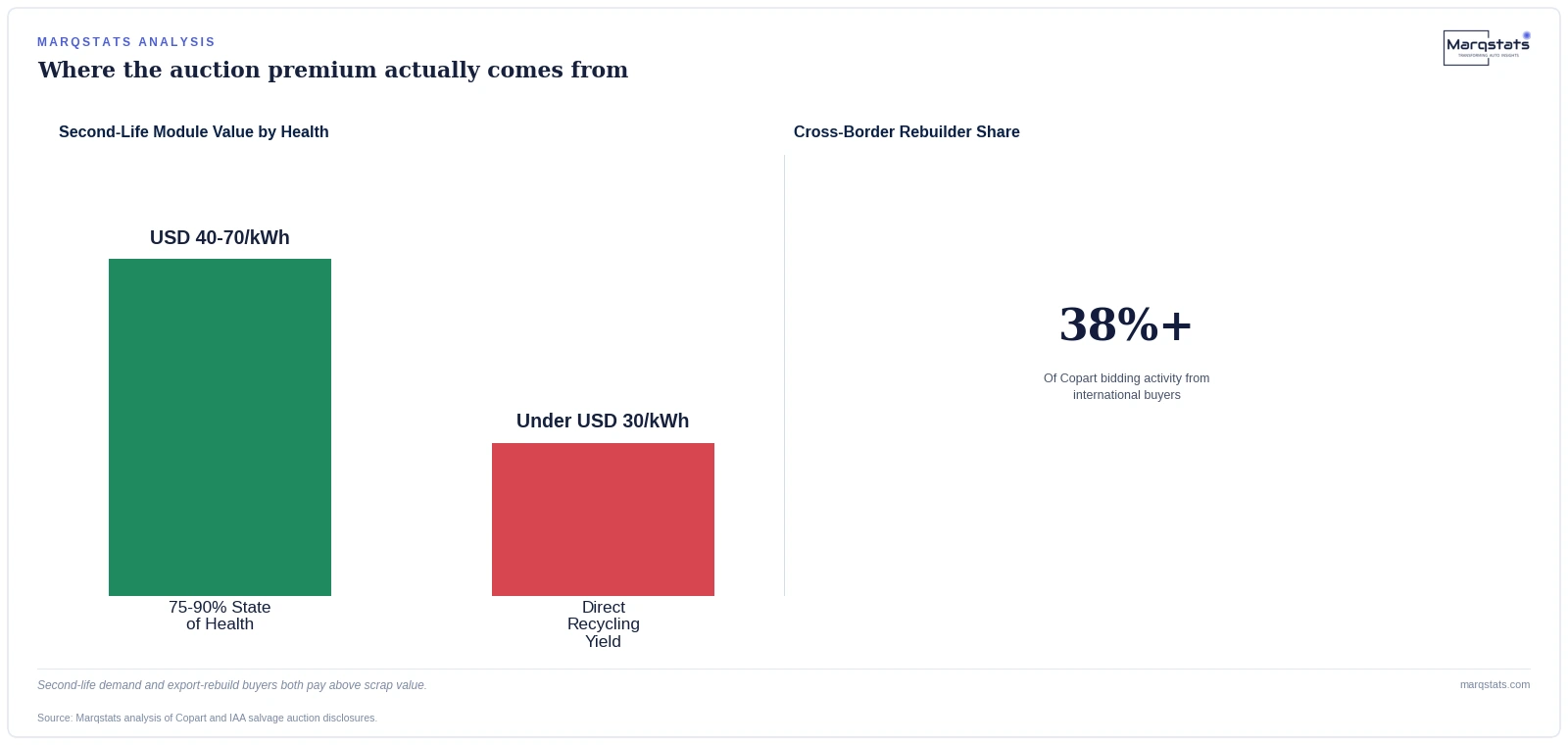
Cross-border rebuilders buy the car to fix it somewhere labor is cheaper. Export a branded-title wreck to Eastern Europe, Central Asia, or Latin America, and a local shop can profitably straighten the frame and swap in salvaged or aftermarket parts at costs that would never pencil out for a collision shop in North America or Western Europe. This buyer group alone accounts for more than 38% of Copart's bidding activity.
Second-life storage builders want the battery specifically, and only if it's still healthy. A pack that survived the crash with 75% to 90% of its original capacity intact is genuinely valuable for stationary use - solar microgrids, agricultural backup power, home battery banks. These modules trade at $40 to $70 per kWh, which is meaningfully more than what raw hydrometallurgical recycling yields.
Nobody at a salvage auction is bidding on the metal. They're bidding on what's still usable.
— Marqstats Analyst Team
When the premium disappears entirely
This whole dynamic collapses under one specific condition: when the title gets an absolute non-repairable designation, or when the battery pack itself has suffered thermal damage. At that point, none of the three buyer types above can legally or physically do anything with the vehicle - no parts harvesting, no export-and-rebuild, no battery reuse. What's left is straightforward material recycling, and the price collapses down toward that $1,000 to $2,000 metallurgical floor, minus whatever it costs to process it.
The counter-argument: isn't this premium just a temporary market inefficiency?
It's fair to ask whether this auction premium reflects genuine, durable value or just a market that hasn't yet priced wrecked EVs efficiently - as EV parts markets mature and more standardized aftermarket and recycled-parts supply chains develop, dismantlers' margins on harvested parts could compress, and the export-rebuild opportunity depends on labor cost gaps between regions that won't necessarily persist forever. Both are reasonable long-term possibilities. But right now, none of the underlying drivers - expensive OEM parts with long lead times, real labor cost differentials across borders, genuine second-life demand for healthy battery modules - show signs of disappearing soon, which is why the premium has held up consistently enough to be treated as structural rather than transitional.
What this means if you're on either side of this transaction
- Insurers estimating salvage recovery value should model auction pricing, not metallurgical scrap value, for any vehicle that isn't a confirmed non-repairable or thermally damaged total loss.
- Anyone buying a salvage-title EV for parts or rebuild should verify title category carefully, since a non-repairable designation eliminates the parts-harvesting and export pathways that drive most of the auction premium.
- Second-life battery buyers should prioritize collision total losses specifically over mechanically degraded retirements, since collision-totaled packs more often retain higher State of Health.
The full market picture
Marqstats' complete global EV salvage and scrap material floor-value analysis, including full auction channel data and a two-scenario forecast through 2030, is available in the linked report below.
Related reportGlobal Out-of-Warranty EV Salvage and Scrap Material Floor-Value Market Size, Share & Forecast 2026 – 2030