Wolfsburg Has 978 Cars Per 1,000 Residents. It's Not Because Everyone There Loves Driving.
In brief: Wolfsburg's car density approaches one vehicle per resident, a figure so far outside normal urban patterns it demands explanation. That explanation has nothing to do with Wolfsburg residents owning unusually many cars personally, and everything to do with Volkswagen, headquartered there, registering its own company fleets, executive pools and internal test vehicles locally.
How a Registration Address Becomes a Statistical Artifact
German vehicle registration, like most national systems, ties a car's official record to wherever its owner chooses to register it — not to where it's actually driven day to day. For an individual private buyer, those two locations are almost always the same place. For a large corporate fleet, they frequently aren't: a company can register thousands of vehicles at its headquarters address for administrative simplicity, tax reasons, or fleet management convenience, regardless of where those vehicles are actually deployed and driven.
Why Volkswagen Specifically Produces This Pattern
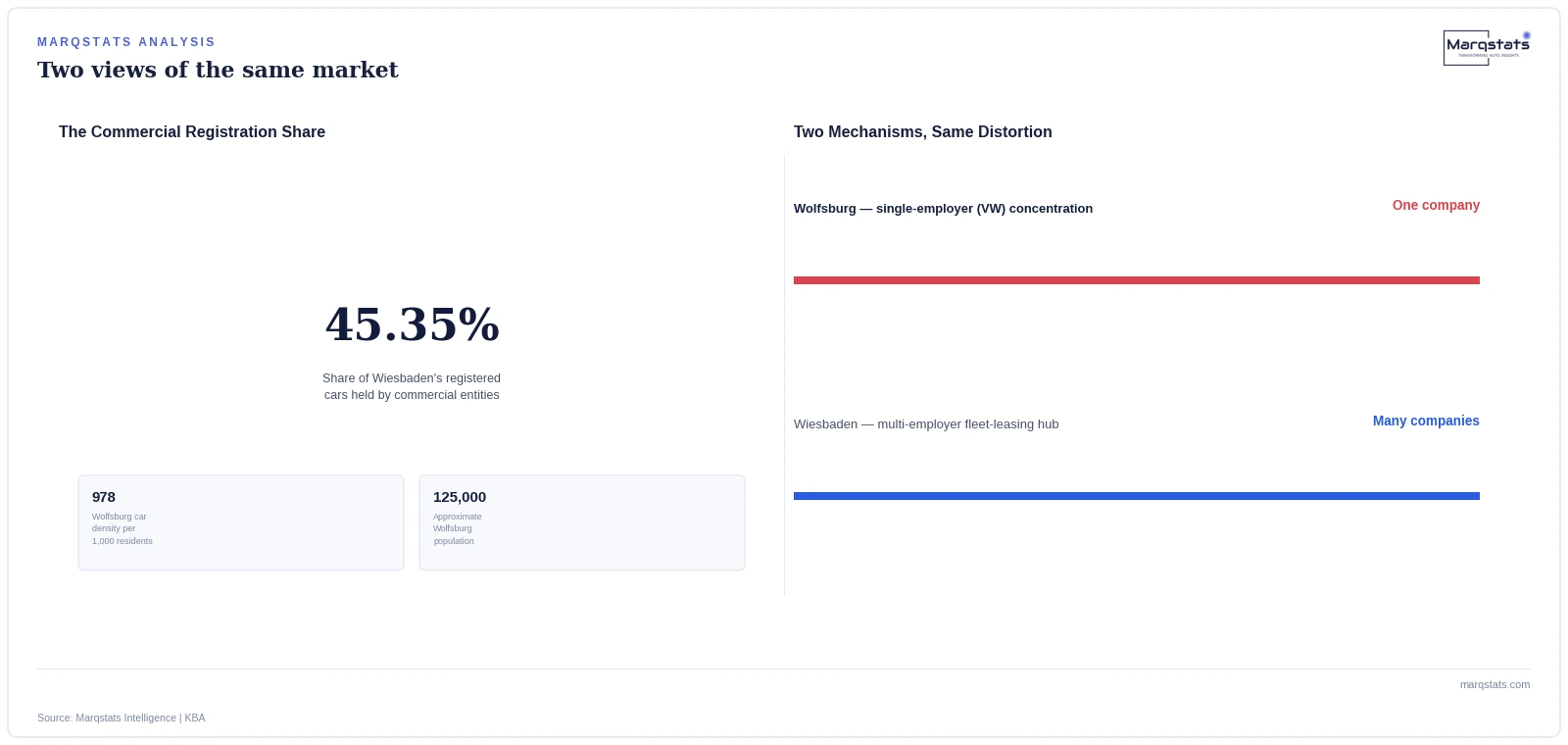
Volkswagen's Wolfsburg headquarters is where the company centrally administers its own company car fleets, executive vehicle pools, and internal test and development vehicles — a genuinely large population of cars that exists primarily for corporate operational reasons rather than personal consumer use, all registered in a single municipality of roughly 125,000 residents. Commercial registrations account for more than half of all vehicles registered in Wolfsburg specifically because of this concentration.
Wolfsburg's car density doesn't describe how Germans drive. It describes where Volkswagen keeps its paperwork.
— Marqstats Analyst Team
How Big a Share of Germany's Fleet This Actually Represents
It's worth being precise about scale here rather than leaving the impression this is a handful of oddly-shaped cities. Wolfsburg's population sits around 125,000, meaning its roughly 122,000 registered vehicles at that density already represent a meaningful fraction of Niedersachsen's own regional total. Add Wiesbaden's comparable commercial concentration, and two mid-sized German cities together account for a genuinely material share of the national fleet whose registration location tells an analyst almost nothing about where the vehicles are actually driven day to day.
Wolfsburg alone accounts for a meaningful slice of Niedersachsen's own 10.10% share of the national fleet, and Niedersachsen's regional total is itself materially inflated by exactly this single-city concentration. Extrapolated nationally, cities like Wolfsburg and Wiesbaden combined likely account for hundreds of thousands of registered vehicles whose actual driving activity is dispersed across dozens of other regions entirely, a genuinely material distortion once aggregated across Germany's full sixteen-state registration picture rather than viewed city by city in isolation.
Why This Isn't Simply a Data-Quality Failure
It's tempting to read this as a flaw in KBA's own record-keeping, but that framing misses the point. KBA accurately records where each vehicle is legally registered — that data is correct on its own terms. The distortion emerges entirely from the gap between what registration address measures (legal ownership location) and what a market analyst actually wants to know (where vehicles physically operate and generate real driving activity). The registry was never designed to answer the second question, which is precisely why treating it as if it does produces numbers like Wolfsburg's.
The Mirror-Image Case: Berlin's Artificially Low Density
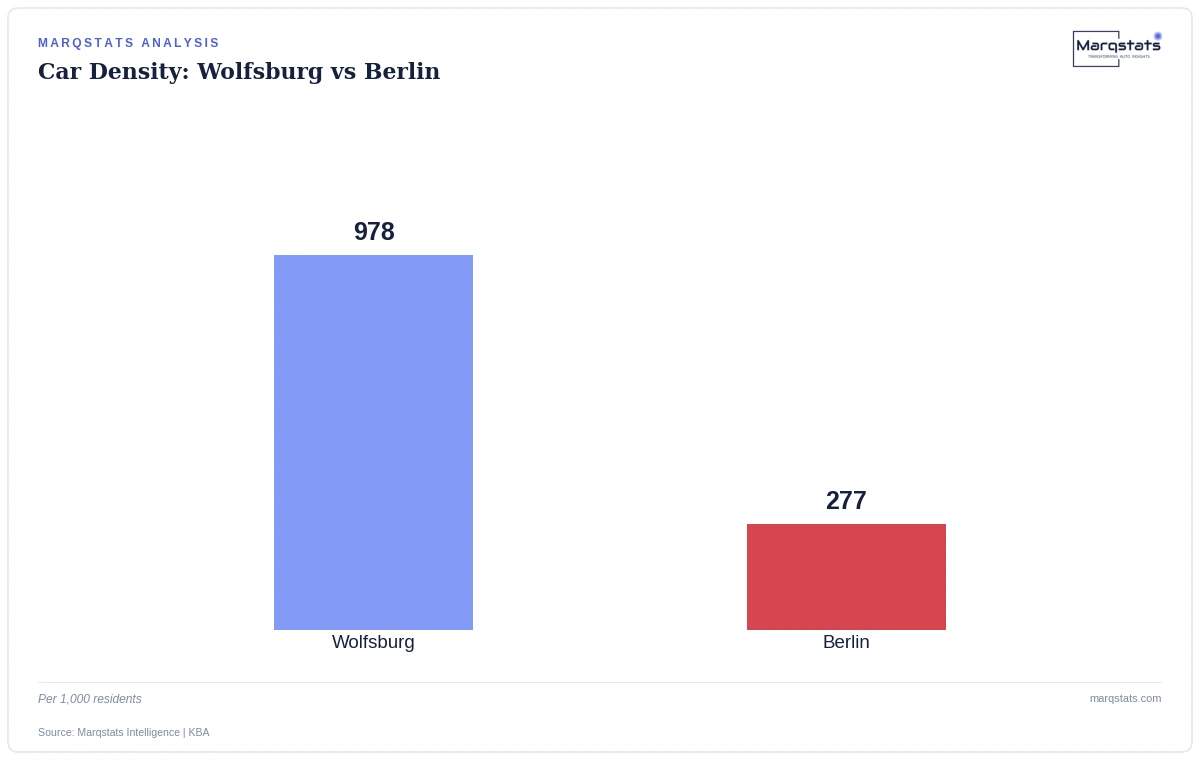
Berlin shows the inverse distortion for a related reason. As Germany's capital and largest city, Berlin has a naturally large population base with comparatively lower private car ownership rates typical of major European urban centers with strong public transit — but it also lacks the kind of single-employer corporate registration concentration Wolfsburg has. The result is a car-density figure, 277 per 1,000 residents, that looks unusually low relative to Berlin's genuine economic and population significance, purely because Berlin has no Volkswagen-scale corporate registrant distorting its own statistics upward the way Wolfsburg does.
The Munich Variant: A Different Kind of Distortion Entirely
Munich adds a third distinct mechanism worth distinguishing from Wolfsburg and Wiesbaden's corporate registration concentration: short-term mobility operators. Munich shows 2.02 rental vehicles per 1,000 residents alongside more than 3,000 carsharing vehicles, and because rental operators turn over their fleets every six to twelve months, Munich functions as a genuine entry point introducing new embedded telematics and OTA-capable vehicles into the broader German used-car market — a distortion driven by fleet churn velocity rather than static corporate headquarters concentration, but a distortion nonetheless for anyone reading raw registration density as a proxy for organic consumer demand.
What Volkswagen's Own Perspective Likely Is
From Volkswagen's own operational standpoint, none of this represents a problem worth solving — centralizing company car, executive pool and test vehicle registration at company headquarters is simply efficient corporate administration, with no internal reason to distribute registrations more evenly across the country where employees or test drivers might actually be located. The distortion is a byproduct of a rational corporate practice, not a deliberate attempt to skew national statistics, which is worth keeping in mind before assuming any bad intent behind the pattern.
Wiesbaden's Version of the Same Pattern
Wiesbaden offers a third variation on the theme: 45.35% of its registered cars belong to commercial entities, a concentration driven by major fleet-leasing companies and enterprise mobility providers maintaining administrative hubs there. Unlike Wolfsburg's single-employer concentration, Wiesbaden's distortion comes from multiple leasing and fleet-management businesses independently choosing the same city for headquarters convenience — a different mechanism producing a structurally similar statistical artifact.
Why No One Has Fixed This Already
The honest answer is that fixing this distortion doesn't serve anyone's direct commercial interest strongly enough to prioritize it. Volkswagen has no reason to spread its registrations more evenly; KBA's mandate is accurate registry-keeping, not regional demand estimation; and market researchers who do notice the distortion typically work around it case by case, as this piece has, rather than building the kind of systematic cross-referenced dataset that would resolve it permanently for the whole market at once.
What a Genuine Regional Picture Would Require
Building a corrected regional connected-vehicle map for Germany would require data sources registration statistics alone cannot provide: anonymized telematics location data aggregated by mobile network operators, or voluntary disclosure from major fleet operators about where their registered vehicles actually operate day to day. Neither currently exists in a form accessible to market analysts, which is precisely why registration-based regional statistics remain the default despite their known limitations in specific, identifiable cities.
Why This Matters for Anyone Using German Regional Data
A telematics provider, telecom operator, or infrastructure planner using raw KBA regional registration figures to prioritize investment or coverage would be working from a genuinely misleading map in specific, identifiable locations. Wolfsburg and Wiesbaden look like connected-vehicle hotspots on paper; the vehicles registered there are substantially driven elsewhere across the country, by employees and lessees who happen to work for or lease from companies headquartered in those specific cities.
What This Means for Telecom Infrastructure Planning Specifically
A mobile network operator planning 5G Standalone edge-cloud infrastructure investment based on raw regional registration density would be led toward over-investing in Wolfsburg and Wiesbaden specifically and under-investing in the actual dispersed locations where those registered vehicles' drivers and lessees genuinely live and commute — a capital-allocation error with real financial consequences, not merely an academic curiosity about how German statistics work.
The same logic extends to insurers pricing regional risk and logistics planners routing service networks around apparent demand hotspots — any downstream decision built on raw regional registration density inherits this same distortion silently, without any obvious warning sign in the data itself that something is off.
Outlook: One Trigger, Not Three
This distortion has no evidenced expiration date — it's a structural feature of how German corporate fleet registration works, not a temporary reporting quirk. The only realistic path to a corrected regional picture is third-party reconciliation against actual vehicle telemetry location, since neither Volkswagen nor Germany's fleet-leasing industry has any operational reason to change where they register their own vehicles.
The broader lesson extends well beyond Germany's own borders: any national registry system tying vehicle records to a legal registration address rather than genuine operating location will produce comparable distortions wherever corporate fleet administration concentrates in a small number of headquarters cities, a structural pattern worth checking for in any country's regional connected-vehicle data before treating raw registration density as a reliable proxy for actual driving activity.