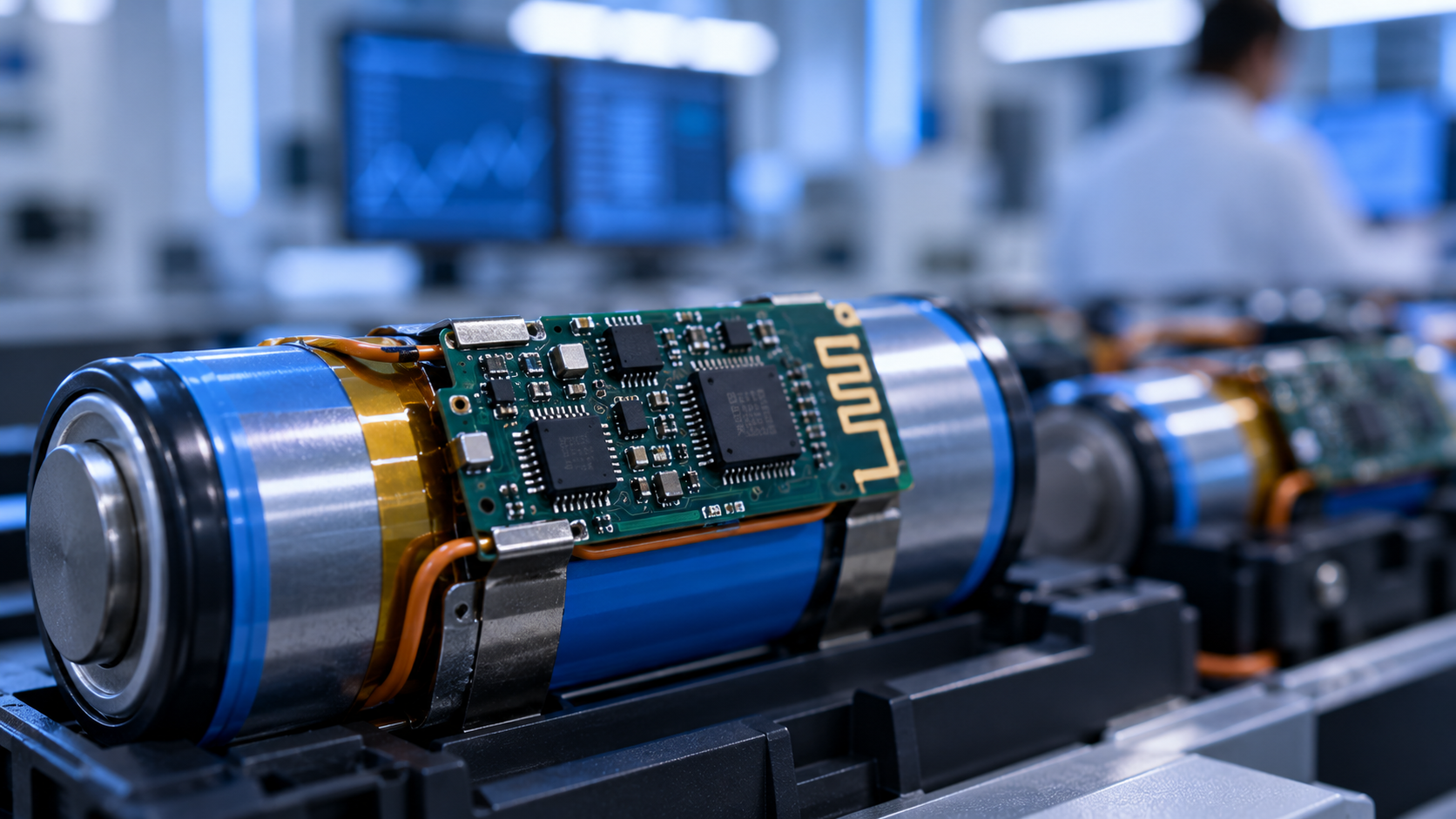
General Motors, Lotus Cars and BMW Group all made the same choice
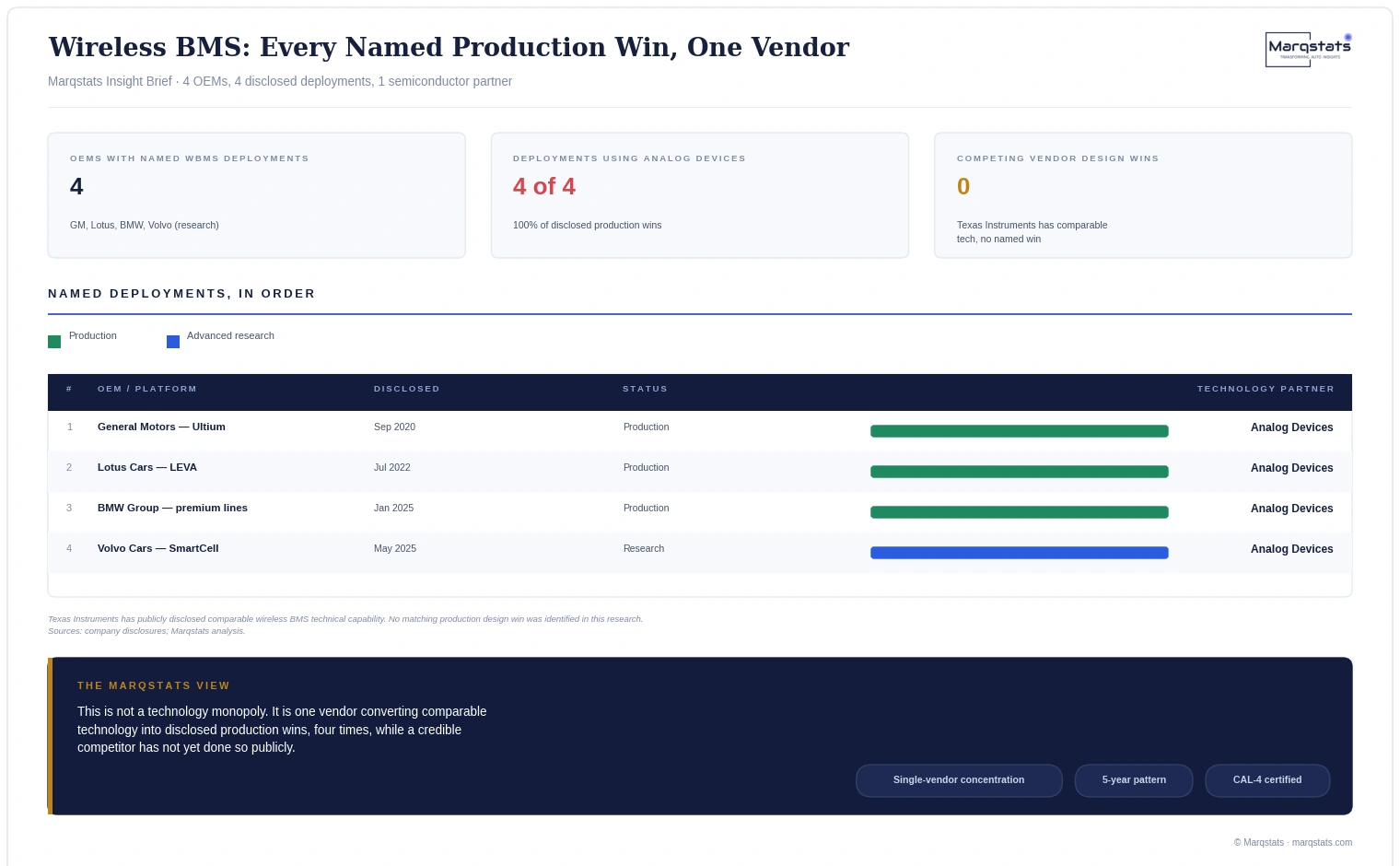
Every disclosed production or advanced-research wireless battery management system deployment identified in this research uses the same semiconductor partner: Analog Devices. General Motors' Ultium platform, in series production since September 2020. Lotus Cars' LEVA architecture, integrated July 2022. BMW Group's premium production EV lines, deployed January 2025. Volvo Car Corporation's SmartCell wireless propulsion research platform, demonstrated May 2025.
Four separate original equipment manufacturers, spanning a mass-market American brand, a British performance marque, a German premium manufacturer and a Swedish OEM's advanced research arm, all converged on the same underlying wireless BMS technology partner within roughly five years of the first production disclosure.
This isn't because nobody else can build wireless BMS
Texas Instruments has publicly disclosed wireless battery monitoring technical capability comparable to Analog Devices' offering. No matching production design win for Texas Instruments' wireless BMS technology was identified anywhere in this research. That is the more interesting fact than the concentration itself: this is not a case of one vendor holding a technology monopoly. It is a case of one vendor converting comparable technology into disclosed production wins, and a credible competitor not doing so, at least not yet, at least not publicly.
Wireless BMS eliminates up to 90% of a battery pack's internal wiring harness and reduces pack mechanical enclosure volume by up to 15%, according to Analog Devices' own technical disclosures. Those are real, substantial engineering benefits, which is presumably why four different OEMs independently arrived at wireless architecture as worth adopting. What is not independently arrived at is the choice of technology partner.
What concentration like this usually means
A pattern where every disclosed production win in a new technology category goes to one supplier typically reflects one of a small number of underlying dynamics: a genuine first-mover technical lead that is difficult to close quickly, a qualification and certification process expensive enough that switching costs lock in an early leader, or simply that later entrants' comparable technology has not yet found its first OEM design win, a chicken-and-egg problem in supplier selection.
Analog Devices' wBMS platform carries an ISO 21434 CAL-4 cybersecurity certification, the highest assurance level in that automotive cybersecurity standard, which is exactly the kind of certification that takes years to obtain and creates a real switching barrier once obtained by a first mover. That is a plausible, and testable, explanation for at least part of the concentration.
The interesting story in wireless BMS isn't the technology. It's that a comparably capable competitor has zero production wins to show for it.
— Marqstats Research
What this means for OEMs and for the incumbent
For an OEM evaluating wireless BMS architecture today, the single-vendor pattern is a legitimate diligence item, not a reason to avoid the technology. A design decision that locks a vehicle platform into one semiconductor supplier for the life of that platform, often seven to ten years, carries supply-chain concentration risk independent of how good that supplier's technology is. The four OEMs who have already committed evidently judged the technical benefit worth that risk; a fifth OEM evaluating the same choice today should at minimum confirm whether a genuine second source exists before assuming the same trade-off applies.
For Analog Devices, the concentration is both a real competitive moat, difficult for a challenger to unwind quickly given certification lead times, and a strategic vulnerability if a single major OEM design loss to a competitor breaks the pattern publicly. For any competing semiconductor supplier, including one with comparable technology and no production win, the strategic target is not matching the technology, which multiple companies already have. It is converting that technology into one disclosed, named production design win, which nobody but Analog Devices has yet achieved.
OEMs evaluating wireless BMS should treat single-vendor concentration as a supply-chain diligence item, not a red flag against the architecture itself.
A credible second source with comparable technology and no production win is a genuine market opportunity, not evidence the incumbent's lead is unbeatable.
Watch for the first production design win by a challenger vendor as the signal that this pattern is breaking, not for a change in underlying chip capability, which may already exist today.
The counter-case: four data points is not yet a permanent pattern
The fair objection is that four named OEM design wins over five years, in an automotive industry where individual platform decisions routinely take three to five years to move from technology selection to production, is a small sample from which to conclude a durable, structural moat. Automotive design cycles are long enough that a challenger vendor could plausibly already be engaged with an OEM on a design win not yet publicly disclosed, and the next announcement could as easily go to a competitor as to Analog Devices again.
We think the pattern is real and worth flagging precisely because it has held across four independent OEM decisions with no publicly disclosed counter-example, but we would revise this analysis immediately on the first disclosed competing production win, and any reader using this concentration as an investment or competitive-strategy input should treat it as a current-state observation, not a permanent structural feature of the wireless BMS market.