EV battery deployment grew 30% in 2025. Its share of the total still fell.
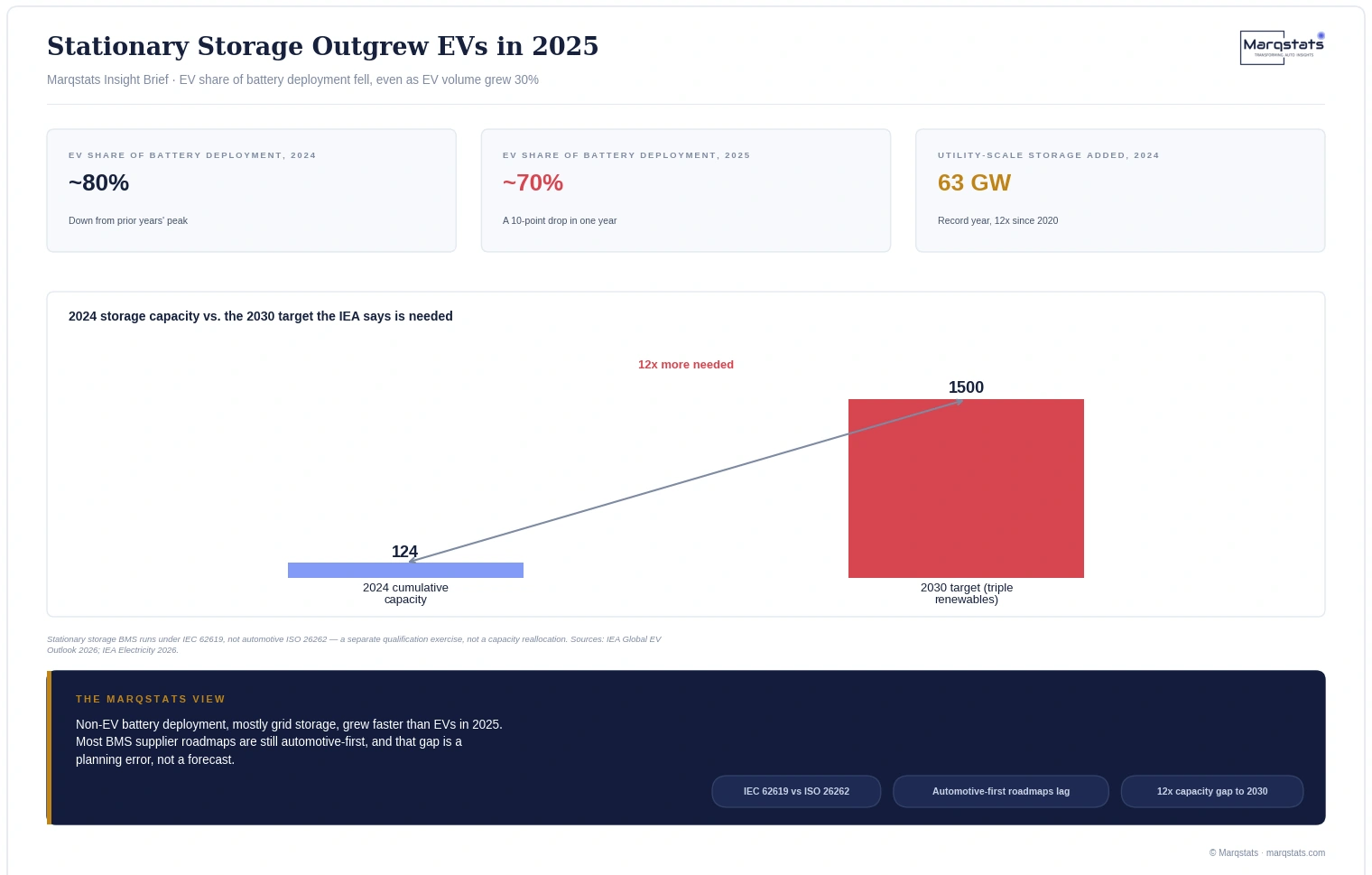
Global EV battery deployment reached 1.2 TWh in 2025, up almost 30% year-on-year, according to the International Energy Agency. In the same release, the IEA reports that EVs' share of total global battery deployment fell from almost 80% in 2024 to just over 70% in 2025.
Those two facts are only consistent with one explanation: non-EV battery deployment, overwhelmingly stationary energy storage, grew even faster than EVs did in 2025. This is the first year in the period this research covers where that has been true, and it is a structural shift in demand composition that most published BMS market commentary, built around automotive-first framing, has not caught up to.
Why this matters for BMS specifically, not just battery demand generally
Stationary storage and automotive traction battery packs are not interchangeable BMS design problems. Automotive BMS is governed by ISO 26262 functional safety, with duty cycles measured in charge-discharge events per day and a design life tied to vehicle ownership patterns. Stationary storage BMS operates under IEC 62619, with duty cycles that can involve near-continuous cycling for grid arbitrage or frequency regulation, and design lives measured against a fixed installation rather than a mobile asset with variable usage.
A BMS supplier whose product line, qualification history and sales relationships are built around automotive traction cannot simply redirect existing inventory or engineering resources at stationary storage demand. The compliance framework, the thermal and duty-cycle design envelope, and frequently the customer relationships themselves are different enough that this is a distinct qualification exercise, not a capacity reallocation.
The scale of what's already been missed
Utility-scale battery storage additions reached a record 63 GW in 2024, bringing cumulative installed capacity to 124 GW, more than a twelvefold increase since 2020. To meet the International Energy Agency's own target of tripling global renewable energy capacity by 2030, battery storage capacity needs to expand sixfold to 1,500 GW, with battery energy storage systems accounting for 90% of that increase.
A BMS supplier evaluating where to allocate qualification and business-development resources in 2026 is looking at a segment that has already demonstrated faster relative growth than the segment most of the industry's commentary still treats as the default market. That is not a forecast. It already happened, in the most recent full year of data available.
Stationary storage didn't sneak up on the battery industry. It's in the same IEA release everyone already cites for the EV numbers. It just isn't the number anyone leads with.
— Marqstats Research
What this means for BMS suppliers and investors
For a BMS semiconductor or systems supplier whose product roadmap and sales motion are automotive-first, this is a distinct near-term qualification target, not an incidental extension of existing automotive design wins. IEC 62619 qualification, stationary-specific thermal and duty-cycle validation, and grid-storage customer relationships are a separate go-to-market exercise from automotive OEM design wins, and a supplier starting that process in 2026 is starting later than the demand data would have justified.
For an investor evaluating BMS-adjacent opportunities, a supplier with genuine dual-qualified automotive and stationary storage capability, rather than an automotive-only supplier hoping to extend into storage opportunistically, is evaluating a structurally different and, on this data, faster-growing demand base. That distinction is not yet widely priced into how the sector talks about "the BMS market" as a single, automotive-dominated category.
Stationary storage BMS is a separate qualification and go-to-market exercise from automotive BMS, governed by a different standard (IEC 62619 vs. ISO 26262) and a different duty-cycle envelope.
Non-EV battery deployment grew faster than EV deployment in 2025, the most recent full year of IEA data, reversing the prior two years' pattern.
A supplier or investor treating stationary storage as an automotive-adjacent afterthought is working from a demand picture that is at least one year out of date.
The counter-case: automotive still dominates in absolute volume
The fair objection is that a share shift from 80% to 70% still leaves EVs as roughly 70% of total battery deployment, and light-duty EVs alone still represent more than 85% of EV battery deployment specifically. In absolute terms, automotive traction remains the largest single BMS demand segment by a wide margin, and a supplier with a strong automotive franchise is not making a mistake by continuing to prioritise it.
The point of this piece is about relative growth rate and forward resource allocation, not about which segment is larger today. A segment that is smaller in absolute terms but growing faster in relative terms is exactly the kind of signal that should change where incremental qualification and business-development investment goes, even while the larger segment continues to justify the bulk of existing resources. Ignoring the growth-rate signal because the base-rate segment is still larger is a common and specifically identifiable planning error.